6OGB | pdb_00006ogb

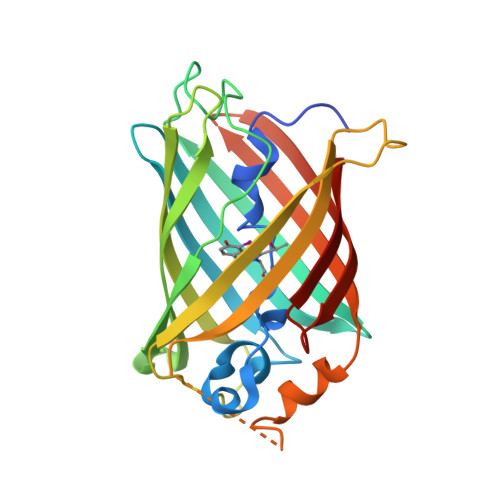
Crystal structure of Green Fluorescent Protein (GFP); S65T, Y66(3-I1Y), H148D; circular permutant (50-51)


Experimental Data Snapshot

  • Method: X-RAY DIFFRACTION
  • Resolution: 1.65 Å
  • R-Value Free: 
    0.178 (Depositor), 0.180 (DCC) 
  • R-Value Work: 
    0.156 (Depositor), 0.158 (DCC) 
  • R-Value Observed: 
    0.157 (Depositor) 

Starting Model: experimental
View more details

wwPDB Validation 3D Report Full Report

Validation slider image for 6OGB

This is version 2.0 of the entry. See complete history

Literature

Unusual Spectroscopic and Electric Field Sensitivity of Chromophores with Short Hydrogen Bonds: GFP and PYP as Model Systems.

Lin, C.Y.Boxer, S.G.

(2020) J Phys Chem B 124: 9513-9525

  • DOI: https://doi.org/10.1021/acs.jpcb.0c07730
  • Primary Citation Related Structures: 
    6OG8, 6OG9, 6OGA, 6OGB, 6OGC, 6UN5, 6UN6, 6UN7

  • PubMed Abstract: 

    Short hydrogen bonds, with heavy-atom distances less than 2.7 Å, are believed to exhibit proton delocalization, and their possible role in catalysis has been widely debated. While spectroscopic and/or structural methods are usually employed to study the degree of proton delocalization, ambiguities still arise, and no direct information on the corresponding potential energy surface is obtained. Here, we apply an external electric field to perturb the short hydrogen bond(s) within a collection of green fluorescent protein S65T/H148D variants and photoactive yellow protein mutants, where the chromophore participates in the short hydrogen bond(s) and serves as an optical probe of the proton position. As the proton is charged, its position may shift in response to the external electric field, and the chromophore's electronic absorption can thus reflect the ease of proton transfer. The results suggest that low-barrier hydrogen bonds (LBHBs) are not present within these proteins even when proton affinities between donor and acceptor are closely matched. Exploiting the chromophores as precalibrated electrostatic probes, the covalency of short hydrogen bonds as a nonelectrostatic component is also revealed. A theoretical framework is developed to address a possible contribution of unusually large polarizabilities of short hydrogen bonds due to proton delocalization, but no clear evidence for this phenomenon is found in accordance with the absence of LBHBs.


  • Organizational Affiliation
    • Department of Chemistry, Stanford University, Stanford, California 94305, United States.

Macromolecule Content 

  • Total Structure Weight: 57.04 kDa 
  • Atom Count: 4,091 
  • Modeled Residue Count: 455 
  • Deposited Residue Count: 502 
  • Unique protein chains: 1

Macromolecules

Find similar proteins by:|  3D Structure
Entity ID: 1
MoleculeChains  Sequence LengthOrganismDetailsImage
Crystal structure of Green Fluorescent Protein (GFP); S65T, Y66(3-I1Y), H148D; circular permutant (50-51)
A, B
251Aequorea victoriaMutation(s): 0 
UniProt
Find proteins for P42212 (Aequorea victoria)
Explore P42212 
Go to UniProtKB:  P42212
Entity Groups
Sequence Clusters30% Identity50% Identity70% Identity90% Identity95% Identity100% Identity
UniProt GroupP42212
Sequence Annotations
Expand
Reference Sequence

Small Molecules

Ligands 2 Unique
IDChains Name / Formula / InChI Key2D Diagram3D Interactions
GOL

Query on GOL


Download:Ideal Coordinates CCD File
D [auth A],
E [auth A],
F [auth A],
K [auth B]
GLYCEROL
C3 H8 O3
PEDCQBHIVMGVHV-UHFFFAOYSA-N
ACT

Query on ACT


Download:Ideal Coordinates CCD File
C [auth A],
G [auth B],
H [auth B],
I [auth B],
J [auth B]
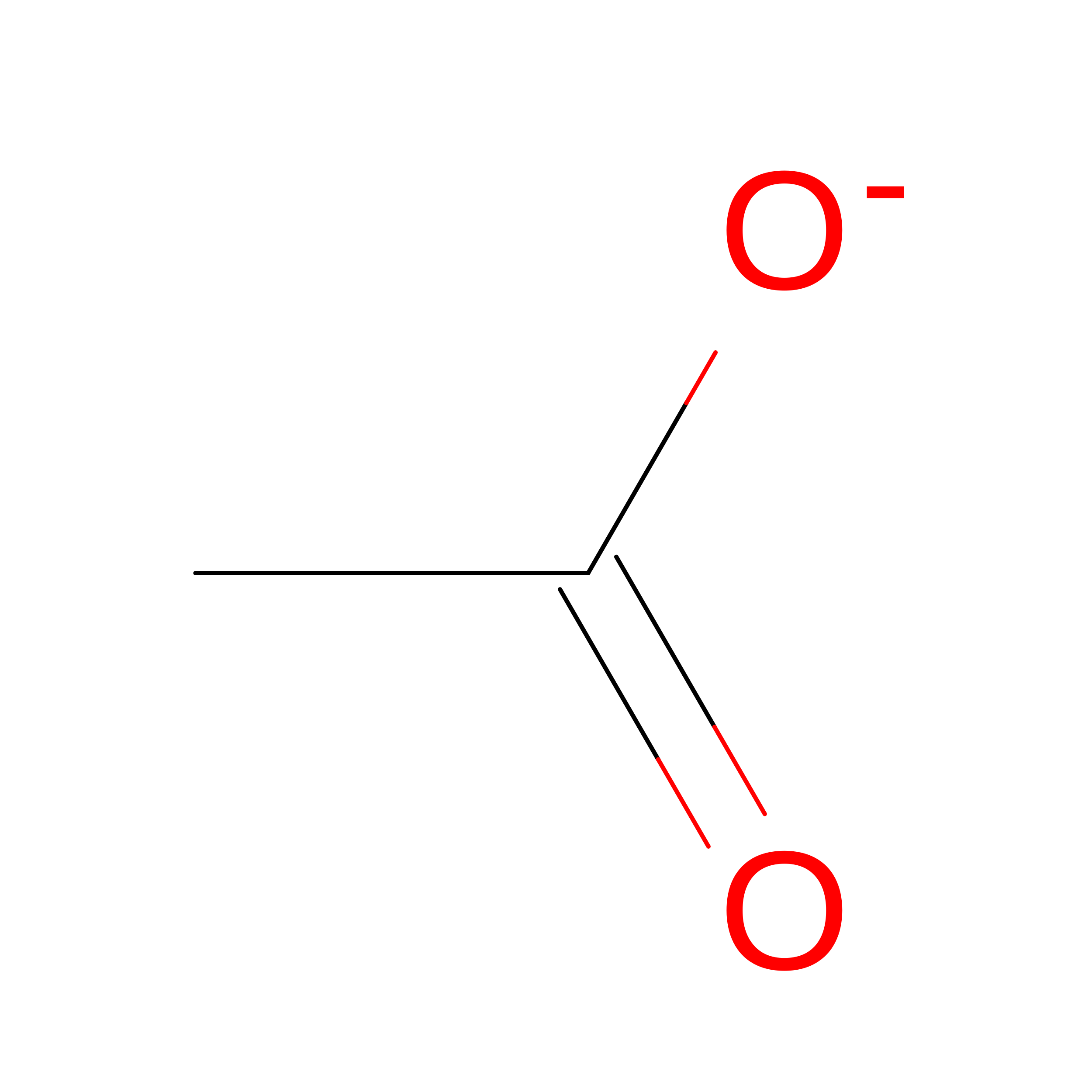
ACETATE ION
C2 H3 O2
QTBSBXVTEAMEQO-UHFFFAOYSA-M
Modified Residues  1 Unique
IDChains TypeFormula2D DiagramParent
I1C
Query on I1C
A, B
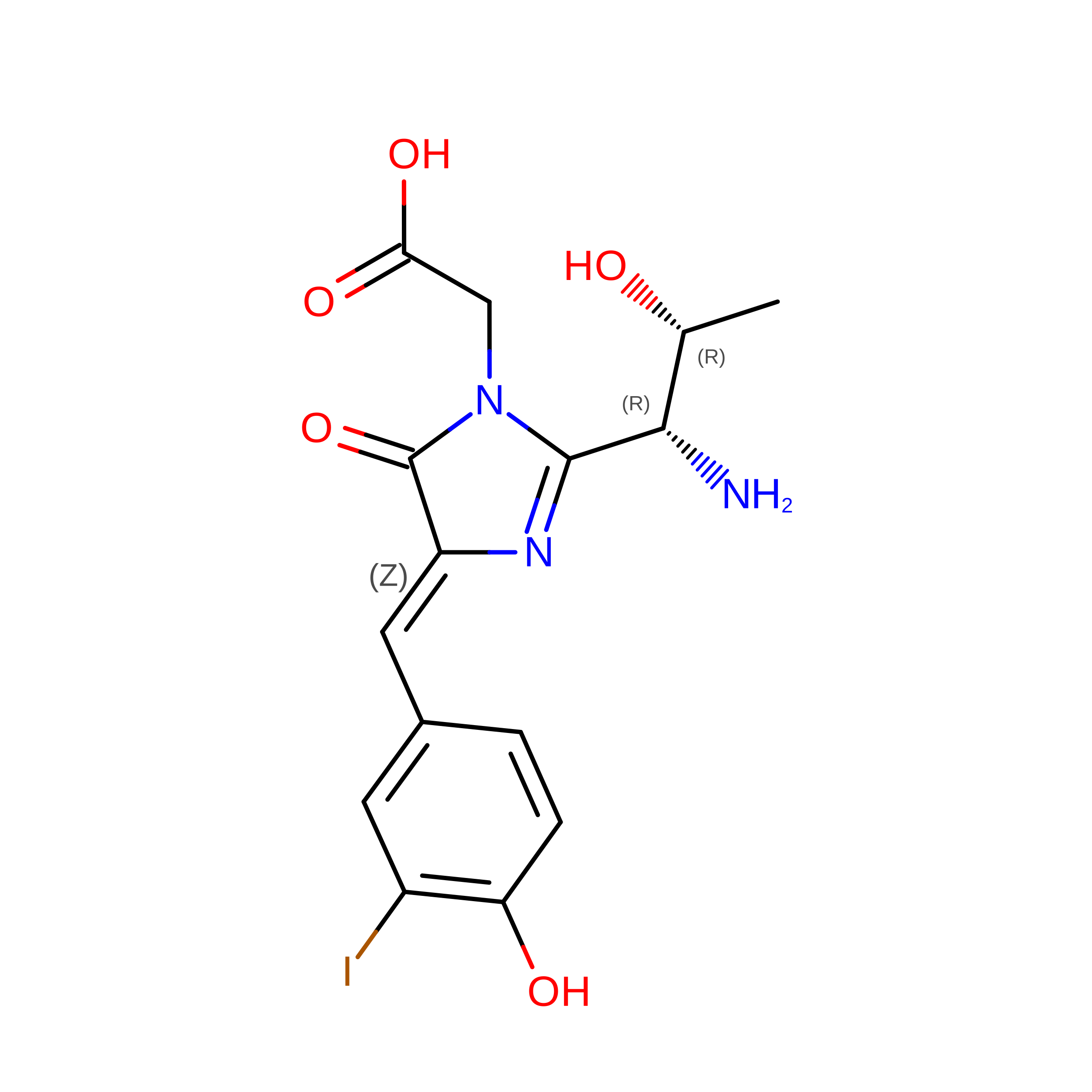
L-PEPTIDE LINKINGC15 H16 I N3 O5Thr, Tyr, Gly

Experimental Data & Validation

Experimental Data

  • Method: X-RAY DIFFRACTION
  • Resolution: 1.65 Å
  • R-Value Free:  0.178 (Depositor), 0.180 (DCC) 
  • R-Value Work:  0.156 (Depositor), 0.158 (DCC) 
  • R-Value Observed: 0.157 (Depositor) 
Space Group: P 1 21 1
Unit Cell:
Length ( Å )Angle ( ˚ )
a = 51.81α = 90
b = 68.69β = 99.762
c = 61.64γ = 90
Software Package:
Software NamePurpose
PHENIXrefinement
XDSdata reduction
XDSdata scaling
PHENIXphasing

Structure Validation

View Full Validation Report


Entry History 

& Funding Information

Deposition Data


Funding OrganizationLocationGrant Number
National Institutes of Health/National Institute of General Medical Sciences (NIH/NIGMS)United States118044

Revision History  (Full details and data files)

  • Version 1.0: 2020-04-08
    Type: Initial release
  • Version 1.1: 2020-10-28
    Changes: Database references
  • Version 1.2: 2020-11-04
    Changes: Database references
  • Version 1.3: 2023-10-11
    Changes: Data collection, Database references, Refinement description
  • Version 1.4: 2023-11-15
    Changes: Data collection, Derived calculations
  • Version 2.0: 2026-03-18
    Changes: Polymer sequence, Structure summary