6O29 | pdb_00006o29

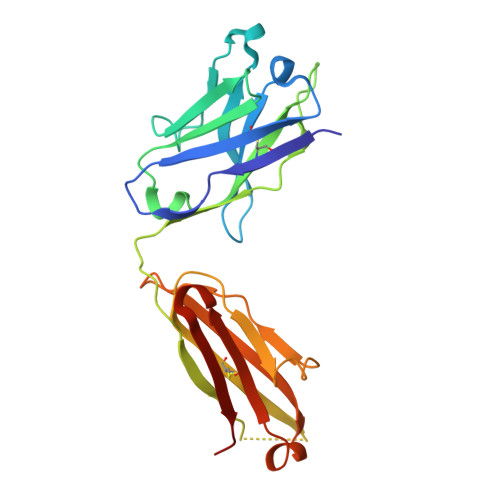
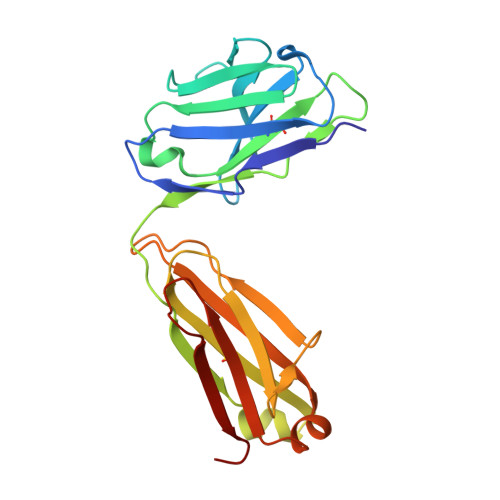
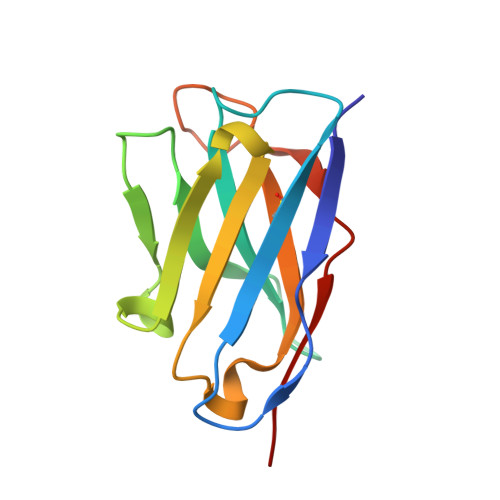
Crystal structure of 4493 Fab in complex with circumsporozoite protein NPDP and anti-kappa VHH domain


Experimental Data Snapshot

  • Method: X-RAY DIFFRACTION
  • Resolution: 2.40 Å
  • R-Value Free: 
    0.240 (Depositor), 0.280 (DCC) 
  • R-Value Work: 
    0.201 (Depositor) 
  • R-Value Observed: 
    0.202 (Depositor) 

Starting Model: other
View more details

wwPDB Validation 3D Report Full Report

Validation slider image for 6O29

This is version 1.3 of the entry. See complete history

Literature

Evolution of protective human antibodies against Plasmodium falciparum circumsporozoite protein repeat motifs.

Murugan, R.Scally, S.W.Costa, G.Mustafa, G.Thai, E.Decker, T.Bosch, A.Prieto, K.Levashina, E.A.Julien, J.P.Wardemann, H.

(2020) Nat Med 26: 1135-1145

  • DOI: https://doi.org/10.1038/s41591-020-0881-9
  • Primary Citation Related Structures: 
    6O23, 6O24, 6O25, 6O26, 6O28, 6O29, 6O2A, 6O2B, 6O2C, 6ULE, 6ULF, 6VLN

  • PubMed Abstract: 

    The circumsporozoite protein of the human malaria parasite Plasmodium falciparum (PfCSP) is the main target of antibodies that prevent the infection and disease, as shown in animal models. However, the limited efficacy of the PfCSP-based vaccine RTS,S calls for a better understanding of the mechanisms driving the development of the most potent human PfCSP antibodies and identification of their target epitopes. By characterizing 200 human monoclonal PfCSP antibodies induced by sporozoite immunization, we establish that the most potent antibodies bind around a conserved (N/D)PNANPN(V/A) core. High antibody affinity to the core correlates with protection from parasitemia in mice and evolves around the recognition of NANP motifs. The data suggest that the rational design of a next-generation PfCSP vaccine that elicits high-affinity antibody responses against the core epitope will promote the induction of protective humoral immune responses.


  • Organizational Affiliation
    • B Cell Immunology, German Cancer Research Institute (DKFZ), Heidelberg, Germany.

Macromolecule Content 

  • Total Structure Weight: 120.67 kDa 
  • Atom Count: 8,344 
  • Modeled Residue Count: 1,140 
  • Deposited Residue Count: 1,154 
  • Unique protein chains: 4

Macromolecules

Find similar proteins by:|  3D Structure
Entity ID: 1
MoleculeChains  Sequence LengthOrganismDetailsImage
4493 Fab heavy chainA,
C [auth H]
225Homo sapiensMutation(s): 0 
Find similar proteins by:|  3D Structure
Entity ID: 2
MoleculeChains  Sequence LengthOrganismDetailsImage
4493 Kappa light chainB,
D [auth L]
215Homo sapiensMutation(s): 0 
Find similar proteins by:  Sequence   |   3D Structure  
Entity ID: 3
MoleculeChains  Sequence LengthOrganismDetailsImage
Circumsporozoite proteinE [auth C],
F [auth D]
16Plasmodium falciparumMutation(s): 0 
UniProt
Find proteins for P19597 (Plasmodium falciparum (isolate NF54))
Explore P19597 
Go to UniProtKB:  P19597
Entity Groups
Sequence Clusters30% Identity50% Identity70% Identity90% Identity95% Identity100% Identity
UniProt GroupP19597
Sequence Annotations
Expand
Reference Sequence
Find similar proteins by:|  3D Structure
Entity ID: 4
MoleculeChains  Sequence LengthOrganismDetailsImage
Anti-kappa VHH domainG [auth K],
H [auth E]
121Lama glamaMutation(s): 0 

Experimental Data & Validation

Experimental Data

  • Method: X-RAY DIFFRACTION
  • Resolution: 2.40 Å
  • R-Value Free:  0.240 (Depositor), 0.280 (DCC) 
  • R-Value Work:  0.201 (Depositor) 
  • R-Value Observed: 0.202 (Depositor) 
Space Group: P 21 21 21
Unit Cell:
Length ( Å )Angle ( ˚ )
a = 54.537α = 90
b = 79.761β = 90
c = 281.795γ = 90
Software Package:
Software NamePurpose
PHENIXrefinement
XDSdata reduction
XDSdata scaling
PHENIXphasing

Structure Validation

View Full Validation Report


Entry History 

& Funding Information

Deposition Data


Funding OrganizationLocationGrant Number
Bill & Melinda Gates Foundation--

Revision History  (Full details and data files)

  • Version 1.0: 2020-07-01
    Type: Initial release
  • Version 1.1: 2020-07-29
    Changes: Database references
  • Version 1.2: 2024-04-03
    Changes: Data collection, Database references, Refinement description
  • Version 1.3: 2024-10-16
    Changes: Structure summary