6NIG | pdb_00006nig

Crystal structure of the human TLR2-Diprovocim complex


Experimental Data Snapshot

  • Method: X-RAY DIFFRACTION
  • Resolution: 2.35 Å
  • R-Value Free: 
    0.236 (Depositor), 0.248 (DCC) 
  • R-Value Work: 
    0.210 (Depositor), 0.225 (DCC) 
  • R-Value Observed: 
    0.210 (Depositor) 

Starting Model: experimental
View more details

wwPDB Validation 3D Report Full Report

Validation slider image for 6NIG

Ligand Structure Quality Assessment 


This is version 2.2 of the entry. See complete history

Literature

Structural Basis of TLR2/TLR1 Activation by the Synthetic Agonist Diprovocim.

Su, L.Wang, Y.Wang, J.Mifune, Y.Morin, M.D.Jones, B.T.Moresco, E.M.Y.Boger, D.L.Beutler, B.Zhang, H.

(2019) J Med Chem 62: 2938-2949

  • DOI: https://doi.org/10.1021/acs.jmedchem.8b01583
  • Primary Citation Related Structures: 
    6NIG, 6NIH

  • PubMed Abstract: 

    Diprovocim is a recently discovered exceptionally potent, synthetic small molecule agonist of TLR2/TLR1 and has shown significant adjuvant activity in anticancer vaccination against murine melanoma. Since Diprovocim bears no structural similarity to the canonical lipopeptide ligands of TLR2/TLR1, we investigated how Diprovocim interacts with TLR2/TLR1 through in vitro biophysical, structural, and computational approaches. We found that Diprovocim induced the formation of TLR2/TLR1 heterodimers as well as TLR2 homodimers in vitro. We determined the crystal structure of Diprovocim in a complex with a TLR2 ectodomain, which revealed, unexpectedly, two Diprovocim molecules bound to the ligand binding pocket formed between two TLR2 ectodomains. Extensive hydrophobic interactions and a hydrogen-bonding network between the protein and Diprovocim molecules are observed within the defined ligand binding pocket and likely underlie the high potency of Diprovocim. Our work shed first light into the activation mechanism of TLR2/TLR1 by a noncanonical agonist. The structural information obtained here may be exploited to manipulate TLR2/TLR1-dependent signaling.


  • Organizational Affiliation
    • Department of Pharmaceutical Sciences, School of Pharmacy , University of Pittsburgh , Pittsburgh , Pennsylvania 15213 , United States.

Macromolecule Content 

  • Total Structure Weight: 268.44 kDa 
  • Atom Count: 17,937 
  • Modeled Residue Count: 2,186 
  • Deposited Residue Count: 2,304 
  • Unique protein chains: 1

Macromolecules

Find similar proteins by:|  3D Structure
Entity ID: 1
MoleculeChains  Sequence LengthOrganismDetailsImage
Toll-like receptor 2,Variable lymphocyte receptor B
A, B, C, D
576Homo sapiensEptatretus stoutii
This entity is chimeric
Mutation(s): 0 
Gene Names: TLR2TIL4VLRB
UniProt & NIH Common Fund Data Resources
Find proteins for O60603 (Homo sapiens)
Explore O60603 
Go to UniProtKB:  O60603
PHAROS:  O60603
GTEx:  ENSG00000137462 
Find proteins for Q2YE02 (Eptatretus stoutii)
Explore Q2YE02 
Go to UniProtKB:  Q2YE02
Entity Groups
Sequence Clusters30% Identity50% Identity70% Identity90% Identity95% Identity100% Identity
UniProt GroupsQ2YE02O60603
Glycosylation
Glycosylation Sites: 4Go to GlyGen: O60603-1
Sequence Annotations
Expand
Reference Sequence

Oligosaccharides

Help  
Entity ID: 2
MoleculeChains Length2D Diagram GlycosylationD Interactions
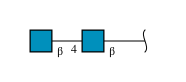
2-acetamido-2-deoxy-beta-D-glucopyranose-(1-4)-2-acetamido-2-deoxy-beta-D-glucopyranose
E, F, G, H
2N-Glycosylation
Glycosylation Resources
GlyTouCan: G42666HT
GlyCosmos: G42666HT
GlyGen: G42666HT

Small Molecules

Ligands 2 Unique
IDChains Name / Formula / InChI Key2D Diagram3D Interactions
KQD

Query on KQD


Download:Ideal Coordinates CCD File
I [auth A],
N [auth B],
Q [auth C],
S [auth D]
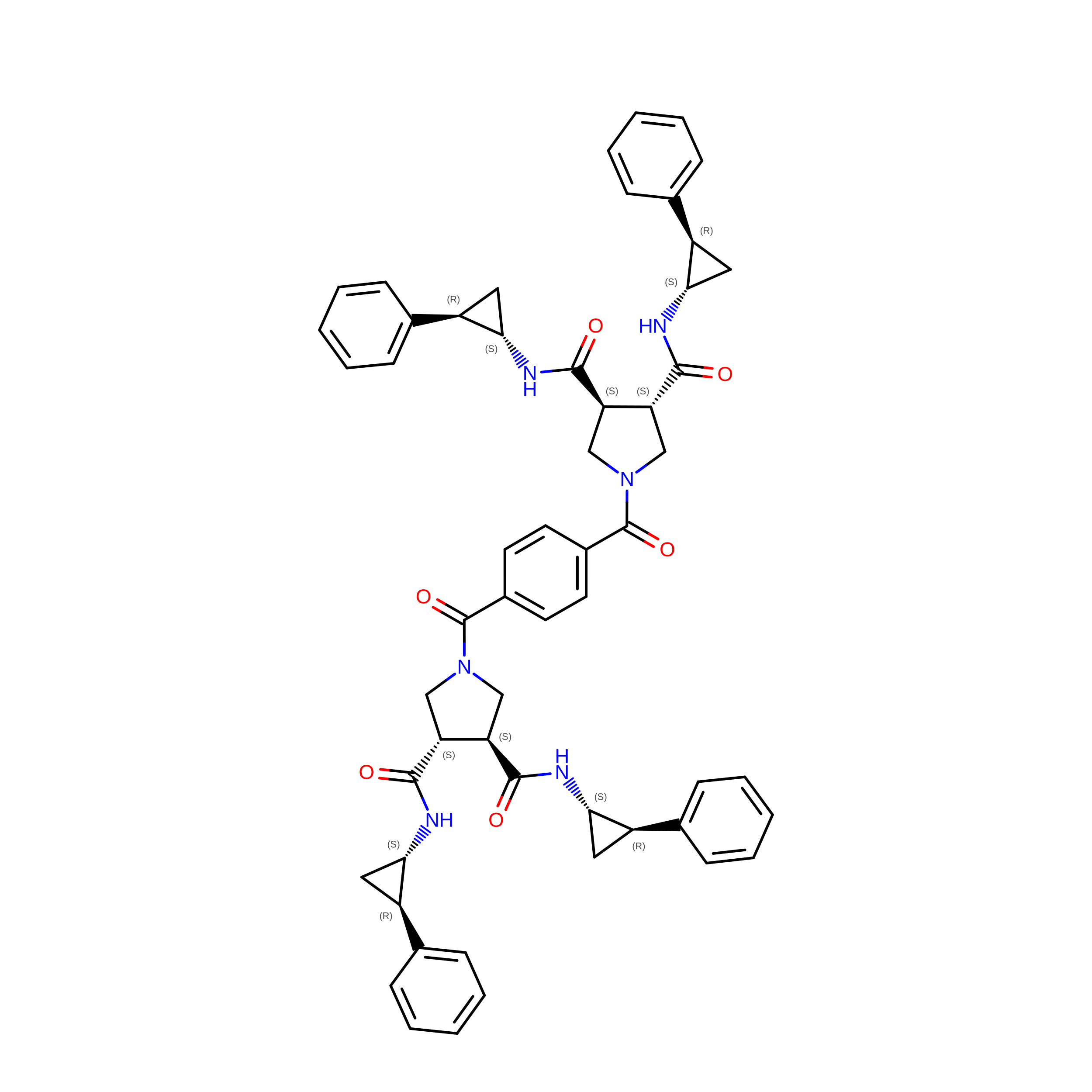
(3S,4S,3'S,4'S)-1,1'-(1,4-phenylenedicarbonyl)bis{N~3~,N~4~-bis[(1S,2R)-2-phenylcyclopropyl]pyrrolidine-3,4-dicarboxami de}
C56 H56 N6 O6
ABZBNXFGYUSVCJ-UYMKNZQYSA-N
NAG

Query on NAG


Download:Ideal Coordinates CCD File
J [auth A]
K [auth A]
L [auth A]
M [auth A]
O [auth B]
J [auth A],
K [auth A],
L [auth A],
M [auth A],
O [auth B],
P [auth B],
R [auth C],
T [auth D],
U [auth D]
2-acetamido-2-deoxy-beta-D-glucopyranose
C8 H15 N O6
OVRNDRQMDRJTHS-FMDGEEDCSA-N
Binding Affinity Annotations 
IDSourceBinding Affinity
KQD BindingDB:  6NIG EC50: min: 0.11, max: 15 (nM) from 2 assay(s)

Experimental Data & Validation

Experimental Data

  • Method: X-RAY DIFFRACTION
  • Resolution: 2.35 Å
  • R-Value Free:  0.236 (Depositor), 0.248 (DCC) 
  • R-Value Work:  0.210 (Depositor), 0.225 (DCC) 
  • R-Value Observed: 0.210 (Depositor) 
Space Group: P 1 21 1
Unit Cell:
Length ( Å )Angle ( ˚ )
a = 66.098α = 90
b = 201.252β = 94.26
c = 109.359γ = 90
Software Package:
Software NamePurpose
PHENIXrefinement
HKL-3000data reduction
HKL-3000data scaling
PHASERphasing

Structure Validation

View Full Validation Report


Ligand Structure Quality Assessment 


Entry History 

& Funding Information

Deposition Data


Funding OrganizationLocationGrant Number
National Institutes of Health/National Institute of General Medical Sciences (NIH/NIGMS)United States--

Revision History  (Full details and data files)

  • Version 1.0: 2019-04-17
    Type: Initial release
  • Version 1.1: 2020-01-01
    Changes: Author supporting evidence
  • Version 2.0: 2020-07-29
    Type: Remediation
    Reason: Carbohydrate remediation
    Changes: Advisory, Atomic model, Data collection, Derived calculations, Structure summary
  • Version 2.1: 2023-10-11
    Changes: Data collection, Database references, Refinement description, Structure summary
  • Version 2.2: 2024-11-20
    Changes: Structure summary