6N2K | pdb_00006n2k

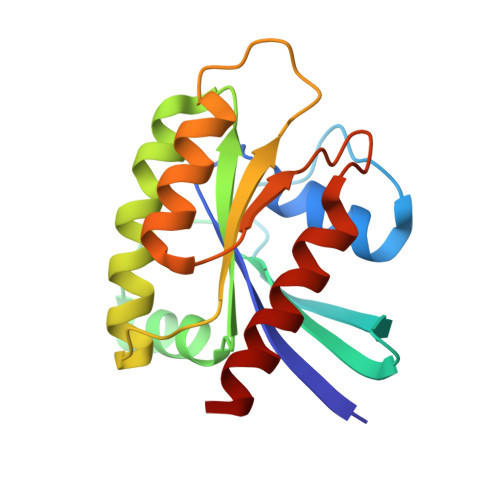
Tetrahydropyridopyrimidines as Covalent Inhibitors of KRAS-G12C


Experimental Data Snapshot

  • Method: X-RAY DIFFRACTION
  • Resolution: 1.72 Å
  • R-Value Free: 
    0.172 (Depositor), 0.173 (DCC) 
  • R-Value Work: 
    0.118 (Depositor), 0.120 (DCC) 
  • R-Value Observed: 
    0.120 (Depositor) 

Starting Model: experimental
View more details

wwPDB Validation 3D Report Full Report

Validation slider image for 6N2K

Ligand Structure Quality Assessment 


This is version 1.3 of the entry. See complete history

Literature

Discovery of Tetrahydropyridopyrimidines as Irreversible Covalent Inhibitors of KRAS-G12C with In Vivo Activity.

Fell, J.B.Fischer, J.P.Baer, B.R.Ballard, J.Blake, J.F.Bouhana, K.Brandhuber, B.J.Briere, D.M.Burgess, L.E.Burkard, M.R.Chiang, H.Chicarelli, M.J.Davidson, K.Gaudino, J.J.Hallin, J.Hanson, L.Hee, K.Hicken, E.J.Hinklin, R.J.Marx, M.A.Mejia, M.J.Olson, P.Savechenkov, P.Sudhakar, N.Tang, T.P.Vigers, G.P.Zecca, H.Christensen, J.G.

(2018) ACS Med Chem Lett 9: 1230-1234

  • DOI: https://doi.org/10.1021/acsmedchemlett.8b00382
  • Primary Citation Related Structures: 
    6N2J, 6N2K

  • PubMed Abstract: 

    KRAS is the most frequently mutated driver oncogene in human cancer, and KRAS mutations are commonly associated with poor prognosis and resistance to standard treatment. The ability to effectively target and block the function of mutated KRAS has remained elusive despite decades of research. Recent findings have demonstrated that directly targeting KRAS-G12C with electrophilic small molecules that covalently modify the mutated codon 12 cysteine is feasible. We have discovered a series of tetrahydropyridopyrimidines as irreversible covalent inhibitors of KRAS-G12C with in vivo activity. The PK/PD and efficacy of compound 13 will be highlighted.


  • Organizational Affiliation
    • Array BioPharma, Inc., 3200 Walnut Street, Boulder, Colorado 80301, United States.

Macromolecule Content 

  • Total Structure Weight: 20.34 kDa 
  • Atom Count: 1,664 
  • Modeled Residue Count: 169 
  • Deposited Residue Count: 170 
  • Unique protein chains: 1

Macromolecules

Find similar proteins by:|  3D Structure
Entity ID: 1
MoleculeChains  Sequence LengthOrganismDetailsImage
GTPase KRas170Homo sapiensMutation(s): 4 
Gene Names: KRASKRAS2RASK2
EC: 3.6.5.2
UniProt & NIH Common Fund Data Resources
Find proteins for P01116 (Homo sapiens)
Explore P01116 
Go to UniProtKB:  P01116
PHAROS:  P01116
GTEx:  ENSG00000133703 
Entity Groups
Sequence Clusters30% Identity50% Identity70% Identity90% Identity95% Identity100% Identity
UniProt GroupP01116
Sequence Annotations
Expand
Reference Sequence

Small Molecules

Ligands 3 Unique
IDChains Name / Formula / InChI Key2D Diagram3D Interactions
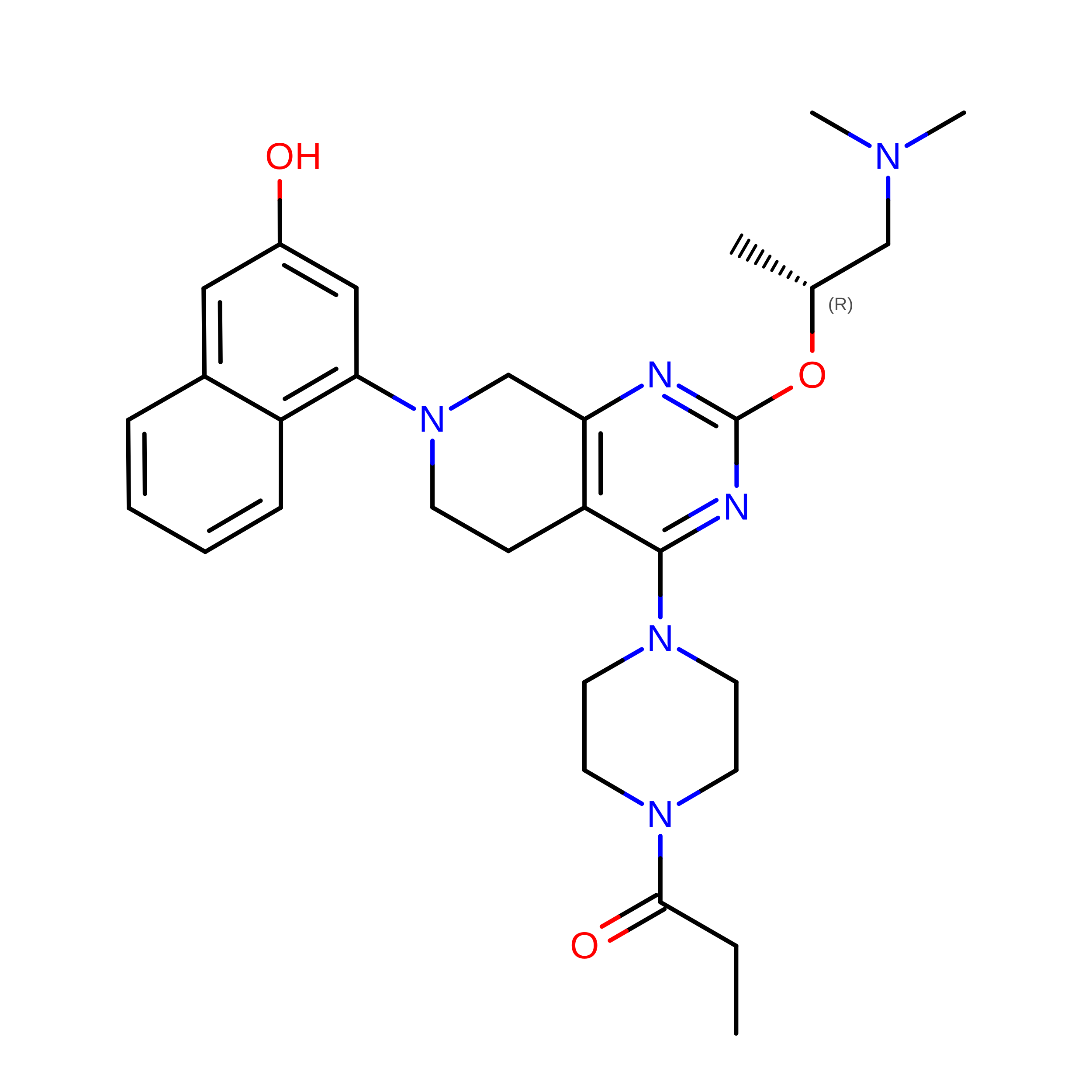
K9J
(Subject of Investigation/LOI)

Query on K9J


Download:Ideal Coordinates CCD File
D [auth A]1-{4-[2-{[(2R)-1-(dimethylamino)propan-2-yl]oxy}-7-(3-hydroxynaphthalen-1-yl)-5,6,7,8-tetrahydropyrido[3,4-d]pyrimidin-4-yl]piperazin-1-yl}propan-1-one
C29 H38 N6 O3
XWVXFKORKNADOR-HXUWFJFHSA-N
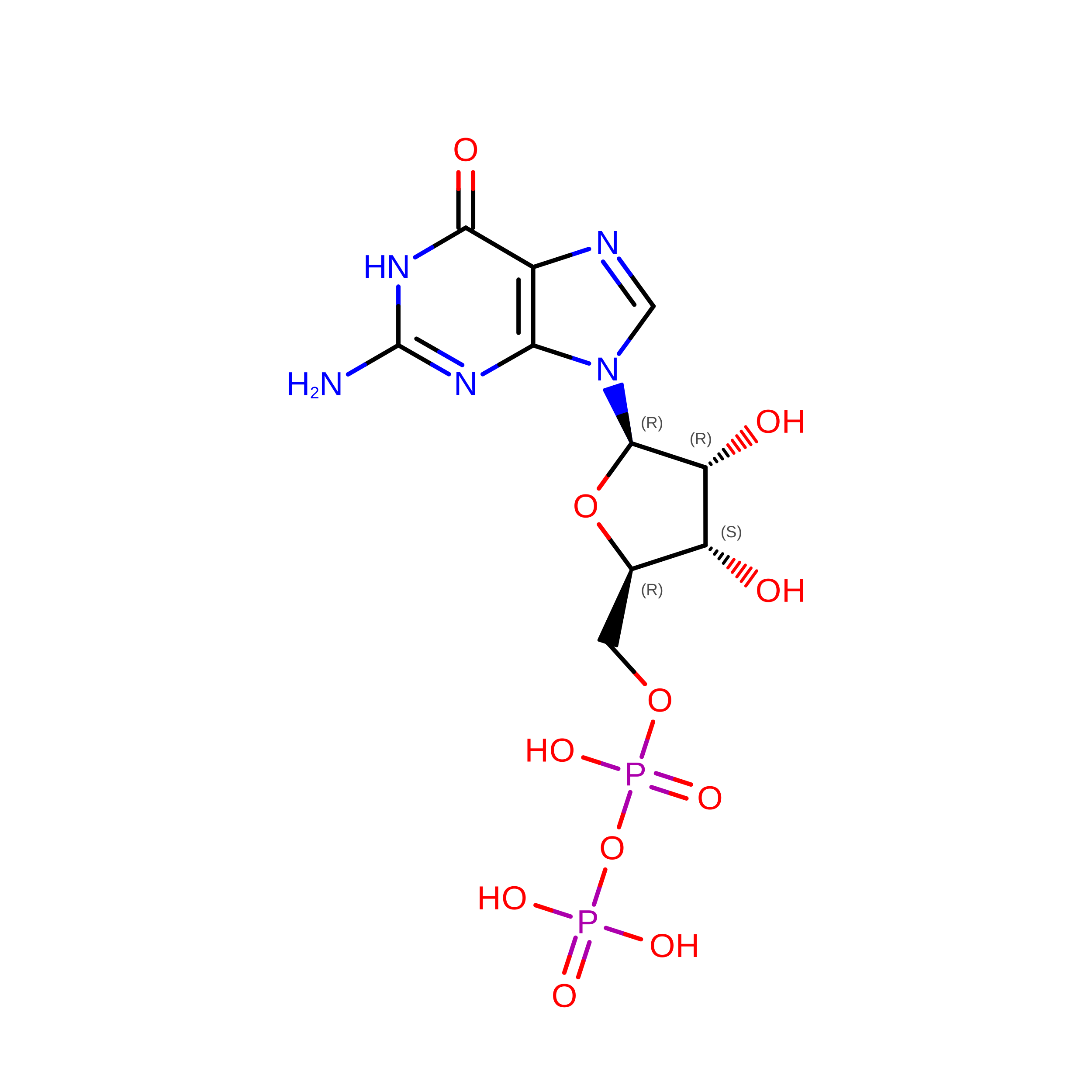
GDP

Query on GDP


Download:Ideal Coordinates CCD File
B [auth A]GUANOSINE-5'-DIPHOSPHATE
C10 H15 N5 O11 P2
QGWNDRXFNXRZMB-UUOKFMHZSA-N
MG

Query on MG


Download:Ideal Coordinates CCD File
C [auth A]MAGNESIUM ION
Mg
JLVVSXFLKOJNIY-UHFFFAOYSA-N

Experimental Data & Validation

Experimental Data

  • Method: X-RAY DIFFRACTION
  • Resolution: 1.72 Å
  • R-Value Free:  0.172 (Depositor), 0.173 (DCC) 
  • R-Value Work:  0.118 (Depositor), 0.120 (DCC) 
  • R-Value Observed: 0.120 (Depositor) 
Space Group: P 21 21 21
Unit Cell:
Length ( Å )Angle ( ˚ )
a = 39.969α = 90
b = 49.975β = 90
c = 92.623γ = 90
Software Package:
Software NamePurpose
MOSFLMdata reduction
Aimlessdata scaling
PHASERphasing
REFMACrefinement
PDB_EXTRACTdata extraction

Structure Validation

View Full Validation Report


Ligand Structure Quality Assessment 


Entry History 

Deposition Data

  • Released Date: 2018-12-12 
  • Deposition Author(s): Vigers, G.P.

Revision History  (Full details and data files)

  • Version 1.0: 2018-12-12
    Type: Initial release
  • Version 1.1: 2019-01-23
    Changes: Data collection, Database references
  • Version 1.2: 2023-10-11
    Changes: Data collection, Database references, Derived calculations, Refinement description
  • Version 1.3: 2024-11-20
    Changes: Structure summary