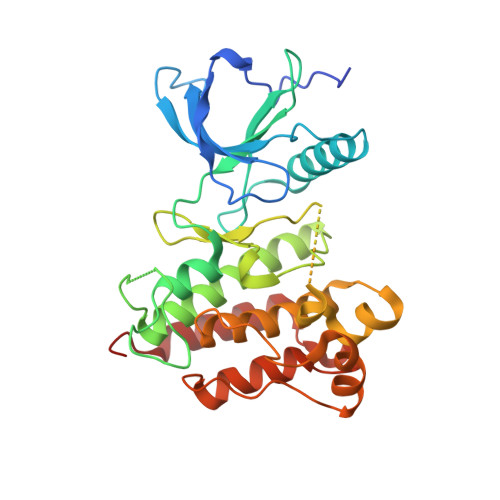
6MZW | pdb_00006mzw

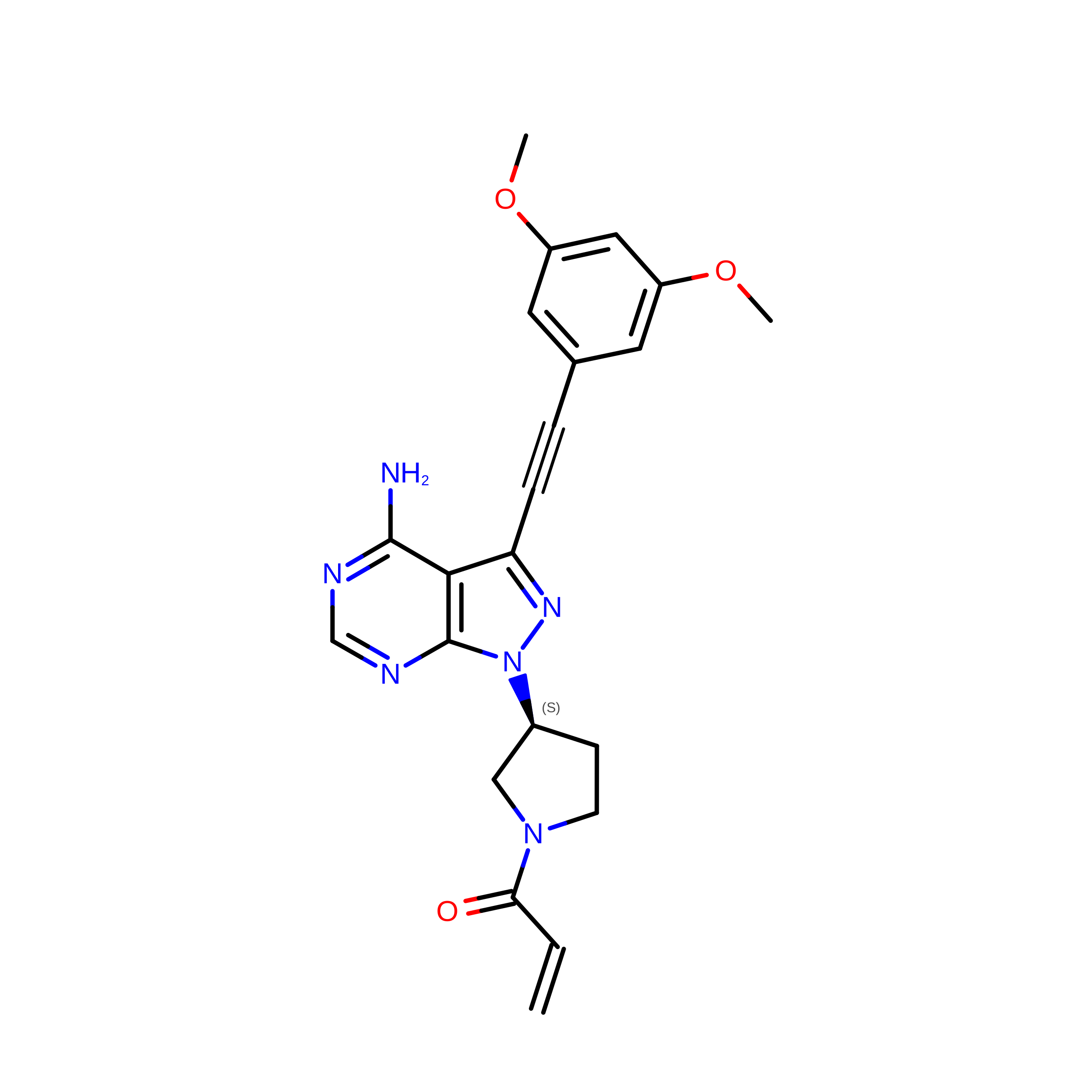
TAS-120 covalent complex with FGFR1


Experimental Data Snapshot

  • Method: X-RAY DIFFRACTION
  • Resolution: 2.20 Å
  • R-Value Free: 
    0.297 (Depositor), 0.296 (DCC) 
  • R-Value Work: 
    0.241 (Depositor), 0.247 (DCC) 
  • R-Value Observed: 
    0.244 (Depositor) 

Starting Model: experimental
View more details

wwPDB Validation 3D Report Full Report

Validation slider image for 6MZW

Ligand Structure Quality Assessment 


This is version 1.4 of the entry. See complete history

Literature

TAS-120 Cancer Target Binding: Defining Reactivity and Revealing the First Fibroblast Growth Factor Receptor 1 (FGFR1) Irreversible Structure.

Kalyukina, M.Yosaatmadja, Y.Middleditch, M.J.Patterson, A.V.Smaill, J.B.Squire, C.J.

(2019) ChemMedChem 14: 494-500

  • DOI: https://doi.org/10.1002/cmdc.201800719
  • Primary Citation Related Structures: 
    6MZQ, 6MZW

  • PubMed Abstract: 

    1-[(3S)-3-[4-Amino-3-[2-(3,5-dimethoxyphenyl)ethynyl]-1H-pyrazolo[3,4-d]pyrimidin-1-yl]-1-pyrrolidinyl]-2-propen-1-one (TAS-120) is an irreversible inhibitor of the fibroblast growth factor receptor (FGFR) family, and is currently under phase I/II clinical trials in patients with confirmed advanced metastatic solid tumours harbouring FGFR aberrations. This inhibitor specifically targets the P-loop of the FGFR tyrosine kinase domain, forming a covalent adduct with a cysteine side chain of the protein. Our mass spectrometry experiments characterise an exceptionally fast chemical reaction in forming the covalent complex. The structural basis of this reactivity is revealed by a sequence of three X-ray crystal structures: a free ligand structure, a reversible FGFR1 structure, and the first reported irreversible FGFR1 adduct structure. We hypothesise that the most significant reactivity feature of TAS-120 is its inherent ability to undertake conformational sampling of the FGFR P-loop. In designing novel covalent FGFR inhibitors, such a phenomenon presents an attractive strategy requiring appropriate positioning of an acrylamide group similarly to that of TAS-120.


  • Organizational Affiliation
    • School of Biological Sciences, The University of Auckland, Private Bag 92019, Auckland, 1142, New Zealand.

Macromolecule Content 

  • Total Structure Weight: 71.7 kDa 
  • Atom Count: 4,124 
  • Modeled Residue Count: 540 
  • Deposited Residue Count: 622 
  • Unique protein chains: 1

Macromolecules

Find similar proteins by:|  3D Structure
Entity ID: 1
MoleculeChains  Sequence LengthOrganismDetailsImage
Fibroblast growth factor receptor 1
A, B
311Homo sapiensMutation(s): 0 
Gene Names: FGFR1BFGFRCEKFGFBRFLGFLT2HBGFR
EC: 2.7.10.1
UniProt & NIH Common Fund Data Resources
Find proteins for P11362 (Homo sapiens)
Explore P11362 
Go to UniProtKB:  P11362
PHAROS:  P11362
GTEx:  ENSG00000077782 
Entity Groups
Sequence Clusters30% Identity50% Identity70% Identity90% Identity95% Identity100% Identity
UniProt GroupP11362
Sequence Annotations
Expand
Reference Sequence

Small Molecules

Binding Affinity Annotations 
IDSourceBinding Affinity
TZ0 BindingDB:  6MZW IC50: min: 1, max: 190 (nM) from 12 assay(s)

Experimental Data & Validation

Experimental Data

  • Method: X-RAY DIFFRACTION
  • Resolution: 2.20 Å
  • R-Value Free:  0.297 (Depositor), 0.296 (DCC) 
  • R-Value Work:  0.241 (Depositor), 0.247 (DCC) 
  • R-Value Observed: 0.244 (Depositor) 
Space Group: C 1 2 1
Unit Cell:
Length ( Å )Angle ( ˚ )
a = 208.919α = 90
b = 48.981β = 106.19
c = 65.119γ = 90
Software Package:
Software NamePurpose
REFMACrefinement
XDSdata reduction
Aimlessdata scaling
PHASERphasing

Structure Validation

View Full Validation Report


Ligand Structure Quality Assessment 


Entry History 

Deposition Data

Revision History  (Full details and data files)

  • Version 1.0: 2019-01-16
    Type: Initial release
  • Version 1.1: 2019-01-30
    Changes: Data collection, Database references
  • Version 1.2: 2019-03-06
    Changes: Data collection, Database references
  • Version 1.3: 2023-10-11
    Changes: Data collection, Database references, Refinement description
  • Version 1.4: 2024-11-20
    Changes: Structure summary