6MVK | pdb_00006mvk

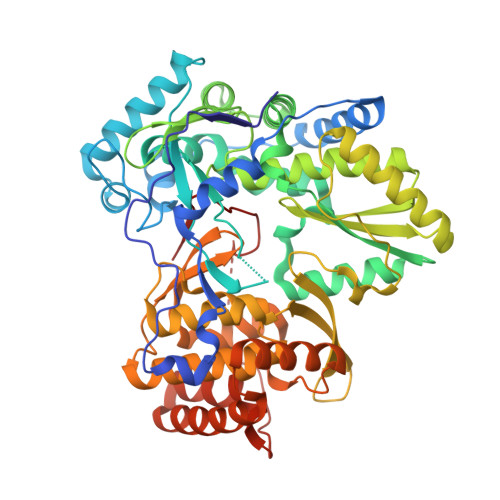
HCV NS5B 1b N316 bound to Compound 18


Experimental Data Snapshot

  • Method: X-RAY DIFFRACTION
  • Resolution: 2.30 Å
  • R-Value Free: 
    0.237 (Depositor), 0.228 (DCC) 
  • R-Value Work: 
    0.207 (Depositor), 0.201 (DCC) 
  • R-Value Observed: 
    0.210 (Depositor) 

wwPDB Validation 3D Report Full Report

Validation slider image for 6MVK

Ligand Structure Quality Assessment 


This is version 1.1 of the entry. See complete history. 

Literature

Design of N-Benzoxaborole Benzofuran GSK8175-Optimization of Human Pharmacokinetics Inspired by Metabolites of a Failed Clinical HCV Inhibitor.

Chong, P.Y., Shotwell, J.B., Miller, J., Price, D.J., Maynard, A., Voitenleitner, C., Mathis, A., Williams, S., Pouliot, J.J., Creech, K., Wang, F., Fang, J., Zhang, H., Tai, V.W., Turner, E., Kahler, K.M., Crosby, R., Peat, A.J.

(2019) J Med Chem 62: 3254-3267

  • DOI: https://doi.org/10.1021/acs.jmedchem.8b01719
  • Primary Citation Related Structures: 
    6MVK, 6MVO, 6MVP, 6MVQ

  • PubMed Abstract: 

    We previously described the discovery of GSK5852 (1), a non-nucleoside polymerase (NS5B) inhibitor of hepatitis C virus (HCV), in which an N-benzyl boronic acid was essential for potent antiviral activity. Unfortunately, facile benzylic oxidation resulted in a short plasma half-life (5 h) in human volunteers, and a backup program was initiated to remove metabolic liabilities associated with 1. Herein, we describe second-generation NS5B inhibitors including GSK8175 (49), a sulfonamide- N-benzoxaborole analog with low in vivo clearance across preclinical species and broad-spectrum activity against HCV replicons. An X-ray structure of NS5B protein cocrystallized with 49 revealed unique protein-inhibitor interactions mediated by an extensive network of ordered water molecules and the first evidence of boronate complex formation within the binding pocket. In clinical studies, 49 displayed a 60-63 h half-life and a robust decrease in viral RNA levels in HCV-infected patients, thereby validating our hypothesis that reducing benzylic oxidation would improve human pharmacokinetics and lower efficacious doses relative to 1.


  • Organizational Affiliation: 
    • GlaxoSmithKline , 5 Moore Drive , Research Triangle Park , North Carolina 27709 , United States.

Macromolecule Content 

  • Total Structure Weight: 126.02 kDa 
  • Atom Count: 8,812 
  • Modeled Residue Count: 1,100 
  • Deposited Residue Count: 1,126 
  • Unique protein chains: 1

Macromolecules

Find similar proteins by:|  3D Structure
Entity ID: 1
MoleculeChains  Sequence LengthOrganismDetailsImage
HCV Polymerase
A, B
563Hepatitis C virus subtype 1bMutation(s): 0 
UniProt
Find proteins for Q99AU2 (Hepatitis C virus genotype 1b)
Explore Q99AU2 
Go to UniProtKB:  Q99AU2
Entity Groups
Sequence Clusters30% Identity50% Identity70% Identity90% Identity95% Identity100% Identity
UniProt GroupQ99AU2
Sequence Annotations
Expand
Reference Sequence

Small Molecules

Ligands 1 Unique
IDChains Name / Formula / InChI Key2D Diagram3D Interactions
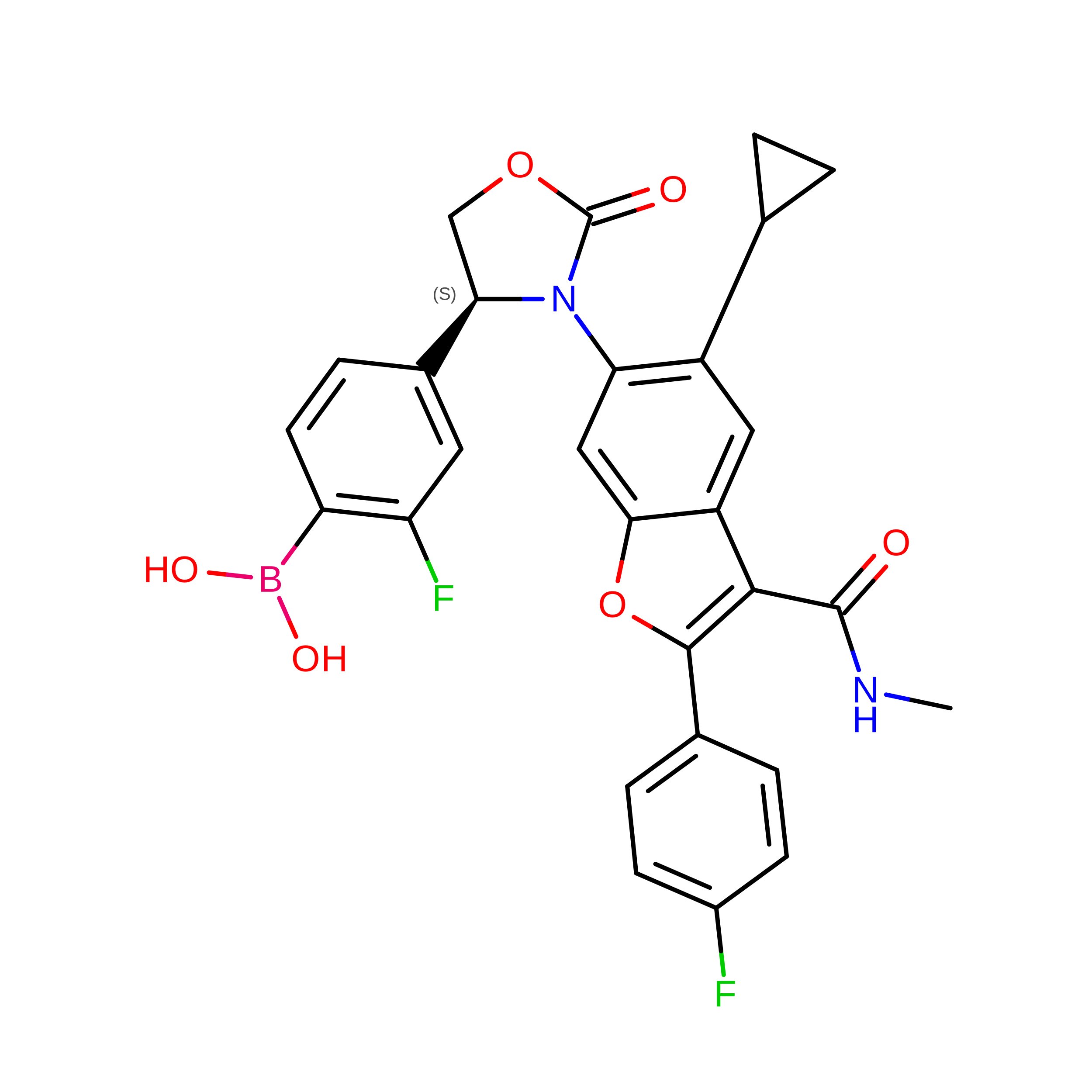
K4J
(Subject of Investigation/LOI)

Query on K4J


Download:Ideal Coordinates CCD File
C [auth A],
D [auth B]
(4-{(4S)-3-[5-cyclopropyl-2-(4-fluorophenyl)-3-(methylcarbamoyl)-1-benzofuran-6-yl]-2-oxo-1,3-oxazolidin-4-yl}-2-fluorophenyl)boronic acid
C28 H23 B F2 N2 O6
PZMMURFIDMHRSQ-HSZRJFAPSA-N

Experimental Data & Validation

Experimental Data

  • Method: X-RAY DIFFRACTION
  • Resolution: 2.30 Å
  • R-Value Free:  0.237 (Depositor), 0.228 (DCC) 
  • R-Value Work:  0.207 (Depositor), 0.201 (DCC) 
  • R-Value Observed: 0.210 (Depositor) 
Space Group: P 21 21 21
Unit Cell:
Length ( Å )Angle ( ˚ )
a = 86.372α = 90
b = 107.468β = 90
c = 126.744γ = 90
Software Package:
Software NamePurpose
HKL-2000data reduction
HKL-2000data scaling
REFMACrefinement
PDB_EXTRACTdata extraction
REFMACphasing

Structure Validation

View Full Validation Report


Ligand Structure Quality Assessment 


Entry History 

Deposition Data

Revision History  (Full details and data files)

  • Version 1.0: 2019-09-04
    Type: Initial release
  • Version 1.1: 2024-03-13
    Changes: Data collection, Database references