6MOG | pdb_00006mog

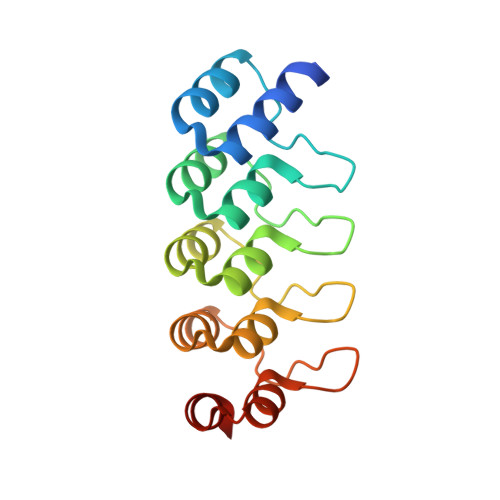
Dimeric DARPin C_R3


Experimental Data Snapshot

  • Method: X-RAY DIFFRACTION
  • Resolution: 1.21 Å
  • R-Value Free: 
    0.171 (Depositor), 0.172 (DCC) 
  • R-Value Work: 
    0.141 (Depositor), 0.143 (DCC) 
  • R-Value Observed: 
    0.142 (Depositor) 

Starting Model: in silico
View more details

wwPDB Validation 3D Report Full Report

Validation slider image for 6MOG

This is version 1.4 of the entry. See complete history

Literature

Topological control of cytokine receptor signaling induces differential effects in hematopoiesis.

Mohan, K.Ueda, G.Kim, A.R.Jude, K.M.Fallas, J.A.Guo, Y.Hafer, M.Miao, Y.Saxton, R.A.Piehler, J.Sankaran, V.G.Baker, D.Garcia, K.C.

(2019) Science 364

  • DOI: https://doi.org/10.1126/science.aav7532
  • Primary Citation Related Structures: 
    6MOE, 6MOF, 6MOG, 6MOH, 6MOI, 6MOJ, 6MOK, 6MOL

  • PubMed Abstract: 

    Although tunable signaling by G protein-coupled receptors can be exploited through medicinal chemistry, a comparable pharmacological approach has been lacking for the modulation of signaling through dimeric receptors, such as those for cytokines. We present a strategy to modulate cytokine receptor signaling output by use of a series of designed C2-symmetric cytokine mimetics, based on the designed ankyrin repeat protein (DARPin) scaffold, that can systematically control erythropoietin receptor (EpoR) dimerization orientation and distance between monomers. We sampled a range of EpoR geometries by varying intermonomer angle and distance, corroborated by several ligand-EpoR complex crystal structures. Across the range, we observed full, partial, and biased agonism as well as stage-selective effects on hematopoiesis. This surrogate ligand strategy opens access to pharmacological modulation of therapeutically important cytokine and growth factor receptor systems.


  • Organizational Affiliation
    • Department of Molecular and Cellular Physiology, Stanford University School of Medicine, Stanford, CA 94305, USA.

Macromolecule Content 

  • Total Structure Weight: 35.9 kDa 
  • Atom Count: 2,641 
  • Modeled Residue Count: 315 
  • Deposited Residue Count: 330 
  • Unique protein chains: 1

Macromolecules

Find similar proteins by:|  3D Structure
Entity ID: 1
MoleculeChains  Sequence LengthOrganismDetailsImage
DARPin C_R3
A, B
165synthetic constructMutation(s): 0 

Small Molecules

Ligands 2 Unique
IDChains Name / Formula / InChI Key2D Diagram3D Interactions
PGE

Query on PGE


Download:Ideal Coordinates CCD File
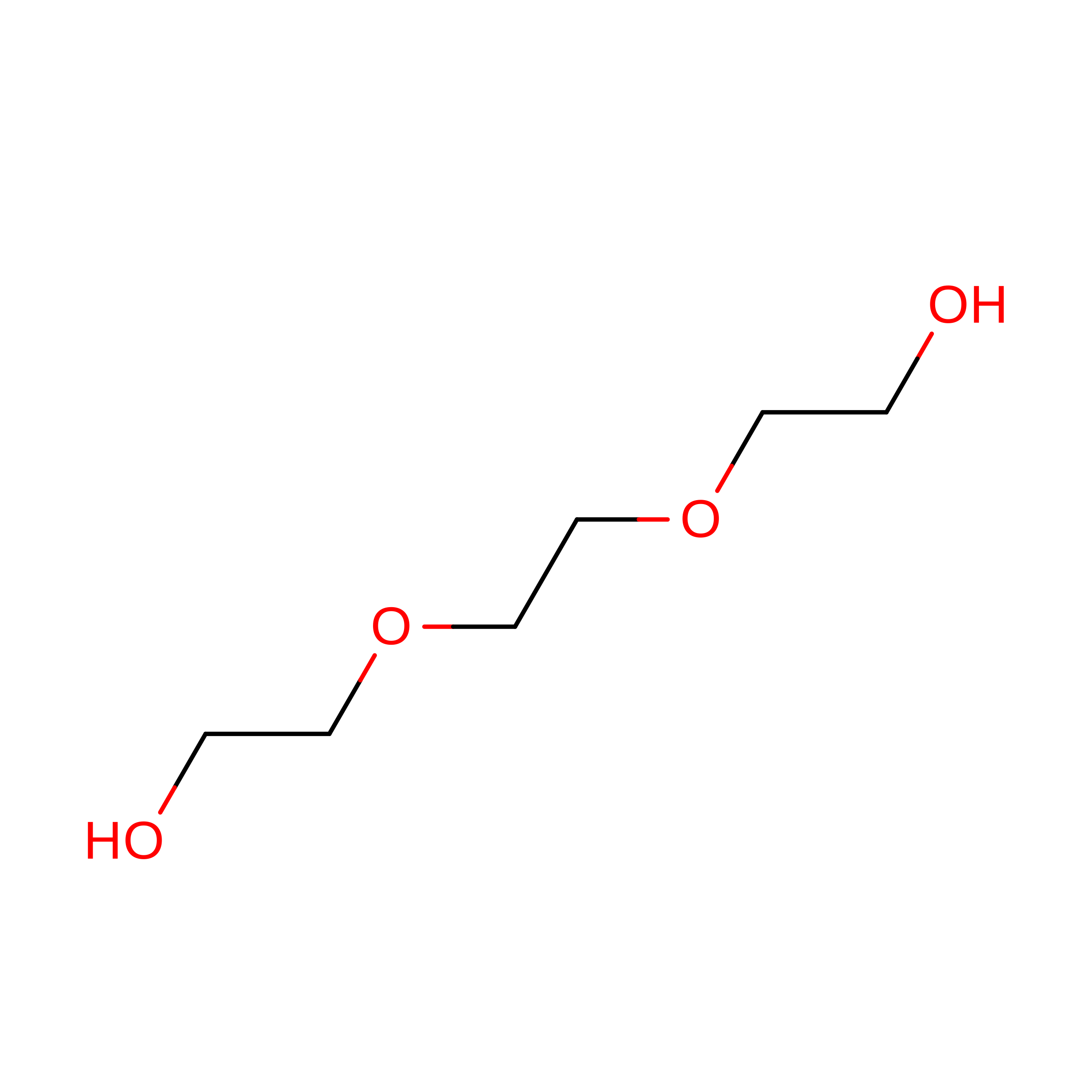
M [auth B]TRIETHYLENE GLYCOL
C6 H14 O4
ZIBGPFATKBEMQZ-UHFFFAOYSA-N
EDO

Query on EDO


Download:Ideal Coordinates CCD File
C [auth A]
D [auth A]
E [auth A]
F [auth A]
G [auth A]
C [auth A],
D [auth A],
E [auth A],
F [auth A],
G [auth A],
H [auth A],
I [auth A],
J [auth B],
K [auth B],
L [auth B]
1,2-ETHANEDIOL
C2 H6 O2
LYCAIKOWRPUZTN-UHFFFAOYSA-N

Experimental Data & Validation

Experimental Data

  • Method: X-RAY DIFFRACTION
  • Resolution: 1.21 Å
  • R-Value Free:  0.171 (Depositor), 0.172 (DCC) 
  • R-Value Work:  0.141 (Depositor), 0.143 (DCC) 
  • R-Value Observed: 0.142 (Depositor) 
Space Group: P 1 21 1
Unit Cell:
Length ( Å )Angle ( ˚ )
a = 36.25α = 90
b = 89.81β = 99.13
c = 44.27γ = 90
Software Package:
Software NamePurpose
PHENIXrefinement
XDSdata reduction
XSCALEdata scaling
PHASERphasing

Structure Validation

View Full Validation Report


Entry History 

& Funding Information

Deposition Data


Funding OrganizationLocationGrant Number
National Institutes of Health/National Institute Of Allergy and Infectious Diseases (NIH/NIAID)United StatesR01-AI51321

Revision History  (Full details and data files)

  • Version 1.0: 2019-06-05
    Type: Initial release
  • Version 1.1: 2019-06-12
    Changes: Data collection, Database references
  • Version 1.2: 2019-12-18
    Changes: Author supporting evidence
  • Version 1.3: 2024-03-13
    Changes: Data collection, Database references
  • Version 1.4: 2024-04-03
    Changes: Refinement description