6MIL | pdb_00006mil

Crystal structure of AF9 YEATS domain in complex with histone H3K9bu


Experimental Data Snapshot

  • Method: X-RAY DIFFRACTION
  • Resolution: 1.93 Å
  • R-Value Free: 
    0.236 (Depositor), 0.231 (DCC) 
  • R-Value Work: 
    0.183 (Depositor), 0.182 (DCC) 
  • R-Value Observed: 
    0.187 (Depositor) 

Starting Model: experimental
View more details

wwPDB Validation 3D Report Full Report

Validation slider image for 6MIL

This is version 1.1 of the entry. See complete history

Literature

Structural insights into the pi-pi-pi stacking mechanism and DNA-binding activity of the YEATS domain.

Klein, B.J.Vann, K.R.Andrews, F.H.Wang, W.W.Zhang, J.Zhang, Y.Beloglazkina, A.A.Mi, W.Li, Y.Li, H.Shi, X.Kutateladze, A.G.Strahl, B.D.Liu, W.R.Kutateladze, T.G.

(2018) Nat Commun 9: 4574-4574

  • DOI: https://doi.org/10.1038/s41467-018-07072-6
  • Primary Citation Related Structures: 
    6MIL, 6MIM, 6MIN, 6MIO, 6MIP, 6MIQ

  • PubMed Abstract: 

    The YEATS domain has been identified as a reader of histone acylation and more recently emerged as a promising anti-cancer therapeutic target. Here, we detail the structural mechanisms for π-π-π stacking involving the YEATS domains of yeast Taf14 and human AF9 and acylated histone H3 peptides and explore DNA-binding activities of these domains. Taf14-YEATS selects for crotonyllysine, forming π stacking with both the crotonyl amide and the alkene moiety, whereas AF9-YEATS exhibits comparable affinities to saturated and unsaturated acyllysines, engaging them through π stacking with the acyl amide. Importantly, AF9-YEATS is capable of binding to DNA, whereas Taf14-YEATS is not. Using a structure-guided approach, we engineered a mutant of Taf14-YEATS that engages crotonyllysine through the aromatic-aliphatic-aromatic π stacking and shows high selectivity for the crotonyl H3K9 modification. Our findings shed light on the molecular principles underlying recognition of acyllysine marks and reveal a previously unidentified DNA-binding activity of AF9-YEATS.


  • Organizational Affiliation
    • Department of Pharmacology, University of Colorado School of Medicine, Aurora, CO, 80045, USA.

Macromolecule Content 

  • Total Structure Weight: 37.72 kDa 
  • Atom Count: 2,814 
  • Modeled Residue Count: 291 
  • Deposited Residue Count: 320 
  • Unique protein chains: 2

Macromolecules

Find similar proteins by:|  3D Structure
Entity ID: 1
MoleculeChains  Sequence LengthOrganismDetailsImage
Protein AF-9
A, C
141Homo sapiensMutation(s): 0 
Gene Names: MLLT3AF9YEATS3
UniProt & NIH Common Fund Data Resources
Find proteins for P42568 (Homo sapiens)
Explore P42568 
Go to UniProtKB:  P42568
PHAROS:  P42568
GTEx:  ENSG00000171843 
Entity Groups
Sequence Clusters30% Identity50% Identity70% Identity90% Identity95% Identity100% Identity
UniProt GroupP42568
Sequence Annotations
Expand
Reference Sequence
Find similar proteins by:  Sequence   |   3D Structure  
Entity ID: 2
MoleculeChains  Sequence LengthOrganismDetailsImage
Histone H3K9bu
B, D
19Homo sapiensMutation(s): 0 
UniProt & NIH Common Fund Data Resources
Find proteins for P68431 (Homo sapiens)
Explore P68431 
Go to UniProtKB:  P68431
Entity Groups
Sequence Clusters30% Identity50% Identity70% Identity90% Identity95% Identity100% Identity
UniProt GroupP68431
Sequence Annotations
Expand
Reference Sequence

Small Molecules

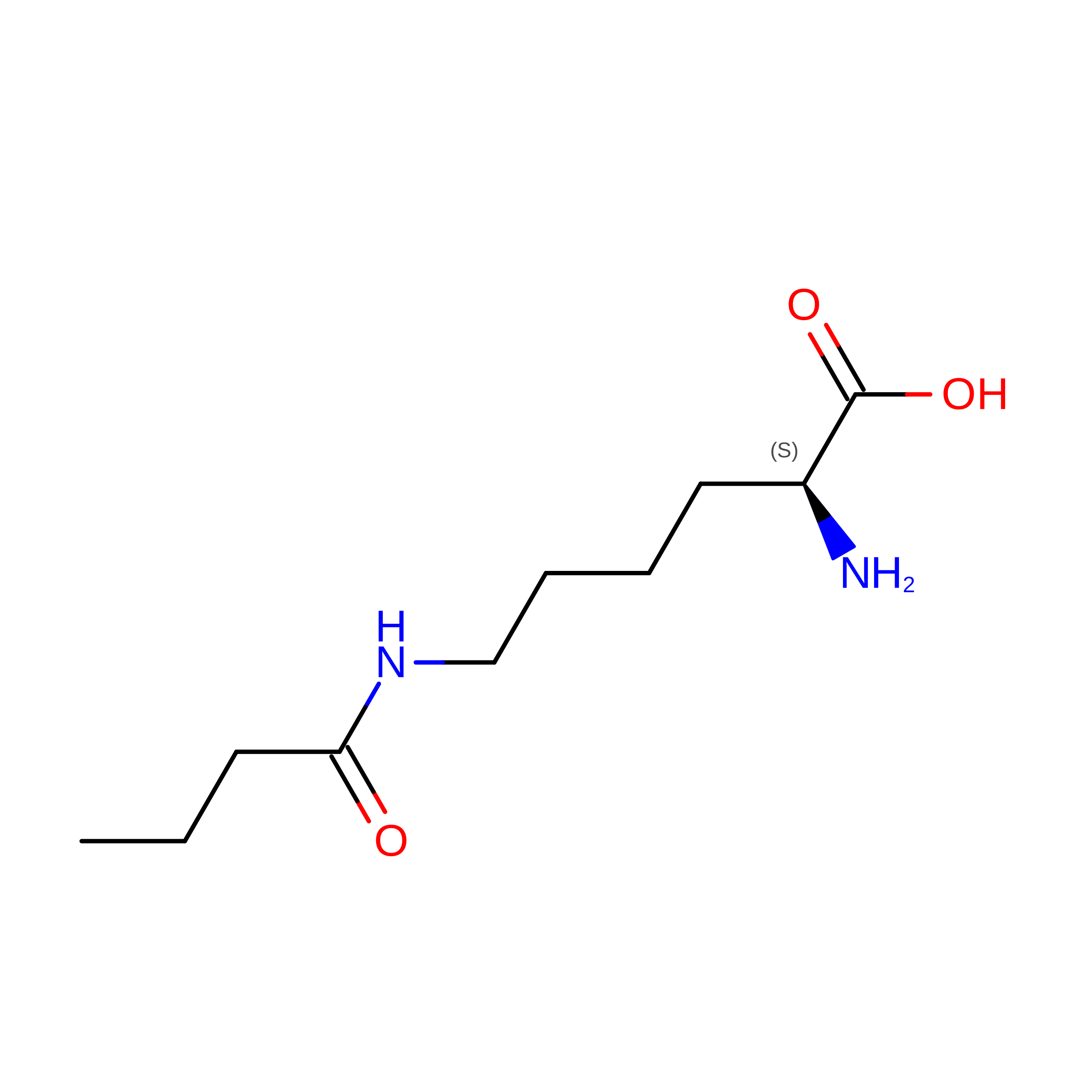
Modified Residues  1 Unique
IDChains TypeFormula2D DiagramParent
BTK
Query on BTK
B, D
L-PEPTIDE LINKINGC10 H20 N2 O3LYS

Experimental Data & Validation

Experimental Data

  • Method: X-RAY DIFFRACTION
  • Resolution: 1.93 Å
  • R-Value Free:  0.236 (Depositor), 0.231 (DCC) 
  • R-Value Work:  0.183 (Depositor), 0.182 (DCC) 
  • R-Value Observed: 0.187 (Depositor) 
Space Group: C 1 2 1
Unit Cell:
Length ( Å )Angle ( ˚ )
a = 123.989α = 90
b = 44.913β = 95.54
c = 70.804γ = 90
Software Package:
Software NamePurpose
PHENIXrefinement
HKL-3000data reduction
HKL-3000data scaling
PHASERphasing

Structure Validation

View Full Validation Report


Entry History 

Deposition Data

Revision History  (Full details and data files)

  • Version 1.0: 2018-11-14
    Type: Initial release
  • Version 1.1: 2023-10-11
    Changes: Data collection, Database references, Refinement description