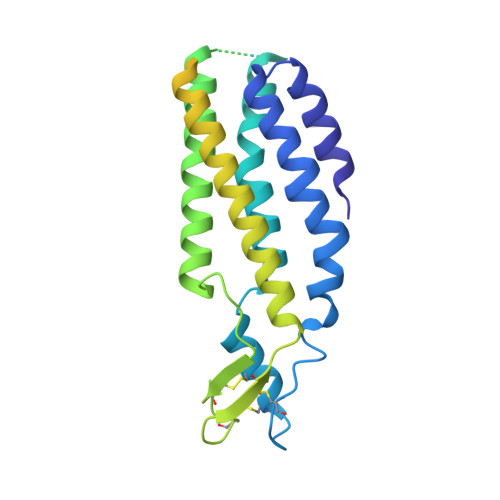
6MHQ | pdb_00006mhq

Structure of connexin-46 intercellular gap junction channel at 3.4 angstrom resolution by cryoEM


Experimental Data Snapshot

  • Method: ELECTRON MICROSCOPY
  • Resolution: 3.40 Å
  • Aggregation State: PARTICLE 
  • Reconstruction Method: SINGLE PARTICLE 

Starting Model: experimental
View more details

wwPDB Validation 3D Report Full Report

Validation slider image for 6MHQ

This is version 1.4 of the entry. See complete history

Literature

Structure of native lens connexin 46/50 intercellular channels by cryo-EM.

Myers, J.B.Haddad, B.G.O'Neill, S.E.Chorev, D.S.Yoshioka, C.C.Robinson, C.V.Zuckerman, D.M.Reichow, S.L.

(2018) Nature 564: 372-377

  • DOI: https://doi.org/10.1038/s41586-018-0786-7
  • Primary Citation Related Structures: 
    6MHQ, 6MHY

  • PubMed Abstract: 

    Gap junctions establish direct pathways for cell-to-cell communication through the assembly of twelve connexin subunits that form intercellular channels connecting neighbouring cells. Co-assembly of different connexin isoforms produces channels with unique properties and enables communication across cell types. Here we used single-particle cryo-electron microscopy to investigate the structural basis of connexin co-assembly in native lens gap junction channels composed of connexin 46 and connexin 50 (Cx46/50). We provide the first comparative analysis to connexin 26 (Cx26), which-together with computational studies-elucidates key energetic features governing gap junction permselectivity. Cx46/50 adopts an open-state conformation that is distinct from the Cx26 crystal structure, yet it appears to be stabilized by a conserved set of hydrophobic anchoring residues. 'Hot spots' of genetic mutations linked to hereditary cataract formation map to the core structural-functional elements identified in Cx46/50, suggesting explanations for many of the disease-causing effects.


  • Organizational Affiliation
    • Department of Chemistry, Portland State University, Portland, OR, USA.

Macromolecule Content 

  • Total Structure Weight: 455.62 kDa 
  • Atom Count: 17,376 
  • Modeled Residue Count: 2,124 
  • Deposited Residue Count: 4,176 
  • Unique protein chains: 1

Macromolecules

Find similar proteins by:|  3D Structure
Entity ID: 1
MoleculeChains  Sequence LengthOrganismDetailsImage
Gap junction alpha-3 protein, connexin-46
A, B, C, D, E
A, B, C, D, E, F, G, H, I, J, K, L
348Ovis ariesMutation(s): 0 
Membrane Entity: Yes 
UniProt
Find proteins for Q9TU17 (Ovis aries)
Explore Q9TU17 
Go to UniProtKB:  Q9TU17
Entity Groups
Sequence Clusters30% Identity50% Identity70% Identity90% Identity95% Identity100% Identity
UniProt GroupQ9TU17
Sequence Annotations
Expand
Reference Sequence

Experimental Data & Validation

Experimental Data

  • Method: ELECTRON MICROSCOPY
  • Resolution: 3.40 Å
  • Aggregation State: PARTICLE 
  • Reconstruction Method: SINGLE PARTICLE 
EM Software:
TaskSoftware PackageVersion
RECONSTRUCTIONRELION2
MODEL REFINEMENTPHENIX1.13

Structure Validation

View Full Validation Report


Entry History 

& Funding Information

Deposition Data


Funding OrganizationLocationGrant Number
National Institutes of Health/National Institute of General Medical Sciences (NIH/NIGMS)United StatesR35-GM124779

Revision History  (Full details and data files)

  • Version 1.0: 2018-12-12
    Type: Initial release
  • Version 1.1: 2018-12-26
    Changes: Data collection, Database references, Structure summary
  • Version 1.2: 2019-01-02
    Changes: Data collection, Database references
  • Version 1.3: 2019-12-18
    Changes: Author supporting evidence, Other
  • Version 1.4: 2024-11-20
    Changes: Data collection, Database references, Refinement description, Structure summary