6MHF | pdb_00006mhf

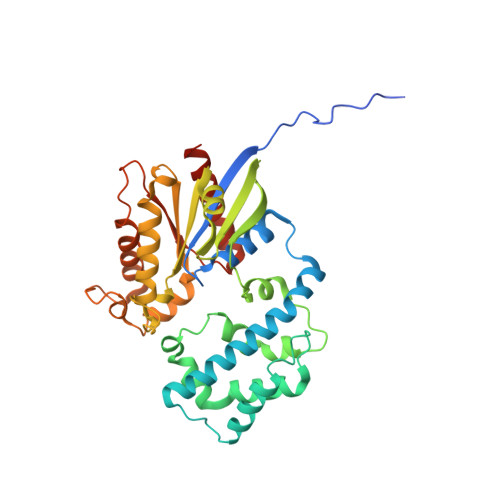
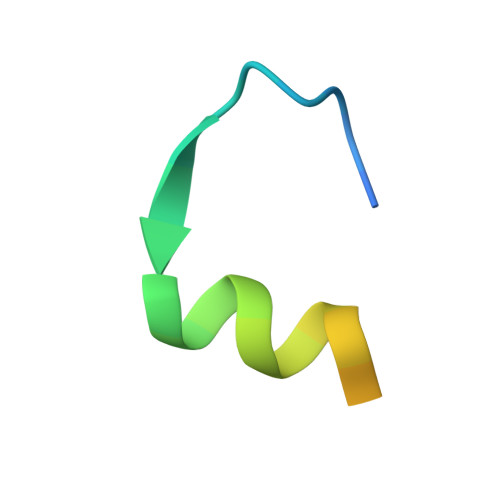
Galphai3 co-crystallized with GIV/Girdin


Experimental Data Snapshot

  • Method: X-RAY DIFFRACTION
  • Resolution: 2.00 Å
  • R-Value Free: 
    0.239 (Depositor), 0.240 (DCC) 
  • R-Value Work: 
    0.206 (Depositor), 0.207 (DCC) 
  • R-Value Observed: 
    0.208 (Depositor) 

Starting Model: experimental
View more details

wwPDB Validation 3D Report Full Report

Validation slider image for 6MHF

Ligand Structure Quality Assessment 


This is version 1.4 of the entry. See complete history

Literature

Structural basis for GPCR-independent activation of heterotrimeric Gi proteins.

Kalogriopoulos, N.A.Rees, S.D.Ngo, T.Kopcho, N.J.Ilatovskiy, A.V.Sun, N.Komives, E.A.Chang, G.Ghosh, P.Kufareva, I.

(2019) Proc Natl Acad Sci U S A 116: 16394-16403

  • DOI: https://doi.org/10.1073/pnas.1906658116
  • Primary Citation Related Structures: 
    6MHE, 6MHF

  • PubMed Abstract: 

    Heterotrimeric G proteins are key molecular switches that control cell behavior. The canonical activation of G proteins by agonist-occupied G protein-coupled receptors (GPCRs) has recently been elucidated from the structural perspective. In contrast, the structural basis for GPCR-independent G protein activation by a novel family of guanine-nucleotide exchange modulators (GEMs) remains unknown. Here, we present a 2.0-Å crystal structure of Gαi in complex with the GEM motif of GIV/Girdin. Nucleotide exchange assays, molecular dynamics simulations, and hydrogen-deuterium exchange experiments demonstrate that GEM binding to the conformational switch II causes structural changes that allosterically propagate to the hydrophobic core of the Gαi GTPase domain. Rearrangement of the hydrophobic core appears to be a common mechanism by which GPCRs and GEMs activate G proteins, although with different efficiency. Atomic-level insights presented here will aid structure-based efforts to selectively target the noncanonical G protein activation.


  • Organizational Affiliation
    • Department of Medicine, University of California San Diego, La Jolla, CA 92093.

Macromolecule Content 

  • Total Structure Weight: 43.91 kDa 
  • Atom Count: 3,022 
  • Modeled Residue Count: 348 
  • Deposited Residue Count: 381 
  • Unique protein chains: 2

Macromolecules

Find similar proteins by:|  3D Structure
Entity ID: 1
MoleculeChains  Sequence LengthOrganismDetailsImage
Guanine nucleotide-binding protein G(k) subunit alpha350Rattus norvegicusMutation(s): 0 
Gene Names: Gnai3Gnai-3
UniProt
Find proteins for P08753 (Rattus norvegicus)
Explore P08753 
Go to UniProtKB:  P08753
Entity Groups
Sequence Clusters30% Identity50% Identity70% Identity90% Identity95% Identity100% Identity
UniProt GroupP08753
Sequence Annotations
Expand
Reference Sequence
Find similar proteins by:|  3D Structure
Entity ID: 2
MoleculeChains  Sequence LengthOrganismDetailsImage
GirdinB [auth C]31Homo sapiensMutation(s): 0 
UniProt & NIH Common Fund Data Resources
Find proteins for Q3V6T2 (Homo sapiens)
Explore Q3V6T2 
Go to UniProtKB:  Q3V6T2
PHAROS:  Q3V6T2
GTEx:  ENSG00000115355 
Entity Groups
Sequence Clusters30% Identity50% Identity70% Identity90% Identity95% Identity100% Identity
UniProt GroupQ3V6T2
Sequence Annotations
Expand
Reference Sequence

Small Molecules

Experimental Data & Validation

Experimental Data

  • Method: X-RAY DIFFRACTION
  • Resolution: 2.00 Å
  • R-Value Free:  0.239 (Depositor), 0.240 (DCC) 
  • R-Value Work:  0.206 (Depositor), 0.207 (DCC) 
  • R-Value Observed: 0.208 (Depositor) 
Space Group: P 43 21 2
Unit Cell:
Length ( Å )Angle ( ˚ )
a = 83.78α = 90
b = 83.78β = 90
c = 141.37γ = 90
Software Package:
Software NamePurpose
PHENIXrefinement
BOSdata collection
MOSFLMdata reduction
Aimlessdata scaling
PHENIXphasing

Structure Validation

View Full Validation Report


Ligand Structure Quality Assessment 


Entry History 

& Funding Information

Deposition Data


Funding OrganizationLocationGrant Number
National Science Foundation (NSF, United States)United StatesNSF/IOS-1444435

Revision History  (Full details and data files)

  • Version 1.0: 2019-07-31
    Type: Initial release
  • Version 1.1: 2019-08-14
    Changes: Data collection, Database references
  • Version 1.2: 2019-08-28
    Changes: Data collection, Database references
  • Version 1.3: 2019-11-27
    Changes: Author supporting evidence
  • Version 1.4: 2023-10-11
    Changes: Data collection, Database references, Refinement description