6LNP | pdb_00006lnp

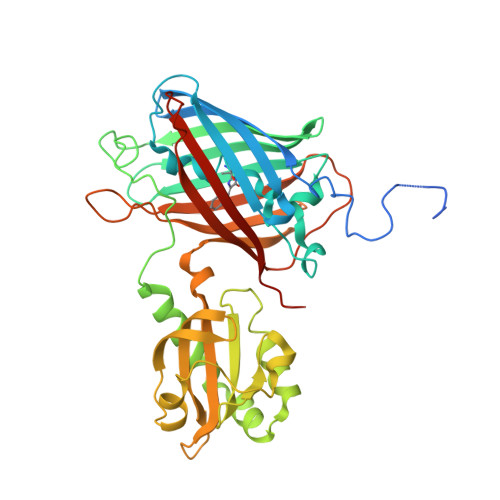
Crystal structure of citrate Biosensor


Experimental Data Snapshot

  • Method: X-RAY DIFFRACTION
  • Resolution: 2.99 Å
  • R-Value Free: 
    0.282 (Depositor), 0.281 (DCC) 
  • R-Value Work: 
    0.223 (Depositor), 0.226 (DCC) 
  • R-Value Observed: 
    0.229 (Depositor) 

Starting Model: experimental
View more details

wwPDB Validation 3D Report Full Report

Validation slider image for 6LNP

Ligand Structure Quality Assessment 


This is version 2.0 of the entry. See complete history

Literature

High-Performance Intensiometric Direct- and Inverse-Response Genetically Encoded Biosensors for Citrate.

Zhao, Y.Shen, Y.Wen, Y.Campbell, R.E.

(2020) ACS Cent Sci 6: 1441-1450

  • DOI: https://doi.org/10.1021/acscentsci.0c00518
  • Primary Citation Related Structures: 
    6LNP

  • PubMed Abstract: 

    Motivated by the growing recognition of citrate as a central metabolite in a variety of biological processes associated with healthy and diseased cellular states, we have developed a series of high-performance genetically encoded citrate biosensors suitable for imaging of citrate concentrations in mammalian cells. The design of these biosensors was guided by structural studies of the citrate-responsive sensor histidine kinase and took advantage of the same conformational changes proposed to propagate from the binding domain to the catalytic domain. Following extensive engineering based on a combination of structure guided mutagenesis and directed evolution, we produced an inverse-response biosensor (Δ F / F min ≈ 18) designated Citroff1 and a direct-response biosensor (Δ F / F min ≈ 9) designated Citron1. We report the X-ray crystal structure of Citron1 and demonstrate the utility of both biosensors for qualitative and quantitative imaging of steady-state and pharmacologically perturbed citrate concentrations in live cells.


  • Organizational Affiliation
    • Department of Chemistry, University of Alberta, Edmonton, Alberta T6G 2G2, Canada.

Macromolecule Content 

  • Total Structure Weight: 90.13 kDa 
  • Atom Count: 5,578 
  • Modeled Residue Count: 733 
  • Deposited Residue Count: 806 
  • Unique protein chains: 1

Macromolecules

Find similar proteins by:|  3D Structure
Entity ID: 1
MoleculeChains  Sequence LengthOrganismDetailsImage
Fusion protein of Green fluorescent protein and Sensor histidine kinase CitAA [auth B],
B [auth D]
403Aequorea victoriaKlebsiella pneumoniaeMutation(s): 0 
EC: 2.7.13.3
UniProt
Find proteins for P42212 (Aequorea victoria)
Explore P42212 
Go to UniProtKB:  P42212
Find proteins for P52687 (Klebsiella pneumoniae)
Explore P52687 
Go to UniProtKB:  P52687
Entity Groups
Sequence Clusters30% Identity50% Identity70% Identity90% Identity95% Identity100% Identity
UniProt GroupsP42212P52687
Sequence Annotations
Expand
Reference Sequence

Small Molecules

Modified Residues  1 Unique
IDChains TypeFormula2D DiagramParent
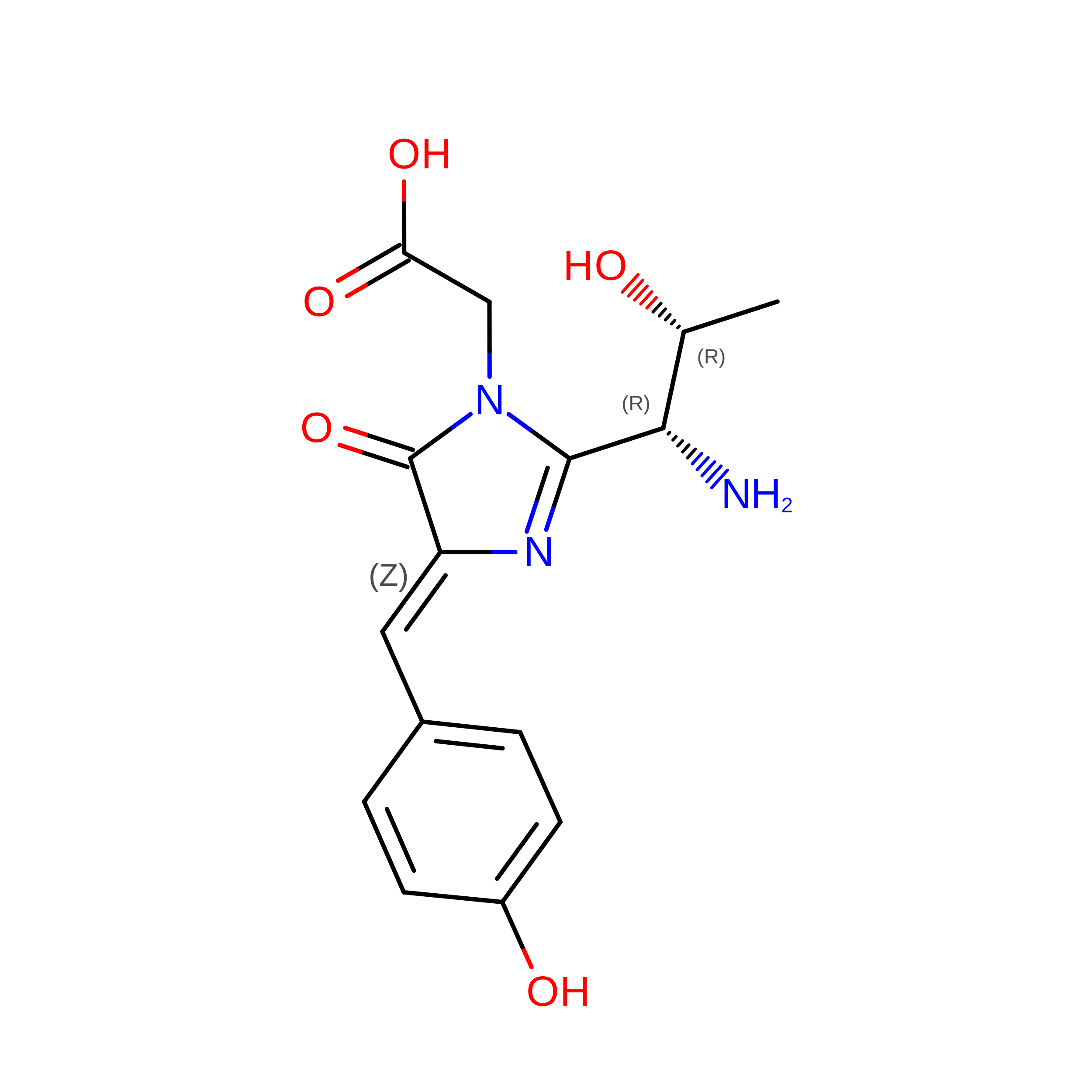
CRO
Query on CRO
A [auth B],
B [auth D]
L-PEPTIDE LINKINGC15 H17 N3 O5THR, TYR, GLY

Experimental Data & Validation

Experimental Data

  • Method: X-RAY DIFFRACTION
  • Resolution: 2.99 Å
  • R-Value Free:  0.282 (Depositor), 0.281 (DCC) 
  • R-Value Work:  0.223 (Depositor), 0.226 (DCC) 
  • R-Value Observed: 0.229 (Depositor) 
Space Group: P 41
Unit Cell:
Length ( Å )Angle ( ˚ )
a = 92.41α = 90
b = 92.41β = 90
c = 123.02γ = 90
Software Package:
Software NamePurpose
PHENIXrefinement
XSCALEdata scaling
PDB_EXTRACTdata extraction
XDSdata reduction
MOLREPphasing

Structure Validation

View Full Validation Report


Ligand Structure Quality Assessment 


Entry History 

& Funding Information

Deposition Data


Funding OrganizationLocationGrant Number
National Natural Science Foundation of China (NSFC)China31870132

Revision History  (Full details and data files)

  • Version 1.0: 2020-05-06
    Type: Initial release
  • Version 1.1: 2020-09-16
    Changes: Database references
  • Version 1.2: 2023-11-22
    Changes: Data collection, Database references, Refinement description
  • Version 1.3: 2024-10-09
    Changes: Structure summary
  • Version 2.0: 2026-03-18
    Changes: Polymer sequence