6KO0 | pdb_00006ko0

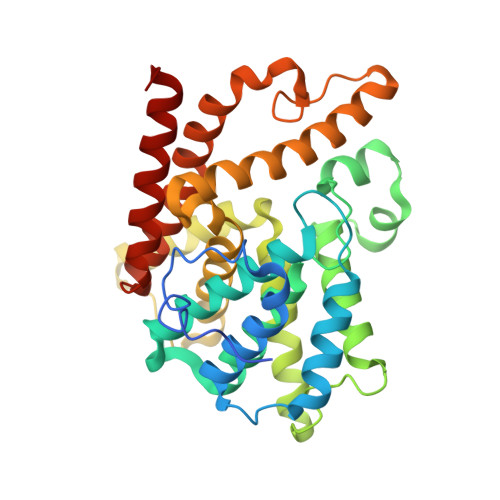
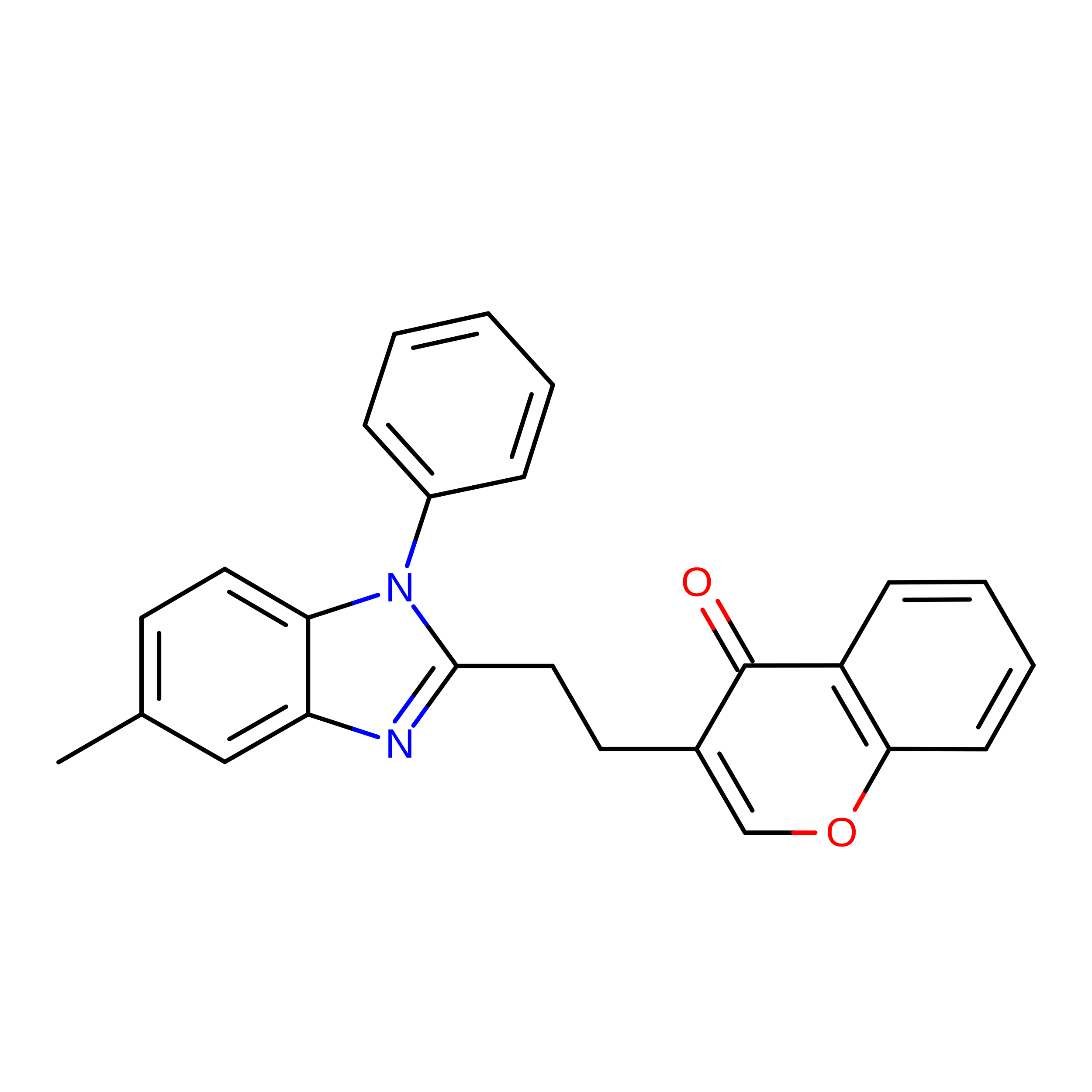
The crystal structue of PDE10A complexed with 1i


Experimental Data Snapshot

  • Method: X-RAY DIFFRACTION
  • Resolution: 2.60 Å
  • R-Value Free: 
    0.327 (Depositor), 0.327 (DCC) 
  • R-Value Work: 
    0.215 (Depositor), 0.218 (DCC) 
  • R-Value Observed: 
    0.220 (Depositor) 

Starting Model: experimental
View more details

wwPDB Validation 3D Report Full Report

Validation slider image for 6KO0

Ligand Structure Quality Assessment 


This is version 1.2 of the entry. See complete history

Literature

Discovery and Optimization of Chromone Derivatives as Novel Selective Phosphodiesterase 10 Inhibitors.

Yu, Y.F.Zhang, C.Huang, Y.Y.Zhang, S.Zhou, Q.Li, X.Lai, Z.Li, Z.Gao, Y.Wu, Y.Guo, L.Wu, D.Luo, H.B.

(2020) ACS Chem Neurosci 11: 1058-1071

  • DOI: https://doi.org/10.1021/acschemneuro.0c00024
  • Primary Citation Related Structures: 
    6KO0, 6KO1

  • PubMed Abstract: 

    Phosphodiesterase 10 (PDE10) inhibitors have received much attention as promising therapeutic agents for central nervous system (CNS) disorders such as schizophrenia and Huntington's disease. Recently, a hit compound 1 with a novel chromone scaffold has shown moderate inhibitory activity against PDE10A (IC 50 = 500 nM). Hit-to-lead optimization has resulted in compound 3e with an improved inhibitory activity (IC 50 = 6.5 nM), remarkable selectivity (>95-fold over other PDEs), and good metabolic stability (RLM t 1/2 = 105 min) by using an integrated strategy (molecular modeling, chemical synthesis, bioassay, and cocrystal structure). The cocrystal structural information provides insights into the binding pattern of 3e in the PDE10A catalytic domain to highlight the key role of the halogen and hydrogen bonds toward Tyr524 and Tyr693, respectively, thereby resulting in high selectivity against other PDEs. These new observations are of benefit for the rational design of the next generation PDE10 inhibitors for CNS disorders.


  • Organizational Affiliation
    • School of Pharmaceutical Sciences, Sun Yat-sen University, Guangzhou 510006, China.

Macromolecule Content 

  • Total Structure Weight: 75.52 kDa 
  • Atom Count: 5,367 
  • Modeled Residue Count: 630 
  • Deposited Residue Count: 644 
  • Unique protein chains: 1

Macromolecules

Find similar proteins by:|  3D Structure
Entity ID: 1
MoleculeChains  Sequence LengthOrganismDetailsImage
cAMP and cAMP-inhibited cGMP 3',5'-cyclic phosphodiesterase 10A
A, B
322Homo sapiensMutation(s): 0 
Gene Names: PDE10A
EC: 3.1.4.17 (PDB Primary Data), 3.1.4.35 (PDB Primary Data)
UniProt & NIH Common Fund Data Resources
Find proteins for Q9Y233 (Homo sapiens)
Explore Q9Y233 
Go to UniProtKB:  Q9Y233
PHAROS:  Q9Y233
GTEx:  ENSG00000112541 
Entity Groups
Sequence Clusters30% Identity50% Identity70% Identity90% Identity95% Identity100% Identity
UniProt GroupQ9Y233
Sequence Annotations
Expand
Reference Sequence

Small Molecules

Experimental Data & Validation

Experimental Data

  • Method: X-RAY DIFFRACTION
  • Resolution: 2.60 Å
  • R-Value Free:  0.327 (Depositor), 0.327 (DCC) 
  • R-Value Work:  0.215 (Depositor), 0.218 (DCC) 
  • R-Value Observed: 0.220 (Depositor) 
Space Group: P 21 21 21
Unit Cell:
Length ( Å )Angle ( ˚ )
a = 49.213α = 90
b = 81.535β = 90
c = 161.375γ = 90
Software Package:
Software NamePurpose
PHENIXrefinement
CrysalisProdata reduction
CrysalisProdata scaling
PHASERphasing

Structure Validation

View Full Validation Report


Ligand Structure Quality Assessment 


Entry History 

& Funding Information

Deposition Data


Funding OrganizationLocationGrant Number
National Natural Science Foundation of ChinaChina81872727
National Natural Science Foundation of ChinaChina81602955
National Natural Science Foundation of ChinaChina21702238
National Natural Science Foundation of ChinaChina21708052
National Natural Science Foundation of ChinaChina81703341

Revision History  (Full details and data files)

  • Version 1.0: 2020-04-01
    Type: Initial release
  • Version 1.1: 2020-04-15
    Changes: Database references
  • Version 1.2: 2023-11-22
    Changes: Data collection, Database references, Derived calculations, Refinement description