Download Mendeley
Structural basis for stabilization of human telomeric G-quadruplex [d-(TTAGGGT)] 4 by anticancer drug adriamycin.
Barthwal, R., Raje, S., Pandav, K.(2021) J Biomol Struct Dyn 39: 795-815
- PubMed: 32070245 Search on PubMed
- DOI: https://doi.org/10.1080/07391102.2020.1730969
- Primary Citation Related Structures:
6KN4 - PubMed Abstract:
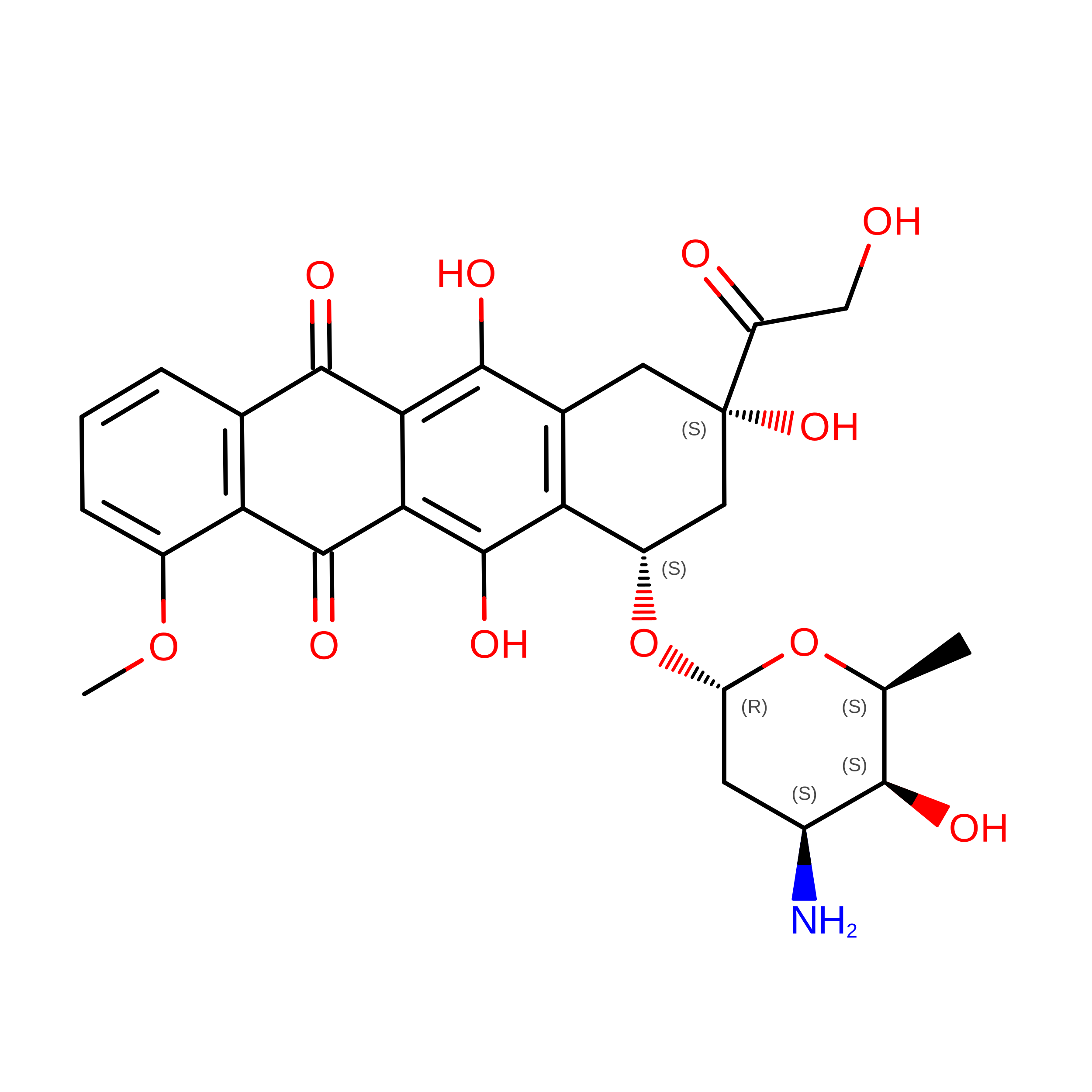
Besides inhibiting DNA duplication, DNA dependent RNA synthesis and topoisomerase-II enzyme action, anticancer drug adriamycin is found to cause telomere dysfunction and shows multiple strategies of action on gene functioning. We present evidence of binding of adriamycin to parallel stranded intermolecular [d-(TTAGGGT)] 4 G-quadruplex DNA comprising human telomeric DNA by proton and phosphorus-31 nuclear magnetic resonance spectroscopy. Diffusion ordered spectroscopy shows formation of complex between the two molecules. Changes in chemical shift and line broadening of DNA and adriamycin protons suggest participation of specific chemical groups/moieties in interaction. Presence of sequential nuclear Overhauser enhancements at all base quartet steps and absence of large downfield shifts in 31 P resonances give clear proof of absence of intercalation of adriamycin chromophore between base quartets. Restrained molecular dynamics simulations using observed 15 short intermolecular inter proton distance contacts depict stacking of ring D of adriamycin with terminal G6 quartet by displacing T7 base and external groove binding close to T1-T2-A3 bases. The disappearance of imino protons monitored as a function of temperature and differential scanning calorimetry experiments yield thermal stabilization of 24 °C, which is likely to come in the way of telomerase association with telomeres. The findings pave the way for design of alternate anthracycline based drugs with specific modifications at ring D to enhance induced thermal stabilization and use alternate mechanism of binding to G-quadruplex DNA for interference in functional pathway of telomere maintenance by telomerase enzyme besides their well known action on duplex DNA. Communicated by Ramaswamy H. Sarma.
- Department of Biotechnology, Indian Institute of Technology Roorkee, Roorkee, India.
Organizational Affiliation: