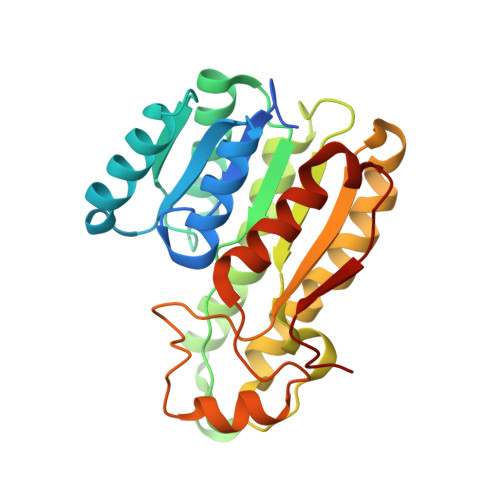
6J7H | pdb_00006j7h

Crystal structure of blue fluorescent protein from metagenomic library


Experimental Data Snapshot

  • Method: X-RAY DIFFRACTION
  • Resolution: 2.31 Å
  • R-Value Free: 
    0.256 (Depositor), 0.257 (DCC) 
  • R-Value Work: 
    0.205 (Depositor), 0.206 (DCC) 
  • R-Value Observed: 
    0.207 (Depositor) 

Starting Model: experimental
View more details

wwPDB Validation 3D Report Full Report

Validation slider image for 6J7H

This is version 1.1 of the entry. See complete history

Literature

Structure-Guided Generation of a Redox-Independent Blue Fluorescent Protein from mBFP.

Seo, P.W.Jo, E.S.You, S.H.Cheong, D.E.Kim, G.J.Kim, J.S.

(2019) J Mol Biology 431: 3191-3202

  • DOI: https://doi.org/10.1016/j.jmb.2019.06.005
  • Primary Citation Related Structures: 
    6J7H, 6J7U

  • PubMed Abstract: 

    Fluorescent proteins, such as the green fluorescent protein, are used for detection of cellular components and events. However, green fluorescent protein and its derivatives have limited usage under anaerobic conditions and require a long maturation time. On the other hand, the NADPH-dependent blue fluorescent protein (BFP) without oxidative modification of residues is instantly functional in both aerobic and anaerobic systems. BFP proteins belong to a short-chain dehydrogenase/reductase (SDR) protein family, and their fluorescent property changes with reaction time in the presence of a substrate. With the aim of developing a better fluorescent reporter independent of redox state, we elucidated the crystal structure of a tetrameric mBFP from soil metagenomes with and without NADPH. Apart from the previously known regions, structure-guided mutational studies have identified several residues that contribute to the fluorescence of mBFP, including two aromatic residues (F97 and Y157) near the nicotinamide moiety of the bound NADPH. A single histidine mutation at Y157 (Y157H) has conferred more stabilized, time-independent fluorescence even in the presence of substrates. Furthermore, we discovered another SDR protein that can also emit blue fluorescence. These results open a new possibility for the development of BFP as a stable cellular reporter for widespread use, independent of subcellular environments.


  • Organizational Affiliation
    • Department of Chemistry, Chonnam National University, Gwangju 61186, Republic of Korea.

Macromolecule Content 

  • Total Structure Weight: 107.53 kDa 
  • Atom Count: 7,364 
  • Modeled Residue Count: 987 
  • Deposited Residue Count: 1,044 
  • Unique protein chains: 1

Macromolecules

Find similar proteins by:|  3D Structure
Entity ID: 1
MoleculeChains  Sequence LengthOrganismDetailsImage
Blue fluorescent protein
A, B, C, D
261uncultured bacteriumMutation(s): 0 
EC: 1.2.4.4
UniProt
Find proteins for A0ACD6B8H7 (uncultured bacterium)
Explore A0ACD6B8H7 
Go to UniProtKB:  A0ACD6B8H7
Entity Groups
Sequence Clusters30% Identity50% Identity70% Identity90% Identity95% Identity100% Identity
UniProt GroupA0ACD6B8H7
Sequence Annotations
Expand
Reference Sequence

Experimental Data & Validation

Experimental Data

  • Method: X-RAY DIFFRACTION
  • Resolution: 2.31 Å
  • R-Value Free:  0.256 (Depositor), 0.257 (DCC) 
  • R-Value Work:  0.205 (Depositor), 0.206 (DCC) 
  • R-Value Observed: 0.207 (Depositor) 
Space Group: P 21 21 21
Unit Cell:
Length ( Å )Angle ( ˚ )
a = 56.281α = 90
b = 90.564β = 90
c = 171.526γ = 90
Software Package:
Software NamePurpose
PHENIXrefinement
HKL-2000data reduction
HKL-2000data scaling
PHENIXphasing

Structure Validation

View Full Validation Report


Entry History 

& Funding Information

Deposition Data


Funding OrganizationLocationGrant Number
National Research Foundation (Korea)Korea, Republic Of--

Revision History  (Full details and data files)

  • Version 1.0: 2019-09-18
    Type: Initial release
  • Version 1.1: 2023-11-22
    Changes: Data collection, Database references, Refinement description