6J1M | pdb_00006j1m

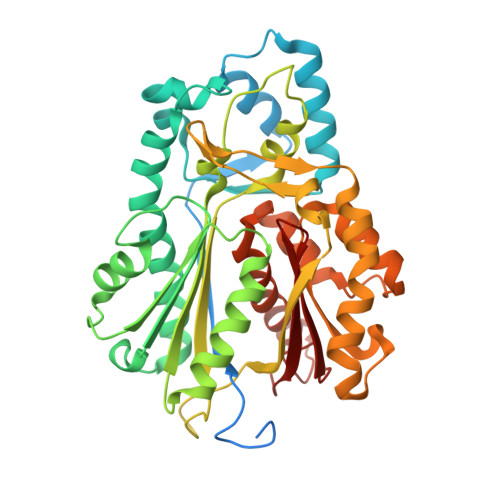
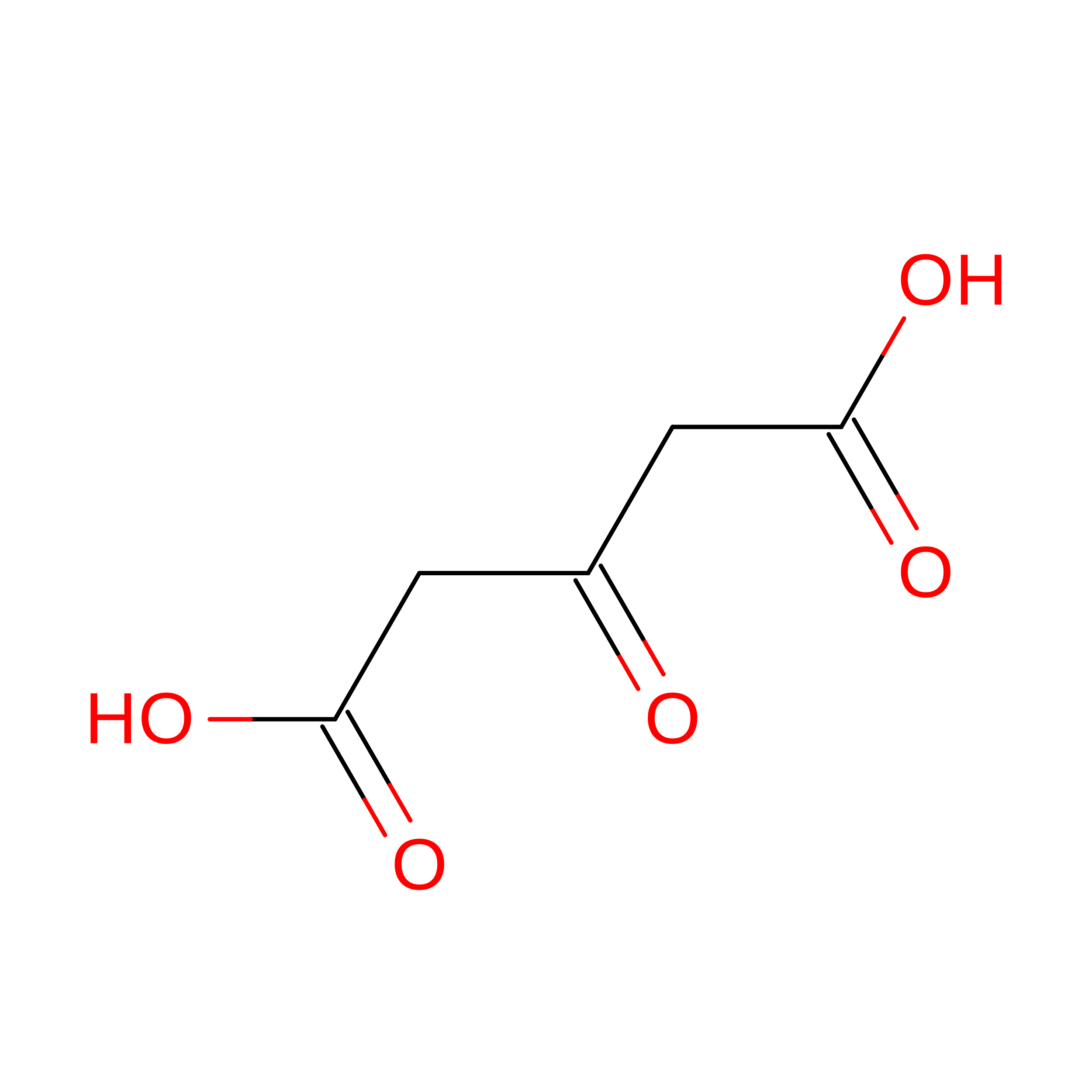
Anisodus acutangulus type III polyketide sythase AaPKS2 in complex with 4-carboxy-3-oxobutanoyl covalent to C166


Experimental Data Snapshot

  • Method: X-RAY DIFFRACTION
  • Resolution: 2.00 Å
  • R-Value Free: 
    0.194 (Depositor), 0.194 (DCC) 
  • R-Value Work: 
    0.180 (Depositor), 0.181 (DCC) 
  • R-Value Observed: 
    0.181 (Depositor) 

Starting Model: experimental
View more details

wwPDB Validation 3D Report Full Report

Validation slider image for 6J1M

This is version 1.3 of the entry. See complete history

Literature

Tropane alkaloids biosynthesis involves an unusual type III polyketide synthase and non-enzymatic condensation.

Huang, J.P.Fang, C.Ma, X.Wang, L.Yang, J.Luo, J.Yan, Y.Zhang, Y.Huang, S.X.

(2019) Nat Commun 10: 4036-4036

  • DOI: https://doi.org/10.1038/s41467-019-11987-z
  • Primary Citation Related Structures: 
    6J1M, 6J1N

  • PubMed Abstract: 

    The skeleton of tropane alkaloids is derived from ornithine-derived N-methylpyrrolinium and two malonyl-CoA units. The enzymatic mechanism that connects N-methylpyrrolinium and malonyl-CoA units remains unknown. Here, we report the characterization of three pyrrolidine ketide synthases (PYKS), AaPYKS, DsPYKS, and AbPYKS, from three different hyoscyamine- and scopolamine-producing plants. By examining the crystal structure and biochemical activity of AaPYKS, we show that the reaction mechanism involves PYKS-mediated malonyl-CoA condensation to generate a 3-oxo-glutaric acid intermediate that can undergo non-enzymatic Mannich-like condensation with N-methylpyrrolinium to yield the racemic 4-(1-methyl-2-pyrrolidinyl)-3-oxobutanoic acid. This study therefore provides a long sought-after biosynthetic mechanism to explain condensation between N-methylpyrrolinium and acetate units and, more importantly, identifies an unusual plant type III polyketide synthase that can only catalyze one round of malonyl-CoA condensation.


  • Organizational Affiliation
    • State Key Laboratory of Phytochemistry and Plant Resources in West China, and CAS Center for Excellence in Molecular Plant Sciences, Kunming Institute of Botany, Chinese Academy of Sciences, Kunming, 650201, China.

Macromolecule Content 

  • Total Structure Weight: 93.99 kDa 
  • Atom Count: 6,466 
  • Modeled Residue Count: 757 
  • Deposited Residue Count: 854 
  • Unique protein chains: 1

Macromolecules

Find similar proteins by:|  3D Structure
Entity ID: 1
MoleculeChains  Sequence LengthOrganismDetailsImage
A. acutangulus PKS2
A, B
427Anisodus acutangulusMutation(s): 0 

Experimental Data & Validation

Experimental Data

  • Method: X-RAY DIFFRACTION
  • Resolution: 2.00 Å
  • R-Value Free:  0.194 (Depositor), 0.194 (DCC) 
  • R-Value Work:  0.180 (Depositor), 0.181 (DCC) 
  • R-Value Observed: 0.181 (Depositor) 
Space Group: P 32 2 1
Unit Cell:
Length ( Å )Angle ( ˚ )
a = 108.144α = 90
b = 108.144β = 90
c = 191.075γ = 120
Software Package:
Software NamePurpose
PHENIXrefinement
HKL-2000data scaling
PDB_EXTRACTdata extraction
HKL-2000data reduction
MoRDaphasing

Structure Validation

View Full Validation Report


Entry History 

& Funding Information

Deposition Data


Funding OrganizationLocationGrant Number
China--

Revision History  (Full details and data files)

  • Version 1.0: 2019-09-11
    Type: Initial release
  • Version 1.1: 2019-09-25
    Changes: Data collection, Database references
  • Version 1.2: 2023-11-22
    Changes: Data collection, Database references, Refinement description
  • Version 1.3: 2025-09-17
    Changes: Advisory, Derived calculations, Structure summary