6IF7 | pdb_00006if7

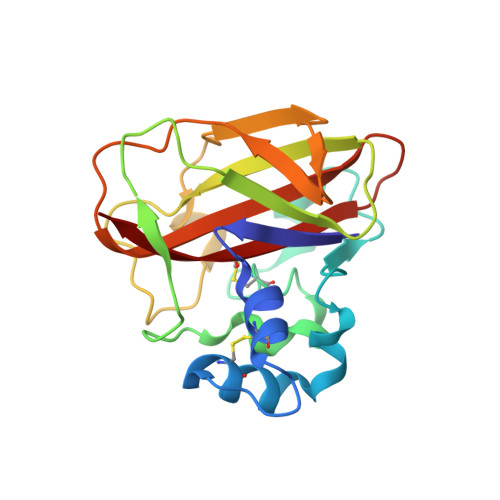
Crystal Structure of AA10 Lytic Polysaccharide Monooxygenase from Tectaria macrodonta


Experimental Data Snapshot

  • Method: X-RAY DIFFRACTION
  • Resolution: 2.20 Å
  • R-Value Free: 
    0.229 (Depositor), 0.234 (DCC) 
  • R-Value Work: 
    0.189 (Depositor), 0.200 (DCC) 
  • R-Value Observed: 
    0.191 (Depositor) 

Starting Model: experimental
View more details

wwPDB Validation 3D Report Full Report

Validation slider image for 6IF7

This is version 2.2 of the entry. See complete history

Literature

Insecticidal fern protein Tma12 is possibly a lytic polysaccharide monooxygenase.

Yadav, S.K.Singh, R.Singh, P.K.Vasudev, P.G.

(2019) Planta 249: 1987-1996

  • DOI: https://doi.org/10.1007/s00425-019-03135-0
  • Primary Citation Related Structures: 
    6IF7

  • PubMed Abstract: 

    Amino acid sequence and crystal structure analyses of Tma12, an insecticidal protein isolated from the fern Tectaria macrodonta, identify it as a carbohydrate-binding protein belonging to the AA10 family of lytic polysaccharide monooxygenases, and provide the first evidence of AA10 proteins in plants. Tma12, isolated from the fern Tectaria macrodonta, is a next-generation insecticidal protein. Transgenic cotton expressing Tma12 exhibits resistance against whitefly and viral diseases. Beside its insecticidal property, the structure and function of Tma12 are unknown. This limits understanding of the insecticidal mechanism of the protein and targeted improvement in its efficacy. Here we report the amino acid sequence analysis and the crystal structure of Tma12, suggesting that it is possibly a lytic polysaccharide monooxygenase (LPMO) of the AA10 family. Amino acid sequence of Tma12 shows 45% identity with a cellulolytic LPMO of Streptomyces coelicolor. The crystal structure of Tma12, obtained at 2.2 Å resolution, possesses all the major structural characteristics of AA10 LPMOs. A H 2 O 2 -based enzymatic assay also supports this finding. It is the first report of the occurrence of LPMO-like protein in a plant. The two facts that Tma12 possesses insecticidal activity and shows structural similarity with LPMOs collectively advocate exploration of microbial LPMOs for insecticidal potential.


  • Organizational Affiliation
    • Genetics and Plant Molecular Biology Division, CSIR-National Botanical Research Institute, Lucknow, 226001, India.

Macromolecule Content 

  • Total Structure Weight: 21.51 kDa 
  • Atom Count: 1,583 
  • Modeled Residue Count: 183 
  • Deposited Residue Count: 183 
  • Unique protein chains: 1

Macromolecules

Find similar proteins by:|  3D Structure
Entity ID: 1
MoleculeChains  Sequence LengthOrganismDetailsImage
Chitin binding protein183Tectaria macrodontaMutation(s): 0 
UniProt
Find proteins for W5QLL4 (Tectaria macrodonta)
Explore W5QLL4 
Go to UniProtKB:  W5QLL4
Entity Groups
Sequence Clusters30% Identity50% Identity70% Identity90% Identity95% Identity100% Identity
UniProt GroupW5QLL4
Glycosylation
Glycosylation Sites: 1
Sequence Annotations
Expand
Reference Sequence

Oligosaccharides

Help  
Entity ID: 2
MoleculeChains Length2D Diagram GlycosylationD Interactions
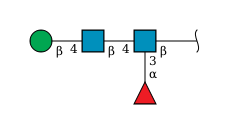
beta-D-mannopyranose-(1-4)-2-acetamido-2-deoxy-beta-D-glucopyranose-(1-4)-[alpha-L-fucopyranose-(1-3)]2-acetamido-2-deoxy-beta-D-glucopyranose
B
4N-Glycosylation
Glycosylation Resources
GlyTouCan: G18638YB
GlyCosmos: G18638YB
GlyGen: G18638YB

Experimental Data & Validation

Experimental Data

  • Method: X-RAY DIFFRACTION
  • Resolution: 2.20 Å
  • R-Value Free:  0.229 (Depositor), 0.234 (DCC) 
  • R-Value Work:  0.189 (Depositor), 0.200 (DCC) 
  • R-Value Observed: 0.191 (Depositor) 
Space Group: P 43 21 2
Unit Cell:
Length ( Å )Angle ( ˚ )
a = 79.221α = 90
b = 79.221β = 90
c = 68.239γ = 90
Software Package:
Software NamePurpose
d*TREKdata collection
HKL-2000data scaling
REFMACrefinement
PDB_EXTRACTdata extraction
HKL-2000data reduction
PHASERphasing
d*TREKdata reduction
SCALEPACKdata scaling

Structure Validation

View Full Validation Report


Entry History 

Deposition Data

Revision History  (Full details and data files)

  • Version 1.0: 2019-04-24
    Type: Initial release
  • Version 1.1: 2019-05-22
    Changes: Data collection, Database references
  • Version 2.0: 2020-07-29
    Type: Remediation
    Reason: Carbohydrate remediation
    Changes: Advisory, Atomic model, Data collection, Derived calculations, Non-polymer description, Structure summary
  • Version 2.1: 2023-11-22
    Changes: Data collection, Database references, Derived calculations, Refinement description, Structure summary
  • Version 2.2: 2024-11-13
    Changes: Structure summary