6H79 | pdb_00006h79

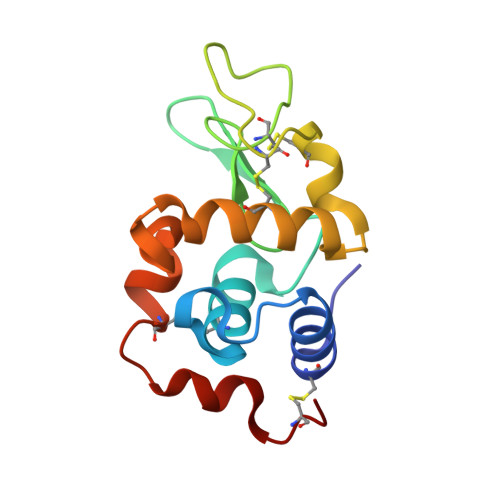
SSX structure of Lysozyme in flow - metal-kapton microfluidic device

  • Classification: HYDROLASE
  • Organism(s): Gallus gallus
  • Mutation(s): No 

  • Deposited: 2018-07-30 Released: 2019-03-20 
  • Deposition Author(s): Monteiro, D.C.F., Trebbin, M.
  • Funding Organization(s): German Research Foundation, German Federal Ministry for Education and Research

Experimental Data Snapshot

  • Method: X-RAY DIFFRACTION
  • Resolution: 2.10 Å
  • R-Value Free: 
    0.216 (Depositor), 0.224 (DCC) 
  • R-Value Work: 
    0.166 (Depositor), 0.178 (DCC) 
  • R-Value Observed: 
    0.168 (Depositor) 

Starting Model: experimental
View more details

wwPDB Validation 3D Report Full Report

Validation slider image for 6H79

This is version 1.2 of the entry. See complete history

Literature

A microfluidic flow-focusing device for low sample consumption serial synchrotron crystallography experiments in liquid flow.

Monteiro, D.C.F.Vakili, M.Harich, J.Sztucki, M.Meier, S.M.Horrell, S.Josts, I.Trebbin, M.

(2019) J Synchrotron Radiat 26: 406-412

  • DOI: https://doi.org/10.1107/S1600577519000304
  • Primary Citation Related Structures: 
    6H79

  • PubMed Abstract: 

    Serial synchrotron crystallography allows low X-ray dose, room-temperature crystal structures of proteins to be determined from a population of microcrystals. Protein production and crystallization is a non-trivial procedure and it is essential to have X-ray-compatible sample environments that keep sample consumption low and the crystals in their native environment. This article presents a fast and optimized manufacturing route to metal-polyimide microfluidic flow-focusing devices which allow for the collection of X-ray diffraction data in flow. The flow-focusing conditions allow for sample consumption to be significantly decreased, while also opening up the possibility of more complex experiments such as rapid mixing for time-resolved serial crystallography. This high-repetition-rate experiment allows for full datasets to be obtained quickly (∼1 h) from crystal slurries in liquid flow. The X-ray compatible microfluidic chips are easily manufacturable, reliable and durable and require sample-flow rates on the order of only 30 µl h -1 .


  • Organizational Affiliation
    • The Hamburg Centre for Ultrafast Imaging, Universität Hamburg, Luruper Chaussee 149, Hamburg 22761, Germany.

Macromolecule Content 

  • Total Structure Weight: 14.51 kDa 
  • Atom Count: 1,059 
  • Modeled Residue Count: 129 
  • Deposited Residue Count: 129 
  • Unique protein chains: 1

Macromolecules

Find similar proteins by:|  3D Structure
Entity ID: 1
MoleculeChains  Sequence LengthOrganismDetailsImage
Lysozyme C129Gallus gallusMutation(s): 0 
EC: 3.2.1.17
UniProt
Find proteins for P00698 (Gallus gallus)
Explore P00698 
Go to UniProtKB:  P00698
Entity Groups
Sequence Clusters30% Identity50% Identity70% Identity90% Identity95% Identity100% Identity
UniProt GroupP00698
Sequence Annotations
Expand
Reference Sequence

Experimental Data & Validation

Experimental Data

  • Method: X-RAY DIFFRACTION
  • Resolution: 2.10 Å
  • R-Value Free:  0.216 (Depositor), 0.224 (DCC) 
  • R-Value Work:  0.166 (Depositor), 0.178 (DCC) 
  • R-Value Observed: 0.168 (Depositor) 
Space Group: P 43 21 2
Unit Cell:
Length ( Å )Angle ( ˚ )
a = 79.3α = 90
b = 79.3β = 90
c = 37.7γ = 90
Software Package:
Software NamePurpose
REFMACrefinement
CrystFELdata reduction
CrystFELdata scaling
MOLREPphasing

Structure Validation

View Full Validation Report


Entry History 

& Funding Information

Deposition Data


Funding OrganizationLocationGrant Number
German Research FoundationGermanyExzellenzcluster 1074
German Federal Ministry for Education and ResearchGermany05K16GU1

Revision History  (Full details and data files)

  • Version 1.0: 2019-03-20
    Type: Initial release
  • Version 1.1: 2024-01-17
    Changes: Data collection, Database references, Refinement description
  • Version 1.2: 2024-10-16
    Changes: Structure summary