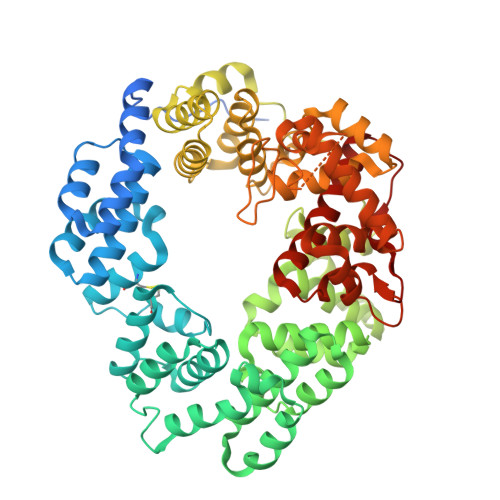
6H5F | pdb_00006h5f

LtgA disordered Helix


Experimental Data Snapshot

  • Method: X-RAY DIFFRACTION
  • Resolution: 2.00 Å
  • R-Value Free: 
    0.246 (Depositor), 0.296 (DCC) 
  • R-Value Work: 
    0.193 (Depositor), 0.305 (DCC) 
  • R-Value Observed: 
    0.196 (Depositor) 

Starting Model: experimental
View more details

wwPDB Validation 3D Report Full Report

Validation slider image for 6H5F

This is version 1.4 of the entry. See complete history

Literature

Defective lytic transglycosylase disrupts cell morphogenesis by hindering cell wall de-O-acetylation inNeisseria meningitidis.

Williams, A.H.Wheeler, R.Deghmane, A.E.Santecchia, I.Schaub, R.E.Hicham, S.Moya Nilges, M.Malosse, C.Chamot-Rooke, J.Haouz, A.Dillard, J.P.Robins, W.P.Taha, M.K.Gomperts Boneca, I.

(2020) Elife 9

  • DOI: https://doi.org/10.7554/eLife.51247
  • Primary Citation Related Structures: 
    6H5F

  • PubMed Abstract: 

    Lytic transglycosylases (LT) are enzymes involved in peptidoglycan (PG) remodeling. However, their contribution to cell-wall-modifying complexes and their potential as antimicrobial drug targets remains unclear. Here, we determined a high-resolution structure of the LT, an outer membrane lipoprotein from Neisseria species with a disordered active site helix (alpha helix 30). We show that deletion of the conserved alpha-helix 30 interferes with the integrity of the cell wall, disrupts cell division, cell separation, and impairs the fitness of the human pathogen Neisseria meningitidis during infection. Additionally, deletion of alpha-helix 30 results in hyperacetylated PG, suggesting this LtgA variant affects the function of the PG de- O- acetylase (Ape 1). Our study revealed that Ape 1 requires LtgA for optimal function, demonstrating that LTs can modulate the activity of their protein-binding partner. We show that targeting specific domains in LTs can be lethal, which opens the possibility that LTs are useful drug-targets.


  • Organizational Affiliation
    • Unité Biologie et Génétique de la Paroi Bactérienne, Institut Pasteur; Groupe Avenir, INSERM 75015, Paris, France.

Macromolecule Content 

  • Total Structure Weight: 67.82 kDa 
  • Atom Count: 4,661 
  • Modeled Residue Count: 563 
  • Deposited Residue Count: 616 
  • Unique protein chains: 1

Macromolecules

Find similar proteins by:|  3D Structure
Entity ID: 1
MoleculeChains  Sequence LengthOrganismDetailsImage
Putative soluble lytic murein transglycosylase616Neisseria meningitidis NM422Mutation(s): 0 
Gene Names: NMB1949
UniProt
Find proteins for Q9JXP1 (Neisseria meningitidis serogroup B (strain ATCC BAA-335 / MC58))
Explore Q9JXP1 
Go to UniProtKB:  Q9JXP1
Entity Groups
Sequence Clusters30% Identity50% Identity70% Identity90% Identity95% Identity100% Identity
UniProt GroupQ9JXP1
Sequence Annotations
Expand
Reference Sequence

Experimental Data & Validation

Experimental Data

  • Method: X-RAY DIFFRACTION
  • Resolution: 2.00 Å
  • R-Value Free:  0.246 (Depositor), 0.296 (DCC) 
  • R-Value Work:  0.193 (Depositor), 0.305 (DCC) 
  • R-Value Observed: 0.196 (Depositor) 
Space Group: P 21 21 21
Unit Cell:
Length ( Å )Angle ( ˚ )
a = 66.822α = 90
b = 72.256β = 90
c = 122.313γ = 90
Software Package:
Software NamePurpose
XDSdata reduction
XDSdata scaling
PHASERphasing
PHENIXrefinement

Structure Validation

View Full Validation Report


Entry History 

Deposition Data

  • Released Date: 2019-08-28 
  • Deposition Author(s): Williams, A.H.
  • This entry supersedes: 4YP4

Revision History  (Full details and data files)

  • Version 1.0: 2019-08-28
    Type: Initial release
  • Version 1.1: 2019-09-04
    Changes: Data collection, Database references, Source and taxonomy, Structure summary
  • Version 1.2: 2020-08-05
    Changes: Database references
  • Version 1.3: 2024-01-17
    Changes: Data collection, Database references, Refinement description
  • Version 1.4: 2024-11-13
    Changes: Structure summary