6H3Z | pdb_00006h3z

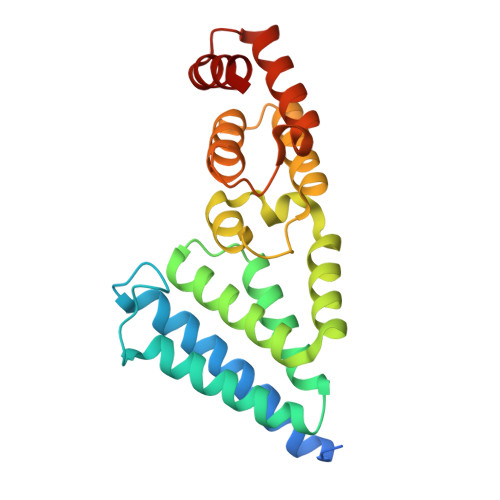
Crystal structure of a C-terminal MIF4G domain in NOT1


Experimental Data Snapshot

  • Method: X-RAY DIFFRACTION
  • Resolution: 3.00 Å
  • R-Value Free: 
    0.244 (Depositor), 0.235 (DCC) 
  • R-Value Work: 
    0.182 (Depositor), 0.191 (DCC) 
  • R-Value Observed: 
    0.185 (Depositor) 

wwPDB Validation 3D Report Full Report

Validation slider image for 6H3Z

This is version 1.2 of the entry. See complete history

Literature

Structural and biochemical analysis of a NOT1 MIF4G-like domain of the CCR4-NOT complex.

Raisch, T.Sandmeir, F.Weichenrieder, O.Valkov, E.Izaurralde, E.

(2018) J Struct Biol 204: 388-395

  • DOI: https://doi.org/10.1016/j.jsb.2018.10.009
  • Primary Citation Related Structures: 
    6H3Z

  • PubMed Abstract: 

    The CCR4-NOT complex plays a central role in the regulation of gene expression and degradation of messenger RNAs. The multisubunit complex assembles on the NOT1 protein, which acts as a 'scaffold' and is highly conserved in eukaryotes. NOT1 consists of a series of helical domains that serve as docking sites for other CCR4-NOT subunits. We describe a crystal structure of a connector domain of NOT1 from the thermophilic fungus Chaetomium thermophilum (Ct). Comparative structural analysis indicates that this domain adopts a MIF4G-like fold and we have termed it the MIF4G-C domain. Solution scattering studies indicate that the human MIF4G-C domain likely adopts a very similar fold to the Ct MIF4G-C. MIF4G domains have been described to mediate interactions with DEAD-box helicases such as DDX6. However, comparison of the interfaces of the MIF4G-C with the MIF4G domain of NOT1 that interacts with DDX6 reveals key structural differences that explain why the MIF4G-C does not bind DDX6. We further show that the human MIF4G-C does not interact stably with other subunits of the CCR4-NOT complex. The structural conservation of the MIF4G-C domain suggests that it may have an important but presently undefined role in the CCR4-NOT complex.


  • Organizational Affiliation
    • Department of Biochemistry, Max Planck Institute for Developmental Biology, Max-Planck-Ring 5, 72076 Tübingen, Germany.

Macromolecule Content 

  • Total Structure Weight: 50.79 kDa 
  • Atom Count: 3,306 
  • Modeled Residue Count: 415 
  • Deposited Residue Count: 452 
  • Unique protein chains: 1

Macromolecules

Find similar proteins by:|  3D Structure
Entity ID: 1
MoleculeChains  Sequence LengthOrganismDetailsImage
CCR4-not transcription complex subunit 1
A, B
226Thermochaetoides thermophila DSM 1495Mutation(s): 0 
Gene Names: CTHT_0042750
UniProt
Find proteins for G0SAL9 (Chaetomium thermophilum (strain DSM 1495 / CBS 144.50 / IMI 039719))
Explore G0SAL9 
Go to UniProtKB:  G0SAL9
Entity Groups
Sequence Clusters30% Identity50% Identity70% Identity90% Identity95% Identity100% Identity
UniProt GroupG0SAL9
Sequence Annotations
Expand
Reference Sequence

Experimental Data & Validation

Experimental Data

  • Method: X-RAY DIFFRACTION
  • Resolution: 3.00 Å
  • R-Value Free:  0.244 (Depositor), 0.235 (DCC) 
  • R-Value Work:  0.182 (Depositor), 0.191 (DCC) 
  • R-Value Observed: 0.185 (Depositor) 
Space Group: P 21 21 21
Unit Cell:
Length ( Å )Angle ( ˚ )
a = 73.93α = 90
b = 79.77β = 90
c = 98.42γ = 90
Software Package:
Software NamePurpose
BUSTERrefinement
XDSdata reduction
XSCALEdata scaling
SHELXDEphasing

Structure Validation

View Full Validation Report


Entry History 

Deposition Data

Revision History  (Full details and data files)

  • Version 1.0: 2018-11-07
    Type: Initial release
  • Version 1.1: 2018-12-26
    Changes: Data collection, Database references
  • Version 1.2: 2024-05-15
    Changes: Data collection, Database references