6GJU | pdb_00006gju

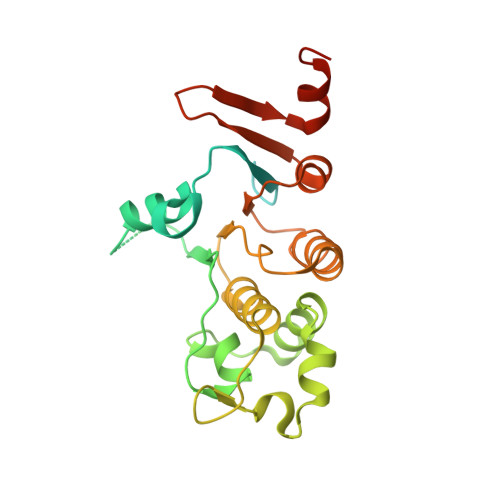
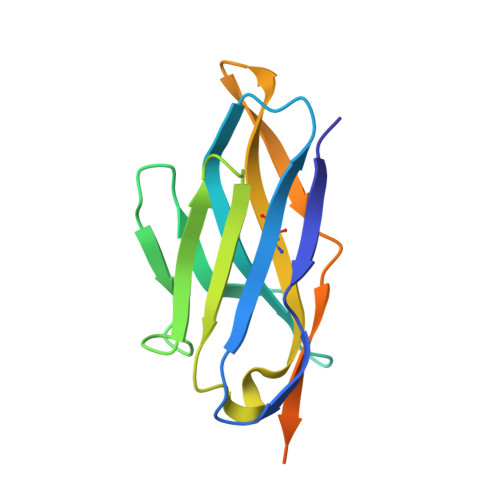
human NBD1 of CFTR in complex with nanobodies T2a and T4


Experimental Data Snapshot

  • Method: X-RAY DIFFRACTION
  • Resolution: 2.60 Å
  • R-Value Free: 
    0.243 (Depositor), 0.262 (DCC) 
  • R-Value Work: 
    0.220 (Depositor), 0.231 (DCC) 
  • R-Value Observed: 
    0.222 (Depositor) 

Starting Models: experimental
View more details

wwPDB Validation 3D Report Full Report

Validation slider image for 6GJU

This is version 1.3 of the entry. See complete history

Literature

Domain-interface dynamics of CFTR revealed by stabilizing nanobodies.

Sigoillot, M.Overtus, M.Grodecka, M.Scholl, D.Garcia-Pino, A.Laeremans, T.He, L.Pardon, E.Hildebrandt, E.Urbatsch, I.Steyaert, J.Riordan, J.R.Govaerts, C.

(2019) Nat Commun 10: 2636-2636

  • DOI: https://doi.org/10.1038/s41467-019-10714-y
  • Primary Citation Related Structures: 
    6GJQ, 6GJS, 6GJU, 6GK4, 6GKD

  • PubMed Abstract: 

    The leading cause of cystic fibrosis (CF) is the deletion of phenylalanine 508 (F508del) in the first nucleotide-binding domain (NBD1) of the cystic fibrosis transmembrane conductance regulator (CFTR). The mutation affects the thermodynamic stability of the domain and the integrity of the interface between NBD1 and the transmembrane domain leading to its clearance by the quality control system. Here, we develop nanobodies targeting NBD1 of human CFTR and demonstrate their ability to stabilize both isolated NBD1 and full-length protein. Crystal structures of NBD1-nanobody complexes provide an atomic description of the epitopes and reveal the molecular basis for stabilization. Furthermore, our data uncover a conformation of CFTR, involving detachment of NBD1 from the transmembrane domain, which contrast with the compact assembly observed in cryo-EM structures. This unexpected interface rearrangement is likely to have major relevance for CF pathogenesis but also for the normal function of CFTR and other ABC proteins.


  • Organizational Affiliation
    • SFMB, Université Libre de Bruxelles (ULB), CP206/02, Boulevard du Triomphe, building BC, B-1050, Brussels, Belgium.

Macromolecule Content 

  • Total Structure Weight: 60.73 kDa 
  • Atom Count: 3,251 
  • Modeled Residue Count: 421 
  • Deposited Residue Count: 550 
  • Unique protein chains: 3

Macromolecules

Find similar proteins by:|  3D Structure
Entity ID: 1
MoleculeChains  Sequence LengthOrganismDetailsImage
Cystic fibrosis transmembrane conductance regulator261Homo sapiensMutation(s): 3 
Gene Names: CFTR
EC: 3.6.3.49 (PDB Primary Data), 5.6.1.6 (UniProt)
UniProt & NIH Common Fund Data Resources
Find proteins for P13569 (Homo sapiens)
Explore P13569 
Go to UniProtKB:  P13569
PHAROS:  P13569
GTEx:  ENSG00000001626 
Entity Groups
Sequence Clusters30% Identity50% Identity70% Identity90% Identity95% Identity100% Identity
UniProt GroupP13569
Sequence Annotations
Expand
Reference Sequence
Find similar proteins by:|  3D Structure
Entity ID: 2
MoleculeChains  Sequence LengthOrganismDetailsImage
Nanobody T4143Lama glamaMutation(s): 0 
Find similar proteins by:|  3D Structure
Entity ID: 3
MoleculeChains  Sequence LengthOrganismDetailsImage
Nanobody T2a146Lama glamaMutation(s): 0 

Experimental Data & Validation

Experimental Data

  • Method: X-RAY DIFFRACTION
  • Resolution: 2.60 Å
  • R-Value Free:  0.243 (Depositor), 0.262 (DCC) 
  • R-Value Work:  0.220 (Depositor), 0.231 (DCC) 
  • R-Value Observed: 0.222 (Depositor) 
Space Group: C 2 2 21
Unit Cell:
Length ( Å )Angle ( ˚ )
a = 38.68α = 90
b = 135.78β = 90
c = 190.65γ = 90
Software Package:
Software NamePurpose
BUSTERrefinement
XDSdata reduction
XDSdata scaling
MOLREPphasing

Structure Validation

View Full Validation Report


Entry History 

Revision History  (Full details and data files)

  • Version 1.0: 2019-06-26
    Type: Initial release
  • Version 1.1: 2019-08-21
    Changes: Data collection
  • Version 1.2: 2024-01-17
    Changes: Data collection, Database references, Refinement description
  • Version 1.3: 2024-10-23
    Changes: Structure summary