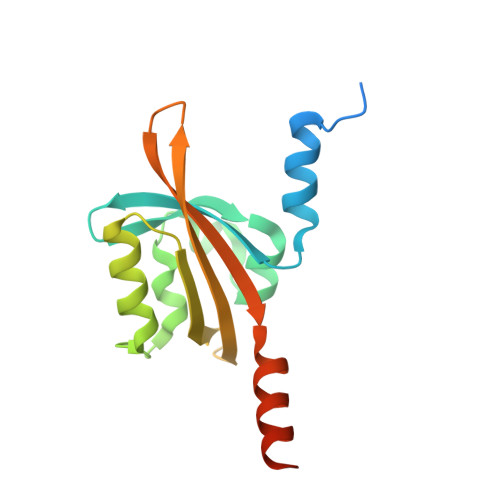
6GG9 | pdb_00006gg9

Crystal structures of a short blue light photoreceptor protein PpSB1-LOV mutant (dark state) - R61H/R66I


Experimental Data Snapshot

  • Method: X-RAY DIFFRACTION
  • Resolution: 2.04 Å
  • R-Value Free: 
    0.237 (Depositor), 0.238 (DCC) 
  • R-Value Work: 
    0.195 (Depositor), 0.196 (DCC) 
  • R-Value Observed: 
    0.197 (Depositor) 

Starting Model: experimental
View more details

wwPDB Validation 3D Report Full Report

Validation slider image for 6GG9

Ligand Structure Quality Assessment 


This is version 1.1 of the entry. See complete history

Literature

Small-angle X-ray scattering study of the kinetics of light-dark transition in a LOV protein.

Rollen, K.Granzin, J.Batra-Safferling, R.Stadler, A.M.

(2018) PLoS One 13: e0200746-e0200746

  • DOI: https://doi.org/10.1371/journal.pone.0200746
  • Primary Citation Related Structures: 
    6GG9

  • PubMed Abstract: 

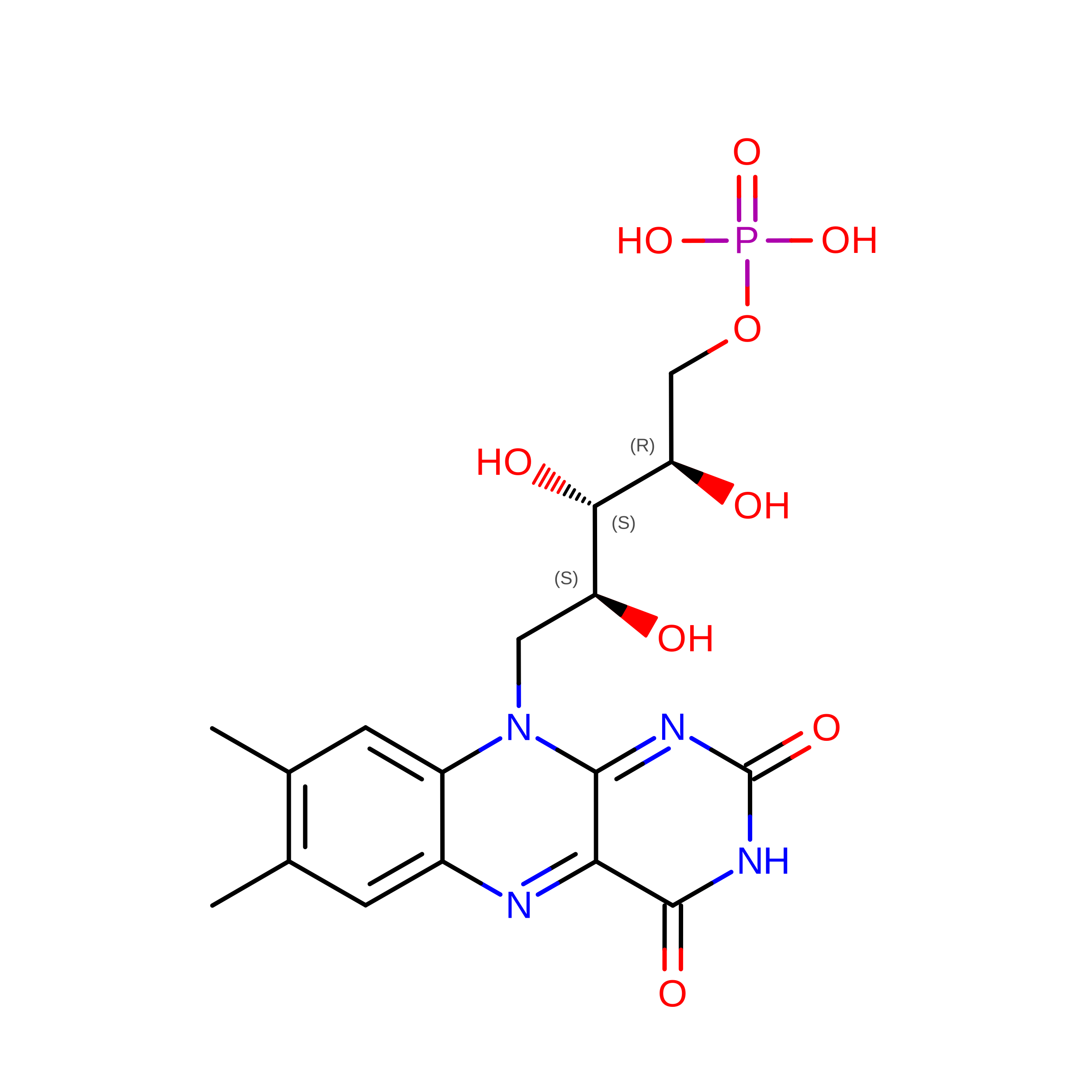
    Light, oxygen, voltage (LOV) photoreceptors consist of conserved photo-responsive domains in bacteria, archaea, plants and fungi, and detect blue-light via a flavin cofactor. We investigated the blue-light induced conformational transition of the dimeric photoreceptor PpSB1-LOV-R66I from Pseudomonas putida in solution by using small-angle X-ray scattering (SAXS). SAXS experiments of the fully populated light- and dark-states under steady-state conditions revealed significant structural differences between the two states that are in agreement with the known structures determined by crystallography. We followed the transition from the light- to the dark-state by using SAXS measurements in real-time. A two-state model based on the light- and dark-state conformations could describe the measured time-course SAXS data with a relaxation time τREC of ~ 34 to 35 min being larger than the recovery time found with UV/vis spectroscopy. Unlike the flavin chromophore-based UV/vis method that is sensitive to the local chromophore environment in flavoproteins, SAXS-based assay depends on protein conformational changes and provides with an alternative to measure the recovery kinetics.


  • Organizational Affiliation
    • Institute of Complex Systems, ICS-6: Structural Biochemistry, Forschungszentrum Jülich, Jülich, Germany.

Macromolecule Content 

  • Total Structure Weight: 76.04 kDa 
  • Atom Count: 4,413 
  • Modeled Residue Count: 538 
  • Deposited Residue Count: 648 
  • Unique protein chains: 1

Macromolecules

Find similar proteins by:|  3D Structure
Entity ID: 1
MoleculeChains  Sequence LengthOrganismDetailsImage
Sensory box protein
A, B, C, D
162Pseudomonas putidaMutation(s): 2 
Gene Names: PP_4629
UniProt
Find proteins for Q88E39 (Pseudomonas putida (strain ATCC 47054 / DSM 6125 / CFBP 8728 / NCIMB 11950 / KT2440))
Explore Q88E39 
Go to UniProtKB:  Q88E39
Entity Groups
Sequence Clusters30% Identity50% Identity70% Identity90% Identity95% Identity100% Identity
UniProt GroupQ88E39
Sequence Annotations
Expand
Reference Sequence

Experimental Data & Validation

Experimental Data

  • Method: X-RAY DIFFRACTION
  • Resolution: 2.04 Å
  • R-Value Free:  0.237 (Depositor), 0.238 (DCC) 
  • R-Value Work:  0.195 (Depositor), 0.196 (DCC) 
  • R-Value Observed: 0.197 (Depositor) 
Space Group: C 1 2 1
Unit Cell:
Length ( Å )Angle ( ˚ )
a = 102.7α = 90
b = 76.506β = 106.23
c = 83.279γ = 90
Software Package:
Software NamePurpose
PHENIXrefinement
XDSdata reduction
Aimlessdata scaling
MOLREPphasing

Structure Validation

View Full Validation Report


Ligand Structure Quality Assessment 


Entry History 

Deposition Data

Revision History  (Full details and data files)

  • Version 1.0: 2018-07-25
    Type: Initial release
  • Version 1.1: 2024-01-17
    Changes: Data collection, Database references, Refinement description