6GG0 | pdb_00006gg0

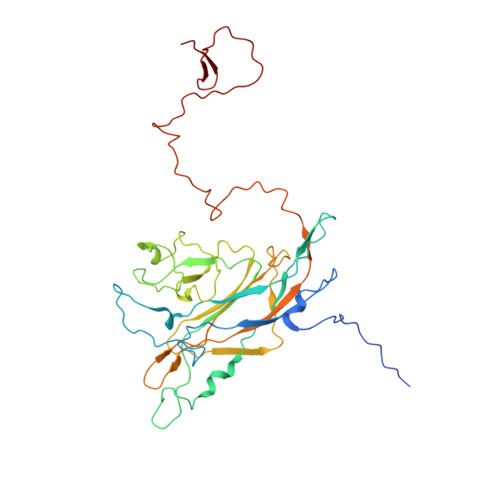
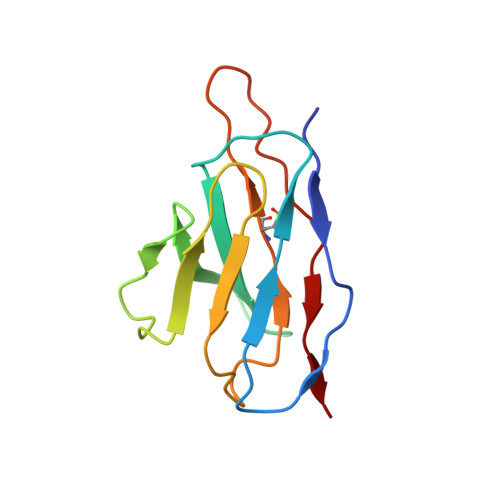
Cryo-EM structure of BK polyomavirus like particle in complex with single chain antibody ScFv41F17


Experimental Data Snapshot

  • Method: ELECTRON MICROSCOPY
  • Resolution: 4.24 Å
  • Aggregation State: PARTICLE 
  • Reconstruction Method: SINGLE PARTICLE 

wwPDB Validation 3D Report Full Report

Validation slider image for 6GG0

This is version 1.5 of the entry. See complete history. 

Literature

Human Memory B Cells Harbor Diverse Cross-Neutralizing Antibodies against BK and JC Polyomaviruses.

Lindner, J.M., Cornacchione, V., Sathe, A., Be, C., Srinivas, H., Riquet, E., Leber, X.C., Hein, A., Wrobel, M.B., Scharenberg, M., Pietzonka, T., Wiesmann, C., Abend, J., Traggiai, E.

(2019) Immunity 50: 668-676.e5

  • DOI: https://doi.org/10.1016/j.immuni.2019.02.003
  • Primary Citation Related Structures: 
    6GG0

  • PubMed Abstract: 

    Human polyomaviruses cause a common childhood infection worldwide and typically elicit a neutralizing antibody and cellular immune response, while establishing a dormant infection in the kidney with minimal clinical manifestations. However, viral reactivation can cause severe pathology in immunocompromised individuals. We developed a high-throughput, functional antibody screen to examine the humoral response to BK polyomavirus. This approach enabled the isolation of antibodies from all peripheral B cell subsets and revealed the anti-BK virus antibody repertoire as clonally complex with respect to immunoglobulin sequences and isotypes (both IgM and IgG), including a high frequency of monoclonal antibodies that broadly neutralize BK virus subtypes and the related JC polyomavirus. Cryo-electron microscopy of a broadly neutralizing IgG single-chain variable fragment complexed with BK virus-like particles revealed the quaternary nature of a conserved viral epitope at the junction between capsid pentamers. These features unravel a potent modality for inhibiting polyomavirus infection in kidney transplant recipients and other immunocompromised patients.


  • Organizational Affiliation: 
    • Novartis Institutes for BioMedical Research, Basel, Switzerland, Cambridge, MA, USA, and Emeryville, CA, USA.

Macromolecule Content 

  • Total Structure Weight: 266.17 kDa 
  • Atom Count: 17,644 
  • Modeled Residue Count: 2,269 
  • Deposited Residue Count: 2,405 
  • Unique protein chains: 3

Macromolecules

Find similar proteins by:|  3D Structure
Entity ID: 1
MoleculeChains  Sequence LengthOrganismDetailsImage
Capsid protein VP1362Betapolyomavirus hominisMutation(s): 0 
Gene Names: VP1, vp1, BK1035_00004, BK1055_00004
UniProt
Find proteins for P03088 (BK polyomavirus)
Explore P03088 
Go to UniProtKB:  P03088
Entity Groups
Sequence Clusters30% Identity50% Identity70% Identity90% Identity95% Identity100% Identity
UniProt GroupP03088
Sequence Annotations
Expand
Reference Sequence
Find similar proteins by:|  3D Structure
Entity ID: 2
MoleculeChains  Sequence LengthOrganismDetailsImage
Heavy chainG [auth H]124Homo sapiensMutation(s): 0 
Entity Groups
Sequence Clusters30% Identity50% Identity70% Identity90% Identity95% Identity100% Identity
Sequence Annotations
Expand
Reference Sequence
Find similar proteins by:|  3D Structure
Entity ID: 3
MoleculeChains  Sequence LengthOrganismDetailsImage
light chainH [auth L]109Homo sapiensMutation(s): 0 
Entity Groups
Sequence Clusters30% Identity50% Identity70% Identity90% Identity95% Identity100% Identity
Sequence Annotations
Expand
Reference Sequence

Experimental Data & Validation

Experimental Data

  • Method: ELECTRON MICROSCOPY
  • Resolution: 4.24 Å
  • Aggregation State: PARTICLE 
  • Reconstruction Method: SINGLE PARTICLE 
EM Software:
TaskSoftware PackageVersion
MODEL REFINEMENTPHENIX

Structure Validation

View Full Validation Report


Entry History 

Deposition Data

  • Released Date: 2019-03-06 
  • Deposition Author(s): Srinivas, H.

Revision History  (Full details and data files)

  • Version 1.0: 2019-03-06
    Type: Initial release
  • Version 1.1: 2019-03-13
    Changes: Data collection, Database references
  • Version 1.2: 2019-03-27
    Changes: Data collection, Database references
  • Version 1.3: 2019-12-11
    Changes: Other
  • Version 1.4: 2024-11-13
    Changes: Data collection, Database references, Derived calculations, Structure summary
  • Version 1.5: 2025-07-09
    Changes: Data collection