6G1N | pdb_00006g1n

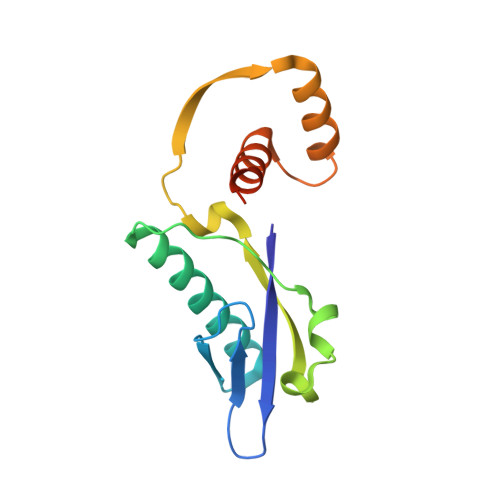
Crystal structure of the Burkholderia Pseudomallei antitoxin HicB


Experimental Data Snapshot

  • Method: X-RAY DIFFRACTION
  • Resolution: 1.85 Å
  • R-Value Free: 
    0.241 (Depositor), 0.260 (DCC) 
  • R-Value Work: 
    0.203 (Depositor) 
  • R-Value Observed: 
    0.205 (Depositor) 

Starting Model: experimental
View more details

wwPDB Validation 3D Report Full Report

Validation slider image for 6G1N

This is version 1.2 of the entry. See complete history

Re-refinement Note

This entry reflects an alternative modeling of the original data in: 6G1C

Literature

The molecular basis of protein toxin HicA-dependent binding of the protein antitoxin HicB to DNA.

Winter, A.J.Williams, C.Isupov, M.N.Crocker, H.Gromova, M.Marsh, P.Wilkinson, O.J.Dillingham, M.S.Harmer, N.J.Titball, R.W.Crump, M.P.

(2018) J Biological Chem 293: 19429-19440

  • DOI: https://doi.org/10.1074/jbc.RA118.005173
  • Primary Citation Related Structures: 
    6G1C, 6G1N, 6G26

  • PubMed Abstract: 

    Toxin-antitoxin (TA) systems are present in many bacteria and play important roles in bacterial growth, physiology, and pathogenicity. Those that are best studied are the type II TA systems, in which both toxins and antitoxins are proteins. The HicAB system is one of the prototypic TA systems, found in many bacterial species. Complex interactions between the protein toxin (HicA), the protein antitoxin (HicB), and the DNA upstream of the encoding genes regulate the activity of this system, but few structural details are available about how HicA destabilizes the HicB-DNA complex. Here, we determined the X-ray structures of HicB and the HicAB complex to 1.8 and 2.5 Å resolution, respectively, and characterized their DNA interactions. This revealed that HicB forms a tetramer and HicA and HicB form a heterooctameric complex that involves structural reorganization of the C-terminal (DNA-binding) region of HicB. Our observations indicated that HicA has a profound impact on binding of HicB to DNA sequences upstream of hicAB in a stoichiometric-dependent way. At low ratios of HicA:HicB, there was no effect on DNA binding, but at higher ratios, the affinity for DNA declined cooperatively, driving dissociation of the HicA:HicB:DNA complex. These results reveal the structural mechanisms by which HicA de-represses the HicB-DNA complex.


  • Organizational Affiliation
    • From the School of Chemistry, University of Bristol Cantock's Close, Bristol BS8 1TS, United Kingdom.

Macromolecule Content 

  • Total Structure Weight: 63.47 kDa 
  • Atom Count: 4,536 
  • Modeled Residue Count: 534 
  • Deposited Residue Count: 568 
  • Unique protein chains: 1

Macromolecules

Find similar proteins by:|  3D Structure
Entity ID: 1
MoleculeChains  Sequence LengthOrganismDetailsImage
antitoxin HicB
A, B, C, D
142Burkholderia pseudomallei K96243Mutation(s): 0 
Gene Names: BPSS0391
UniProt
Find proteins for Q63NA5 (Burkholderia pseudomallei (strain K96243))
Explore Q63NA5 
Go to UniProtKB:  Q63NA5
Entity Groups
Sequence Clusters30% Identity50% Identity70% Identity90% Identity95% Identity100% Identity
UniProt GroupQ63NA5
Sequence Annotations
Expand
Reference Sequence

Experimental Data & Validation

Experimental Data

  • Method: X-RAY DIFFRACTION
  • Resolution: 1.85 Å
  • R-Value Free:  0.241 (Depositor), 0.260 (DCC) 
  • R-Value Work:  0.203 (Depositor) 
  • R-Value Observed: 0.205 (Depositor) 
Space Group: P 41
Unit Cell:
Length ( Å )Angle ( ˚ )
a = 62.58α = 90
b = 62.58β = 90
c = 173.49γ = 90
Software Package:
Software NamePurpose
PHENIXrefinement
xia2data reduction
DIALSdata scaling
PHASERphasing

Structure Validation

View Full Validation Report


Entry History 

& Funding Information

Deposition Data


Funding OrganizationLocationGrant Number
Biotechnology and Biological Sciences Research CouncilUnited KingdomBB/J014400/1

Revision History  (Full details and data files)

  • Version 1.0: 2018-10-31
    Type: Initial release
  • Version 1.1: 2018-12-26
    Changes: Data collection, Database references
  • Version 1.2: 2024-01-17
    Changes: Advisory, Data collection, Database references, Refinement description