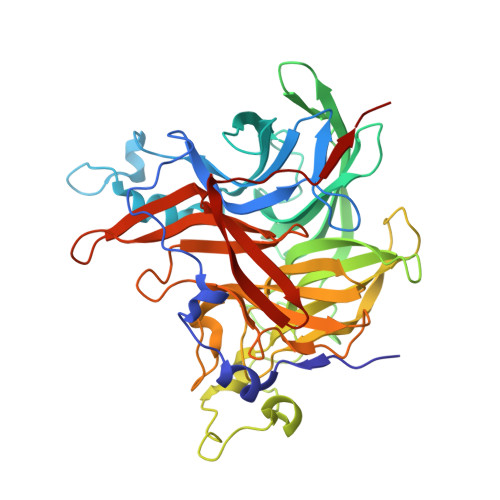
6FRW | pdb_00006frw

X-ray structure of the levansucrase from Erwinia tasmaniensis


Experimental Data Snapshot

  • Method: X-RAY DIFFRACTION
  • Resolution: 1.52 Å
  • R-Value Free: 
    0.209 (Depositor), 0.210 (DCC) 
  • R-Value Work: 
    0.179 (Depositor), 0.182 (DCC) 
  • R-Value Observed: 
    0.181 (Depositor) 

wwPDB Validation 3D Report Full Report

Validation slider image for 6FRW

This is version 1.1 of the entry. See complete history

Literature

Comparison of the Levansucrase from the epiphyte Erwinia tasmaniensis vs its homologue from the phytopathogen Erwinia amylovora.

Polsinelli, I.Caliandro, R.Salomone-Stagni, M.Demitri, N.Rejzek, M.Field, R.A.Benini, S.

(2019) Int J Biol Macromol 127: 496-501

  • DOI: https://doi.org/10.1016/j.ijbiomac.2019.01.074
  • Primary Citation Related Structures: 
    6FRW

  • PubMed Abstract: 

    Erwinia tasmaniensis is an epiphytic bacterium related to the plant pathogen Erwinia amylovora, the etiological agent of fire blight. In this study the levansucrase from E. tasmaniensis (EtLsc) has been compared with the homologous enzyme from E. amylovora (EaLsc). We characterized the enzymatic activity and compared the products profile of both enzymes by High Performance Anion Exchange Chromatography coupled with Pulsed Amperometric Detector (HPAEC-PAD). Moreover we determined the crystal structure of EtLsc to understand the structural peculiarity causing the different product profiles of the two homologues. EtLsc exhibits increased efficiency in the production of FOS, resulting in a better catalyst for biotechnological synthesis than EaLsc. Based on our results, we propose that the role of this enzyme in the life cycle of the two bacteria is most likely related to survival, rather than linked to pathogenicity in E. amylovora.


  • Organizational Affiliation
    • Bioorganic Chemistry and Bio-Crystallography laboratory (B(2)Cl), Faculty of Science and Technology, Free University of Bolzano, Piazza Università 5, 39100 Bolzano, Italy.

Macromolecule Content 

  • Total Structure Weight: 46.83 kDa 
  • Atom Count: 3,829 
  • Modeled Residue Count: 411 
  • Deposited Residue Count: 411 
  • Unique protein chains: 1

Macromolecules

Find similar proteins by:|  3D Structure
Entity ID: 1
MoleculeChains  Sequence LengthOrganismDetailsImage
Levansucrase (Beta-D-fructofuranosyl transferase)411Erwinia tasmaniensisMutation(s): 0 
Gene Names: lscETA_34670
EC: 2.4.1.10
UniProt
Find proteins for B2VCC3 (Erwinia tasmaniensis (strain DSM 17950 / CFBP 7177 / CIP 109463 / NCPPB 4357 / Et1/99))
Explore B2VCC3 
Go to UniProtKB:  B2VCC3
Entity Groups
Sequence Clusters30% Identity50% Identity70% Identity90% Identity95% Identity100% Identity
UniProt GroupB2VCC3
Sequence Annotations
Expand
Reference Sequence

Small Molecules

Ligands 2 Unique
IDChains Name / Formula / InChI Key2D Diagram3D Interactions
GOL

Query on GOL


Download:Ideal Coordinates CCD File
B [auth A]
C [auth A]
D [auth A]
E [auth A]
F [auth A]
B [auth A],
C [auth A],
D [auth A],
E [auth A],
F [auth A],
G [auth A],
H [auth A]
GLYCEROL
C3 H8 O3
PEDCQBHIVMGVHV-UHFFFAOYSA-N
ZN

Query on ZN


Download:Ideal Coordinates CCD File
I [auth A],
J [auth A],
K [auth A]
ZINC ION
Zn
PTFCDOFLOPIGGS-UHFFFAOYSA-N

Experimental Data & Validation

Experimental Data

  • Method: X-RAY DIFFRACTION
  • Resolution: 1.52 Å
  • R-Value Free:  0.209 (Depositor), 0.210 (DCC) 
  • R-Value Work:  0.179 (Depositor), 0.182 (DCC) 
  • R-Value Observed: 0.181 (Depositor) 
Space Group: P 41 21 2
Unit Cell:
Length ( Å )Angle ( ˚ )
a = 128.493α = 90
b = 128.493β = 90
c = 58.945γ = 90
Software Package:
Software NamePurpose
PHENIXrefinement
REFMACrefinement
PDB_EXTRACTdata extraction

Structure Validation

View Full Validation Report


Entry History 

& Funding Information

Deposition Data


Funding OrganizationLocationGrant Number
Free University of BolzanoItaly1440

Revision History  (Full details and data files)

  • Version 1.0: 2019-02-06
    Type: Initial release
  • Version 1.1: 2024-05-08
    Changes: Advisory, Data collection, Database references, Derived calculations