6FPS | pdb_00006fps

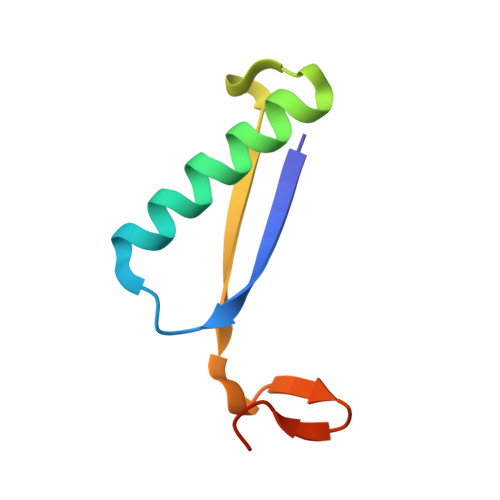
Crystal structure of 4-oxalocrotonate tautomerase triple mutant L8Y/M45Y/F50A


Experimental Data Snapshot

  • Method: X-RAY DIFFRACTION
  • Resolution: 1.90 Å
  • R-Value Free: 
    0.222 (Depositor), 0.228 (DCC) 
  • R-Value Work: 
    0.201 (Depositor), 0.210 (DCC) 
  • R-Value Observed: 
    0.202 (Depositor) 

Starting Model: experimental
View more details

wwPDB Validation 3D Report Full Report

Validation slider image for 6FPS

This is version 1.1 of the entry. See complete history

Literature

Enantioselective Synthesis of Pharmaceutically Active gamma-Aminobutyric Acids Using a Tailor-Made Artificial Michaelase in One-Pot Cascade Reactions.

Biewenga, L.Saravanan, T.Kunzendorf, A.van der Meer, J.Y.Pijning, T.Tepper, P.G.van Merkerk, R.Charnock, S.J.Thunnissen, A.W.H.Poelarends, G.J.

(2019) ACS Catal 9: 1503-1513

  • DOI: https://doi.org/10.1021/acscatal.8b04299
  • Primary Citation Related Structures: 
    6FPS

  • PubMed Abstract: 

    Chiral γ-aminobutyric acid (GABA) analogues represent abundantly prescribed drugs, which are broadly applied as anticonvulsants, as antidepressants, and for the treatment of neuropathic pain. Here we report a one-pot two-step biocatalytic cascade route for synthesis of the pharmaceutically relevant enantiomers of γ-nitrobutyric acids, starting from simple precursors (acetaldehyde and nitroalkenes), using a tailor-made highly enantioselective artificial "Michaelase" (4-oxalocrotonate tautomerase mutant L8Y/M45Y/F50A), an aldehyde dehydrogenase with a broad non-natural substrate scope, and a cofactor recycling system. We also report a three-step chemoenzymatic cascade route for the efficient chemical reduction of enzymatically prepared γ-nitrobutyric acids into GABA analogues in one pot, achieving high enantiopurity (e.r. up to 99:1) and high overall yields (up to 70%). This chemoenzymatic methodology offers a step-economic alternative route to important pharmaceutically active GABA analogues, and highlights the exciting opportunities available for combining chemocatalysts, natural enzymes, and designed artificial biocatalysts in multistep syntheses.


  • Organizational Affiliation
    • Department of Chemical and Pharmaceutical Biology, Groningen Research Institute of Pharmacy, University of Groningen, Antonius Deusinglaan 1, 9713 AV Groningen, The Netherlands.

Macromolecule Content 

  • Total Structure Weight: 123.09 kDa 
  • Atom Count: 8,635 
  • Modeled Residue Count: 1,069 
  • Deposited Residue Count: 1,116 
  • Unique protein chains: 1

Macromolecules

Find similar proteins by:|  3D Structure
Entity ID: 1
MoleculeChains  Sequence LengthOrganismDetailsImage
2-hydroxymuconate tautomerase
A, B, C, D, E
A, B, C, D, E, F, G, H, I, J, K, L, M, N, O, P, Q, R
62Pseudomonas putidaMutation(s): 3 
Gene Names: xylH
EC: 5.3.2.6
UniProt
Find proteins for Q01468 (Pseudomonas putida)
Explore Q01468 
Go to UniProtKB:  Q01468
Entity Groups
Sequence Clusters30% Identity50% Identity70% Identity90% Identity95% Identity100% Identity
UniProt GroupQ01468
Sequence Annotations
Expand
Reference Sequence

Experimental Data & Validation

Experimental Data

  • Method: X-RAY DIFFRACTION
  • Resolution: 1.90 Å
  • R-Value Free:  0.222 (Depositor), 0.228 (DCC) 
  • R-Value Work:  0.201 (Depositor), 0.210 (DCC) 
  • R-Value Observed: 0.202 (Depositor) 
Space Group: P 21 21 21
Unit Cell:
Length ( Å )Angle ( ˚ )
a = 90.046α = 90
b = 99.509β = 90
c = 118.275γ = 90
Software Package:
Software NamePurpose
XDSdata reduction
Aimlessdata scaling
PHASERphasing
REFMACrefinement
PDB_EXTRACTdata extraction

Structure Validation

View Full Validation Report


Entry History 

& Funding Information

Deposition Data


Funding OrganizationLocationGrant Number
European Research Council - European Union Horizon 2020 research and innovation ProgrammeNetherlands635595
European Research Council - European Union Horizon 2020 research and innovation ProgrammeNetherlands713483

Revision History  (Full details and data files)

  • Version 1.0: 2019-03-06
    Type: Initial release
  • Version 1.1: 2024-01-17
    Changes: Data collection, Database references, Refinement description