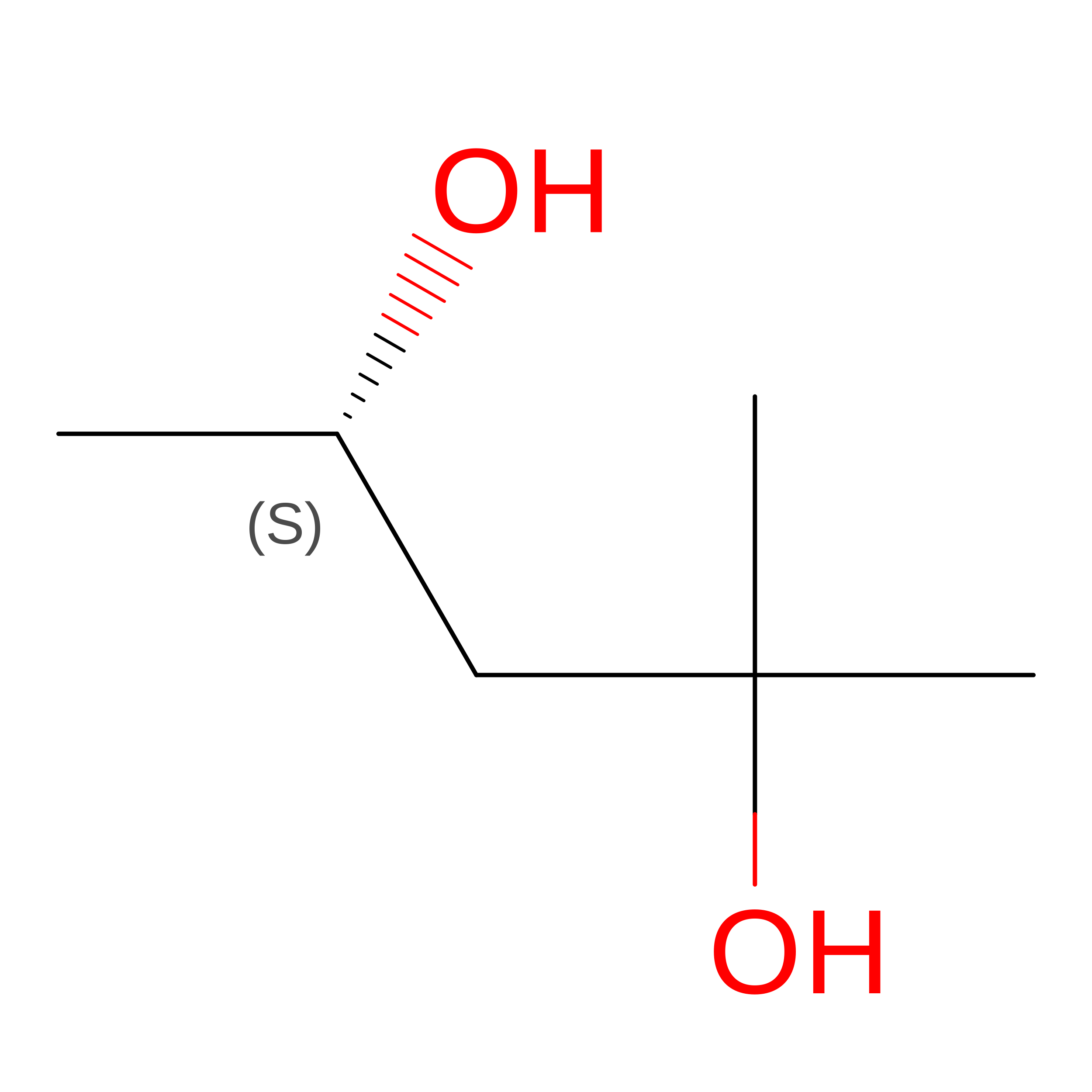
6FPK | pdb_00006fpk

Co-translational folding intermediate dictates membrane targeting of the signal recognition particle (SRP)- receptor


Experimental Data Snapshot

  • Method: X-RAY DIFFRACTION
  • Resolution: 1.95 Å
  • R-Value Free: 
    0.234 (Depositor), 0.233 (DCC) 
  • R-Value Work: 
    0.212 (Depositor), 0.226 (DCC) 
  • R-Value Observed: 
    0.214 (Depositor) 

Starting Model: experimental
View more details

wwPDB Validation 3D Report Full Report

Validation slider image for 6FPK

This is version 1.2 of the entry. See complete history

Literature

Co-translational Folding Intermediate Dictates Membrane Targeting of the Signal Recognition Particle Receptor.

Karniel, A.Mrusek, D.Steinchen, W.Dym, O.Bange, G.Bibi, E.

(2018) J Mol Biology 430: 1607-1620

  • DOI: https://doi.org/10.1016/j.jmb.2018.04.017
  • Primary Citation Related Structures: 
    6FPK, 6FPR, 6FQD

  • PubMed Abstract: 

    Much of our knowledge on the function of proteins is deduced from their mature, folded states. However, it is unknown whether partially synthesized nascent protein segments can execute biological functions during translation and whether their premature folding states matter. A recent observation that a nascent chain performs a distinct function, co-translational targeting in vivo, has been made with the Escherichia coli signal recognition particle receptor FtsY, a major player in the conserved pathway of membrane protein biogenesis. FtsY functions as a membrane-associated entity, but very little is known about the mode of its targeting to the membrane. Here we investigated the underlying structural mechanism of the co-translational FtsY targeting to the membrane. Our results show that helices N 2-4 , which mediate membrane targeting, form a stable folding intermediate co-translationally that greatly differs from its fold in the mature FtsY. These results thus resolve a long-standing mystery of how the receptor targets the membrane even when deleted of its alleged membrane targeting sequence. The structurally distinct targeting determinant of FtsY exists only co-translationally. Our studies will facilitate further efforts to seek cellular factors required for proper targeting and association of FtsY with the membrane. Moreover, the results offer a hallmark example for how co-translational nascent intermediates may dictate biological functions.


  • Organizational Affiliation
    • Department of Biomolecular Sciences, Weizmann Institute of Science, Rehovot 7610001, Israel.

Macromolecule Content 

  • Total Structure Weight: 7.17 kDa 
  • Atom Count: 426 
  • Modeled Residue Count: 53 
  • Deposited Residue Count: 62 
  • Unique protein chains: 1

Macromolecules

Find similar proteins by:|  3D Structure
Entity ID: 1
MoleculeChains  Sequence LengthOrganismDetailsImage
Signal recognition particle receptor FtsY62Escherichia coli K-12Mutation(s): 0 
Gene Names: ftsYb3464JW3429
EC: 3.6.5.4
UniProt
Find proteins for P10121 (Escherichia coli (strain K12))
Explore P10121 
Go to UniProtKB:  P10121
Entity Groups
Sequence Clusters30% Identity50% Identity70% Identity90% Identity95% Identity100% Identity
UniProt GroupP10121
Sequence Annotations
Expand
Reference Sequence

Experimental Data & Validation

Experimental Data

  • Method: X-RAY DIFFRACTION
  • Resolution: 1.95 Å
  • R-Value Free:  0.234 (Depositor), 0.233 (DCC) 
  • R-Value Work:  0.212 (Depositor), 0.226 (DCC) 
  • R-Value Observed: 0.214 (Depositor) 
Space Group: C 2 2 21
Unit Cell:
Length ( Å )Angle ( ˚ )
a = 56.096α = 90
b = 82.555β = 90
c = 29.813γ = 90
Software Package:
Software NamePurpose
REFMACrefinement
MOSFLMdata reduction
XDSdata scaling
PHASERphasing

Structure Validation

View Full Validation Report


Entry History 

& Funding Information

Deposition Data


Funding OrganizationLocationGrant Number
Israel Science FoundationIsraelISF 600/11

Revision History  (Full details and data files)

  • Version 1.0: 2018-05-09
    Type: Initial release
  • Version 1.1: 2018-06-06
    Changes: Data collection, Database references
  • Version 1.2: 2024-01-17
    Changes: Data collection, Database references, Refinement description