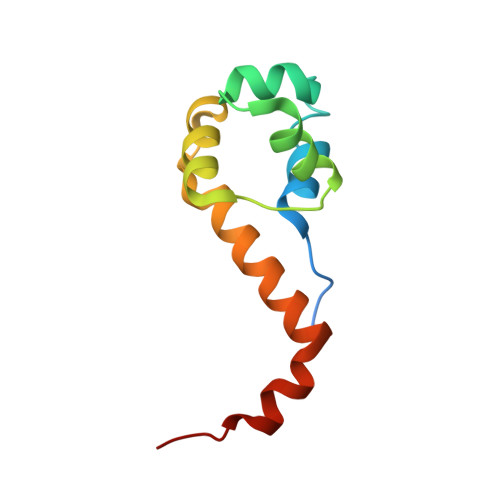
6FIX | pdb_00006fix

antitoxin GraA in complex with its operator

  • Classification: ANTITOXIN
  • Organism(s): Pseudomonas putida
  • Expression System: Escherichia coli
  • Mutation(s): No 

  • Deposited: 2018-01-19 Released: 2019-01-30 
  • Deposition Author(s): Talavera, A., Loris, R.
  • Funding Organization(s): Fonds voor Wetenschappelijk Onderzoek Vlaanderen, Vrije Universiteit Brussel, BioStruct-X

Experimental Data Snapshot

  • Method: X-RAY DIFFRACTION
  • Resolution: 3.80 Å
  • R-Value Free: 
    0.286 (Depositor), 0.293 (DCC) 
  • R-Value Work: 
    0.246 (Depositor), 0.256 (DCC) 
  • R-Value Observed: 
    0.248 (Depositor) 

wwPDB Validation 3D Report Full Report

Validation slider image for 6FIX

This is version 2.2 of the entry. See complete history

Literature

A dual role in regulation and toxicity for the disordered N-terminus of the toxin GraT.

Talavera, A.Tamman, H.Ainelo, A.Konijnenberg, A.Hadzi, S.Sobott, F.Garcia-Pino, A.Horak, R.Loris, R.

(2019) Nat Commun 10: 972-972

  • DOI: https://doi.org/10.1038/s41467-019-08865-z
  • Primary Citation Related Structures: 
    6F8H, 6F8S, 6FIX

  • PubMed Abstract: 

    Bacterial toxin-antitoxin (TA) modules are tightly regulated to maintain growth in favorable conditions or growth arrest during stress. A typical regulatory strategy involves the antitoxin binding and repressing its own promoter while the toxin often acts as a co-repressor. Here we show that Pseudomonas putida graTA-encoded antitoxin GraA and toxin GraT differ from other TA proteins in the sense that not the antitoxin but the toxin possesses a flexible region. GraA auto-represses the graTA promoter: two GraA dimers bind cooperatively at opposite sides of the operator sequence. Contrary to other TA modules, GraT is a de-repressor of the graTA promoter as its N-terminal disordered segment prevents the binding of the GraT 2 A 2 complex to the operator. Removal of this region restores operator binding and abrogates Gr aT toxicity. GraTA represents a TA module where a flexible region in the toxin rather than in the antitoxin controls operon expression and toxin activity.


  • Organizational Affiliation
    • Structural Biology Brussels, Department of Biotechnology, Vrije Universiteit Brussel, B-1050, Brussel, Belgium. atalaver@ulb.ac.be.

Macromolecule Content 

  • Total Structure Weight: 65.72 kDa 
  • Atom Count: 4,036 
  • Modeled Residue Count: 441 
  • Deposited Residue Count: 481 
  • Unique protein chains: 1
  • Unique nucleic acid chains: 2

Macromolecules


Find similar proteins by:|  3D Structure
Entity ID: 1
MoleculeChains  Sequence LengthOrganismDetailsImage
XRE family transcriptional regulator
A, B, D, E
105Pseudomonas putidaMutation(s): 0 
Gene Names: AYO08_18510
Find similar nucleic acids by:  (by identity cutoff) 
Entity ID: 2
MoleculeChains LengthOrganismImage
DNA (30-MER)31Pseudomonas putida
Sequence Annotations
Expand
Reference Sequence
Find similar nucleic acids by:  (by identity cutoff) 
Entity ID: 3
MoleculeChains LengthOrganismImage
DNA (30-MER)30Pseudomonas putida
Sequence Annotations
Expand
Reference Sequence

Experimental Data & Validation

Experimental Data

  • Method: X-RAY DIFFRACTION
  • Resolution: 3.80 Å
  • R-Value Free:  0.286 (Depositor), 0.293 (DCC) 
  • R-Value Work:  0.246 (Depositor), 0.256 (DCC) 
  • R-Value Observed: 0.248 (Depositor) 
Space Group: P 32
Unit Cell:
Length ( Å )Angle ( ˚ )
a = 105.55α = 90
b = 105.55β = 90
c = 149.94γ = 120
Software Package:
Software NamePurpose
PHENIXrefinement
XDSdata reduction
Aimlessdata scaling

Structure Validation

View Full Validation Report


Entry History 

& Funding Information

Deposition Data


Funding OrganizationLocationGrant Number
Fonds voor Wetenschappelijk Onderzoek VlaanderenBelgiumG.0135.15N, GOC1213N, G.0090.11N
Vrije Universiteit BrusselBelgiumOZR2232 to SH, SPR13
BioStruct-XBelgium1673, 6131

Revision History  (Full details and data files)

  • Version 1.0: 2019-01-30
    Type: Initial release
  • Version 2.0: 2019-02-06
    Changes: Data collection, Derived calculations, Polymer sequence, Structure summary
  • Version 2.1: 2019-03-13
    Changes: Data collection, Database references
  • Version 2.2: 2024-05-08
    Changes: Advisory, Data collection, Database references