6FES | pdb_00006fes

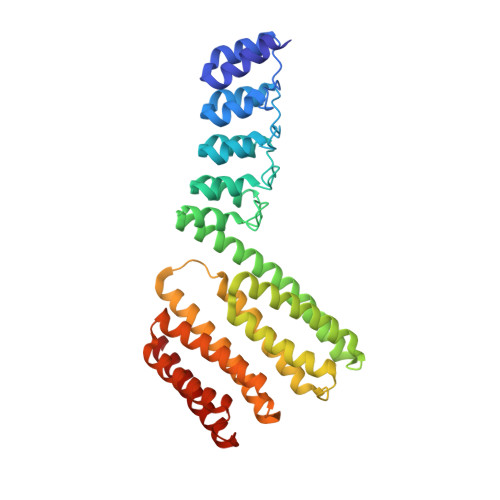
Crystal structure of novel repeat protein BRIC2 fused to DARPin D12


Experimental Data Snapshot

  • Method: X-RAY DIFFRACTION
  • Resolution: 3.00 Å
  • R-Value Free: 
    0.292 (Depositor), 0.296 (DCC) 
  • R-Value Work: 
    0.251 (Depositor), 0.254 (DCC) 
  • R-Value Observed: 
    0.253 (Depositor) 

Starting Model: experimental
View more details

wwPDB Validation 3D Report Full Report

Validation slider image for 6FES

This is version 1.3 of the entry. See complete history

Literature

An Interface-Driven Design Strategy Yields a Novel, Corrugated Protein Architecture.

ElGamacy, M.Coles, M.Ernst, P.Zhu, H.Hartmann, M.D.Pluckthun, A.Lupas, A.N.

(2018) ACS Synth Biol 7: 2226-2235

  • DOI: https://doi.org/10.1021/acssynbio.8b00224
  • Primary Citation Related Structures: 
    6FES, 6FF6

  • PubMed Abstract: 

    Designing proteins with novel folds remains a major challenge, as the biophysical properties of the target fold are not known a priori and no sequence profile exists to describe its features. Therefore, most computational design efforts so far have been directed toward creating proteins that recapitulate existing folds. Here we present a strategy centered upon the design of novel intramolecular interfaces that enables the construction of a target fold from a set of starting fragments. This strategy effectively reduces the amount of computational sampling necessary to achieve an optimal sequence, without compromising the level of topological control. The solenoid architecture has been a target of extensive protein design efforts, as it provides a highly modular platform of low topological complexity. However, none of the previous efforts have attempted to depart from the natural form, which is characterized by a uniformly handed superhelical architecture. Here we aimed to design a more complex platform, abolishing the superhelicity by introducing internally alternating handedness, resulting in a novel, corrugated architecture. We employed our interface-driven strategy, designing three proteins and confirming the design by solving the structure of two examples.


  • Organizational Affiliation
    • Department of Protein Evolution , Max-Planck-Institute for Developmental Biology , 72076 Tübingen , Germany.

Macromolecule Content 

  • Total Structure Weight: 165.55 kDa 
  • Atom Count: 11,544 
  • Modeled Residue Count: 1,454 
  • Deposited Residue Count: 1,468 
  • Unique protein chains: 1

Macromolecules

Find similar proteins by:|  3D Structure
Entity ID: 1
MoleculeChains  Sequence LengthOrganismDetailsImage
D12_BRIC2, a synthetic protein,D12_BRIC2, a synthetic protein
A, B, C, D
367synthetic constructMutation(s): 0 

Small Molecules

Ligands 2 Unique
IDChains Name / Formula / InChI Key2D Diagram3D Interactions
SO4

Query on SO4


Download:Ideal Coordinates CCD File
E [auth A]
F [auth A]
G [auth A]
J [auth B]
K [auth B]
E [auth A],
F [auth A],
G [auth A],
J [auth B],
K [auth B],
M [auth C],
P [auth D],
Q [auth D],
R [auth D]
SULFATE ION
O4 S
QAOWNCQODCNURD-UHFFFAOYSA-L
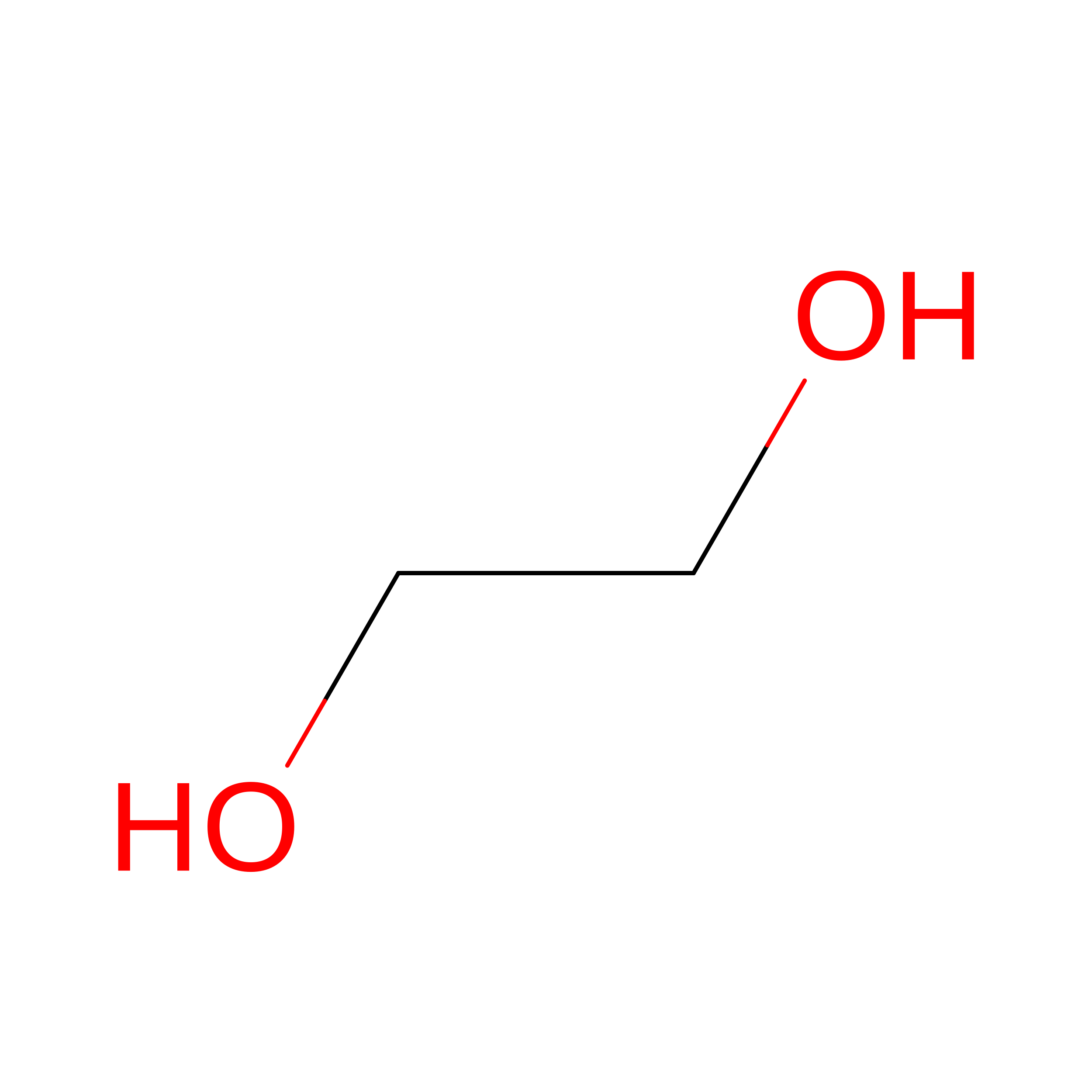
EDO

Query on EDO


Download:Ideal Coordinates CCD File
H [auth A]
I [auth A]
L [auth B]
N [auth C]
O [auth C]
H [auth A],
I [auth A],
L [auth B],
N [auth C],
O [auth C],
S [auth D],
T [auth D]
1,2-ETHANEDIOL
C2 H6 O2
LYCAIKOWRPUZTN-UHFFFAOYSA-N

Experimental Data & Validation

Experimental Data

  • Method: X-RAY DIFFRACTION
  • Resolution: 3.00 Å
  • R-Value Free:  0.292 (Depositor), 0.296 (DCC) 
  • R-Value Work:  0.251 (Depositor), 0.254 (DCC) 
  • R-Value Observed: 0.253 (Depositor) 
Space Group: P 1
Unit Cell:
Length ( Å )Angle ( ˚ )
a = 52.99α = 97.99
b = 63β = 91.92
c = 133.54γ = 110.81
Software Package:
Software NamePurpose
PHENIXrefinement
XDSdata reduction
XSCALEdata scaling
PHASERphasing

Structure Validation

View Full Validation Report


Entry History 

Deposition Data

Revision History  (Full details and data files)

  • Version 1.0: 2018-09-05
    Type: Initial release
  • Version 1.1: 2018-10-03
    Changes: Data collection, Database references
  • Version 1.2: 2024-01-17
    Changes: Data collection, Database references, Refinement description
  • Version 1.3: 2025-10-01
    Changes: Advisory, Derived calculations, Structure summary