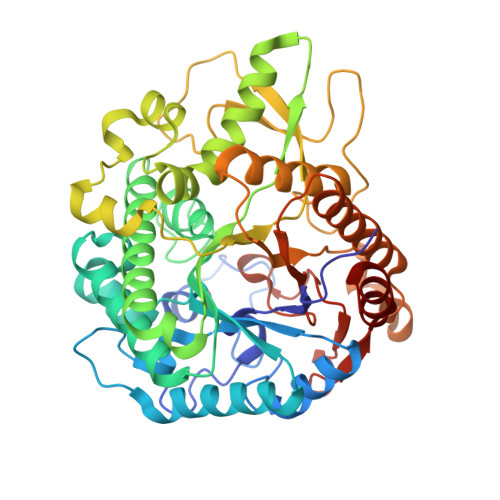
6EFU | pdb_00006efu

Crystal structure of the double mutant L167W / P172L of the beta-glucosidase from Trichoderma harzianum


Experimental Data Snapshot

  • Method: X-RAY DIFFRACTION
  • Resolution: 2.20 Å
  • R-Value Free: 
    0.221 (Depositor), 0.223 (DCC) 
  • R-Value Work: 
    0.178 (Depositor), 0.189 (DCC) 
  • R-Value Observed: 
    0.181 (Depositor) 

Starting Model: experimental
View more details

wwPDB Validation 3D Report Full Report

Validation slider image for 6EFU

This is version 1.2 of the entry. See complete history

Literature

An engineered GH1 beta-glucosidase displays enhanced glucose tolerance and increased sugar release from lignocellulosic materials.

Santos, C.A.Morais, M.A.B.Terrett, O.M.Lyczakowski, J.J.Zanphorlin, L.M.Ferreira-Filho, J.A.Tonoli, C.C.C.Murakami, M.T.Dupree, P.Souza, A.P.

(2019) Sci Rep 9: 4903-4903

  • DOI: https://doi.org/10.1038/s41598-019-41300-3
  • Primary Citation Related Structures: 
    6EFU

  • PubMed Abstract: 

    β-glucosidases play a critical role among the enzymes in enzymatic cocktails designed for plant biomass deconstruction. By catalysing the breakdown of β-1, 4-glycosidic linkages, β-glucosidases produce free fermentable glucose and alleviate the inhibition of other cellulases by cellobiose during saccharification. Despite this benefit, most characterised fungal β-glucosidases show weak activity at high glucose concentrations, limiting enzymatic hydrolysis of plant biomass in industrial settings. In this study, structural analyses combined with site-directed mutagenesis efficiently improved the functional properties of a GH1 β-glucosidase highly expressed by Trichoderma harzianum (ThBgl) under biomass degradation conditions. The tailored enzyme displayed high glucose tolerance levels, confirming that glucose tolerance can be achieved by the substitution of two amino acids that act as gatekeepers, changing active-site accessibility and preventing product inhibition. Furthermore, the enhanced efficiency of the engineered enzyme in terms of the amount of glucose released and ethanol yield was confirmed by saccharification and simultaneous saccharification and fermentation experiments using a wide range of plant biomass feedstocks. Our results not only experimentally confirm the structural basis of glucose tolerance in GH1 β-glucosidases but also demonstrate a strategy to improve technologies for bioethanol production based on enzymatic hydrolysis.


  • Organizational Affiliation
    • Centro de Biologia Molecular e Engenharia Genética, Universidade Estadual de Campinas, Campinas, SP, Brazil.

Macromolecule Content 

  • Total Structure Weight: 106.81 kDa 
  • Atom Count: 7,818 
  • Modeled Residue Count: 929 
  • Deposited Residue Count: 932 
  • Unique protein chains: 1

Macromolecules

Find similar proteins by:|  3D Structure
Entity ID: 1
MoleculeChains  Sequence LengthOrganismDetailsImage
Beta-glucosidase
A, B
466Trichoderma harzianumMutation(s): 2 
Gene Names: bglCI102_8745
EC: 3.2.1.21
UniProt
Find proteins for A0A2T4AR08 (Trichoderma harzianum CBS 226.95)
Explore A0A2T4AR08 
Go to UniProtKB:  A0A2T4AR08
Entity Groups
Sequence Clusters30% Identity50% Identity70% Identity90% Identity95% Identity100% Identity
UniProt GroupA0A2T4AR08
Sequence Annotations
Expand
Reference Sequence

Experimental Data & Validation

Experimental Data

  • Method: X-RAY DIFFRACTION
  • Resolution: 2.20 Å
  • R-Value Free:  0.221 (Depositor), 0.223 (DCC) 
  • R-Value Work:  0.178 (Depositor), 0.189 (DCC) 
  • R-Value Observed: 0.181 (Depositor) 
Space Group: P 21 21 21
Unit Cell:
Length ( Å )Angle ( ˚ )
a = 91.612α = 90
b = 96.213β = 90
c = 96.445γ = 90
Software Package:
Software NamePurpose
XDSdata reduction
XSCALEdata scaling
MOLREPphasing
PHENIXrefinement
PDB_EXTRACTdata extraction

Structure Validation

View Full Validation Report


Entry History 

& Funding Information

Deposition Data


Funding OrganizationLocationGrant Number
Sao Paulo Research Foundation (FAPESP)Brazil2015092020
Sao Paulo Research Foundation (FAPESP)Brazil15269820

Revision History  (Full details and data files)

  • Version 1.0: 2019-06-26
    Type: Initial release
  • Version 1.1: 2020-01-01
    Changes: Author supporting evidence
  • Version 1.2: 2023-10-11
    Changes: Data collection, Database references, Refinement description