6EEQ | pdb_00006eeq

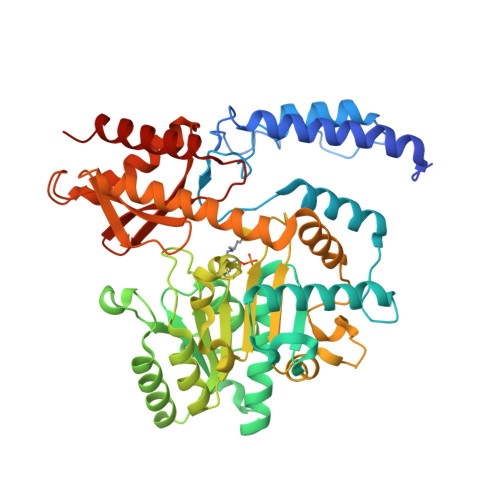
Crystal structure of Rhodiola rosea 4-hydroxyphenylacetaldehyde synthase


Experimental Data Snapshot

  • Method: X-RAY DIFFRACTION
  • Resolution: 2.60 Å
  • R-Value Free: 
    0.269 (Depositor), 0.275 (DCC) 
  • R-Value Work: 
    0.211 (Depositor), 0.220 (DCC) 
  • R-Value Observed: 
    0.217 (Depositor) 

wwPDB Validation 3D Report Full Report

Validation slider image for 6EEQ

This is version 1.5 of the entry. See complete history

Literature

Structural basis for divergent and convergent evolution of catalytic machineries in plant aromatic amino acid decarboxylase proteins.

Torrens-Spence, M.P.Chiang, Y.C.Smith, T.Vicent, M.A.Wang, Y.Weng, J.K.

(2020) Proc Natl Acad Sci U S A 117: 10806-10817

  • DOI: https://doi.org/10.1073/pnas.1920097117
  • Primary Citation Related Structures: 
    6EEI, 6EEM, 6EEQ, 6EEW

  • PubMed Abstract: 

    Radiation of the plant pyridoxal 5'-phosphate (PLP)-dependent aromatic l-amino acid decarboxylase (AAAD) family has yielded an array of paralogous enzymes exhibiting divergent substrate preferences and catalytic mechanisms. Plant AAADs catalyze either the decarboxylation or decarboxylation-dependent oxidative deamination of aromatic l-amino acids to produce aromatic monoamines or aromatic acetaldehydes, respectively. These compounds serve as key precursors for the biosynthesis of several important classes of plant natural products, including indole alkaloids, benzylisoquinoline alkaloids, hydroxycinnamic acid amides, phenylacetaldehyde-derived floral volatiles, and tyrosol derivatives. Here, we present the crystal structures of four functionally distinct plant AAAD paralogs. Through structural and functional analyses, we identify variable structural features of the substrate-binding pocket that underlie the divergent evolution of substrate selectivity toward indole, phenyl, or hydroxyphenyl amino acids in plant AAADs. Moreover, we describe two mechanistic classes of independently arising mutations in AAAD paralogs leading to the convergent evolution of the derived aldehyde synthase activity. Applying knowledge learned from this study, we successfully engineered a shortened benzylisoquinoline alkaloid pathway to produce (S)-norcoclaurine in yeast. This work highlights the pliability of the AAAD fold that allows change of substrate selectivity and access to alternative catalytic mechanisms with only a few mutations.


  • Organizational Affiliation
    • Whitehead Institute for Biomedical Research, Cambridge, MA 02142.

Macromolecule Content 

  • Total Structure Weight: 54.66 kDa 
  • Atom Count: 3,705 
  • Modeled Residue Count: 467 
  • Deposited Residue Count: 490 
  • Unique protein chains: 1

Macromolecules

Find similar proteins by:|  3D Structure
Entity ID: 1
MoleculeChains  Sequence LengthOrganismDetailsImage
4-hydroxyphenylacetaldehyde synthase490Rhodiola roseaMutation(s): 0 
EC: 4.1.1.108
UniProt
Find proteins for A0A2I6B3P0 (Rhodiola rosea)
Explore A0A2I6B3P0 
Go to UniProtKB:  A0A2I6B3P0
Entity Groups
Sequence Clusters30% Identity50% Identity70% Identity90% Identity95% Identity100% Identity
UniProt GroupA0A2I6B3P0
Sequence Annotations
Expand
Reference Sequence

Small Molecules

Modified Residues  1 Unique
IDChains TypeFormula2D DiagramParent
LLP
Query on LLP
A
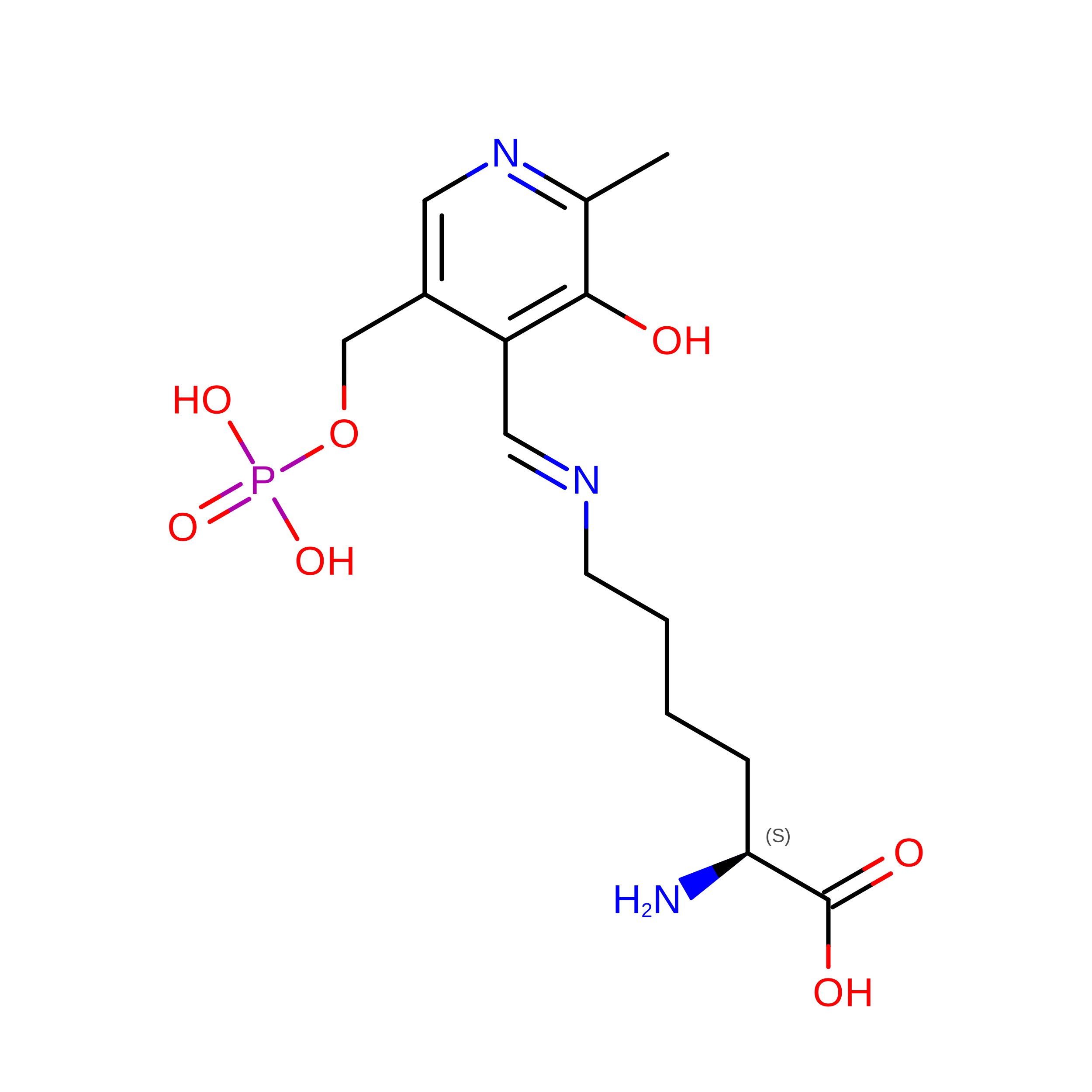
L-PEPTIDE LINKINGC14 H22 N3 O7 PLYS

Experimental Data & Validation

Experimental Data

  • Method: X-RAY DIFFRACTION
  • Resolution: 2.60 Å
  • R-Value Free:  0.269 (Depositor), 0.275 (DCC) 
  • R-Value Work:  0.211 (Depositor), 0.220 (DCC) 
  • R-Value Observed: 0.217 (Depositor) 
Space Group: P 43 21 2
Unit Cell:
Length ( Å )Angle ( ˚ )
a = 118.36α = 90
b = 118.36β = 90
c = 67.04γ = 90
Software Package:
Software NamePurpose
PHENIXrefinement
MOSFLMdata reduction
SCALAdata scaling
PHASERphasing

Structure Validation

View Full Validation Report


Entry History 

& Funding Information

Deposition Data


Funding OrganizationLocationGrant Number
National Institutes of Health/National Institute of General Medical Sciences (NIH/NIGMS)United StatesP41 GM103403

Revision History  (Full details and data files)

  • Version 1.0: 2018-09-19
    Type: Initial release
  • Version 1.1: 2019-10-02
    Changes: Data collection, Database references
  • Version 1.2: 2020-01-01
    Changes: Author supporting evidence
  • Version 1.3: 2020-05-20
    Changes: Database references
  • Version 1.4: 2020-06-03
    Changes: Database references
  • Version 1.5: 2025-04-02
    Changes: Data collection, Database references, Structure summary