6EDL | pdb_00006edl

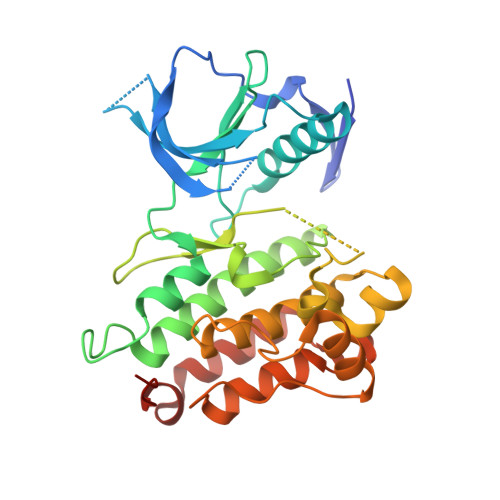
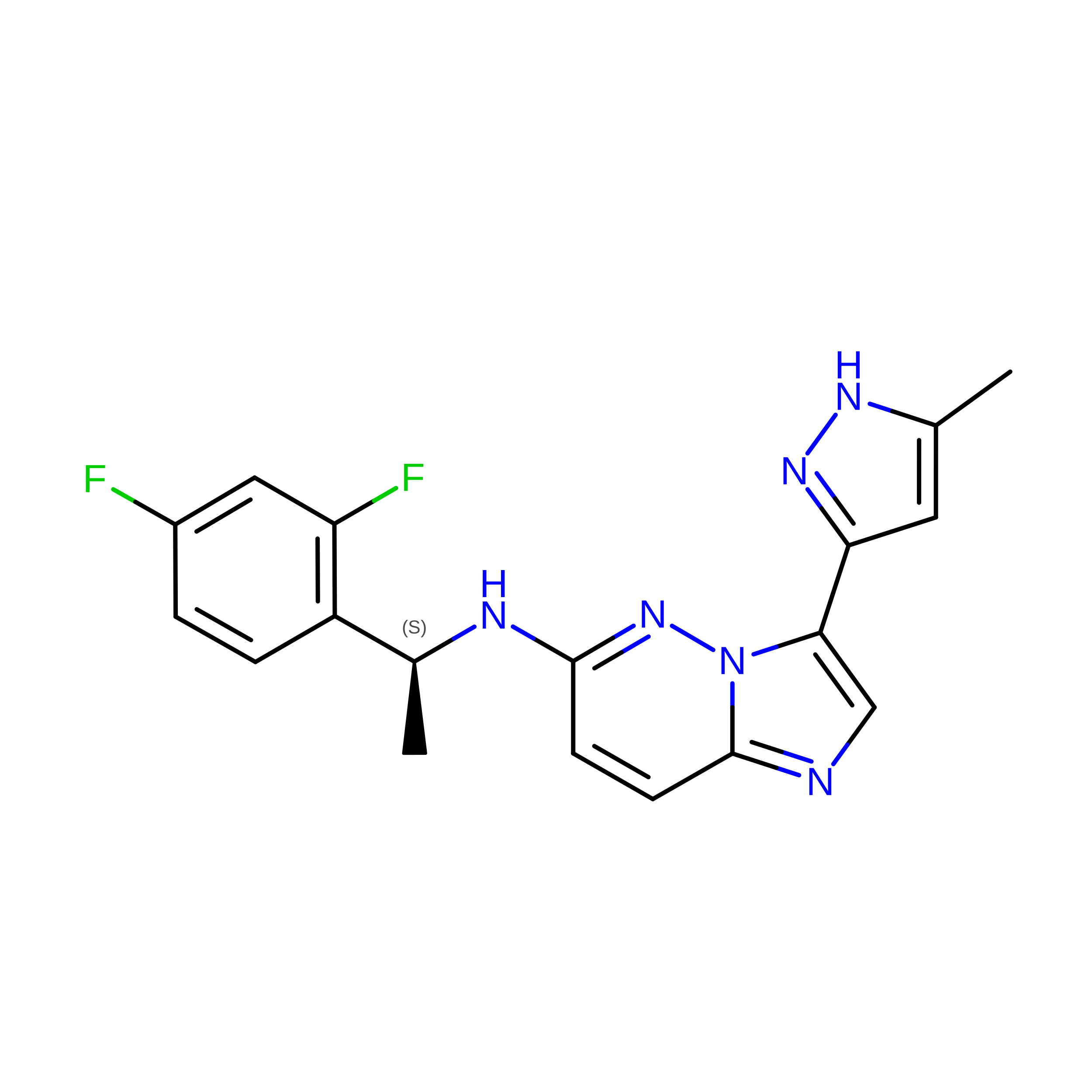
hALK in complex with compound 1 (S)-N-(1-(2,4-difluorophenyl)ethyl)-3-(3-methyl-1H-pyrazol-5-yl)imidazo[1,2-b]pyridazin-6-amine


Experimental Data Snapshot

  • Method: X-RAY DIFFRACTION
  • Resolution: 2.80 Å
  • R-Value Free: 
    0.282 (Depositor), 0.283 (DCC) 
  • R-Value Work: 
    0.227 (Depositor), 0.227 (DCC) 
  • R-Value Observed: 
    0.231 (Depositor) 

wwPDB Validation 3D Report Full Report

Validation slider image for 6EDL

Ligand Structure Quality Assessment 


This is version 1.4 of the entry. See complete history

Literature

Discovery of Potent, Selective, and Brain-Penetrant 1 H-Pyrazol-5-yl-1 H-pyrrolo[2,3- b]pyridines as Anaplastic Lymphoma Kinase (ALK) Inhibitors.

Fushimi, M.Fujimori, I.Wakabayashi, T.Hasui, T.Kawakita, Y.Imamura, K.Kato, T.Murakami, M.Ishii, T.Kikko, Y.Kasahara, M.Nakatani, A.Hiura, Y.Miyamoto, M.Saikatendu, K.Zou, H.Lane, S.W.Lawson, J.D.Imoto, H.

(2019) J Med Chem 62: 4915-4935

  • DOI: https://doi.org/10.1021/acs.jmedchem.8b01630
  • Primary Citation Related Structures: 
    6E0R, 6EBW, 6EDL

  • PubMed Abstract: 

    Anaplastic lymphoma kinase (ALK), a member of the receptor tyrosine kinase family, is predominantly expressed in the brain and implicated in neuronal development and cognition. However, the detailed function of ALK in the central nervous system (CNS) is still unclear. To elucidate the role of ALK in the CNS, it was necessary to discover a potent, selective, and brain-penetrant ALK inhibitor. Scaffold hopping and lead optimization of N-(2,4-difluorobenzyl)-3-(1 H-pyrazol-5-yl)imidazo[1,2- b]pyridazin-6-amine 1 guided by a cocrystal structure of compound 1 bound to ALK resulted in the identification of (6-(1-(5-fluoropyridin-2-yl)ethoxy)-1-(5-methyl-1 H-pyrazol-3-yl)-1 H-pyrrolo[2,3- b]pyridin-3-yl)((2 S)-2-methylmorpholin-4-yl)methanone 13 as a highly potent, selective, and brain-penetrable compound. Intraperitoneal administration of compound 13 significantly decreased the phosphorylated-ALK (p-ALK) levels in the hippocampus and prefrontal cortex in the mouse brain. These results suggest that compound 13 could serve as a useful chemical probe to elucidate the mechanism of ALK-mediated brain functions and the therapeutic potential of ALK inhibition.


  • Organizational Affiliation
    • Neuroscience Drug Discovery Unit, Research , Takeda Pharmaceutical Company Limited , 26-1, Muraoka-Higashi 2-chome, Fujisawa , Kanagawa 251-8555 , Japan.

Macromolecule Content 

  • Total Structure Weight: 36.4 kDa 
  • Atom Count: 2,226 
  • Modeled Residue Count: 282 
  • Deposited Residue Count: 322 
  • Unique protein chains: 1

Macromolecules

Find similar proteins by:|  3D Structure
Entity ID: 1
MoleculeChains  Sequence LengthOrganismDetailsImage
ALK tyrosine kinase receptor322Homo sapiensMutation(s): 0 
Gene Names: ALK
EC: 2.7.10.1
UniProt & NIH Common Fund Data Resources
Find proteins for Q9UM73 (Homo sapiens)
Explore Q9UM73 
Go to UniProtKB:  Q9UM73
PHAROS:  Q9UM73
GTEx:  ENSG00000171094 
Entity Groups
Sequence Clusters30% Identity50% Identity70% Identity90% Identity95% Identity100% Identity
UniProt GroupQ9UM73
Sequence Annotations
Expand
Reference Sequence

Small Molecules

Ligands 1 Unique
IDChains Name / Formula / InChI Key2D Diagram3D Interactions
J4M
(Subject of Investigation/LOI)

Query on J4M


Download:Ideal Coordinates CCD File
B [auth A]N-[(1S)-1-(2,4-difluorophenyl)ethyl]-3-(5-methyl-1H-pyrazol-3-yl)imidazo[1,2-b]pyridazin-6-amine
C18 H16 F2 N6
SMKJDFHRUWJNRS-NSHDSACASA-N

Experimental Data & Validation

Experimental Data

  • Method: X-RAY DIFFRACTION
  • Resolution: 2.80 Å
  • R-Value Free:  0.282 (Depositor), 0.283 (DCC) 
  • R-Value Work:  0.227 (Depositor), 0.227 (DCC) 
  • R-Value Observed: 0.231 (Depositor) 
Space Group: P 21 21 21
Unit Cell:
Length ( Å )Angle ( ˚ )
a = 51.571α = 90
b = 57.409β = 90
c = 103.41γ = 90
Software Package:
Software NamePurpose
PHENIXrefinement
HKL-2000data reduction
HKL-2000data scaling
PHASERphasing

Structure Validation

View Full Validation Report


Ligand Structure Quality Assessment 


Entry History 

Deposition Data

Revision History  (Full details and data files)

  • Version 1.0: 2019-05-01
    Type: Initial release
  • Version 1.1: 2019-05-08
    Changes: Data collection, Database references
  • Version 1.2: 2019-05-15
    Changes: Data collection, Database references
  • Version 1.3: 2019-06-05
    Changes: Data collection, Database references
  • Version 1.4: 2024-03-13
    Changes: Data collection, Database references