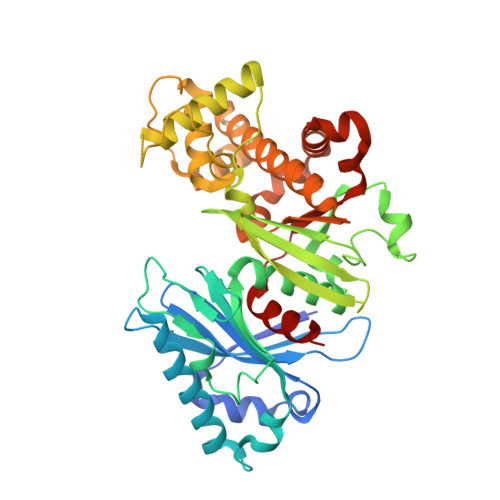
6EDI | pdb_00006edi

Crystal structure of Leishmania braziliensis glucokinase


Experimental Data Snapshot

  • Method: X-RAY DIFFRACTION
  • Resolution: 1.85 Å
  • R-Value Free: 
    0.262 (Depositor), 0.265 (DCC) 
  • R-Value Work: 
    0.212 (Depositor), 0.215 (DCC) 
  • R-Value Observed: 
    0.215 (Depositor) 

Starting Model: experimental
View more details

wwPDB Validation 3D Report Full Report

Validation slider image for 6EDI

This is version 1.5 of the entry. See complete history

Literature

The crystal structure of glucokinase from Leishmania braziliensis.

Buechner, G.S.Millington, M.E.Perry, K.D'Antonio, E.L.

(2019) Mol Biochem Parasitol 227: 47-52

  • DOI: https://doi.org/10.1016/j.molbiopara.2018.12.002
  • Primary Citation Related Structures: 
    6EDI

  • PubMed Abstract: 

    Glucokinase from pathogenic protozoa of the genus Leishmania is a potential drug target for the chemotherapeutic treatment against leishmaniasis because this enzyme is located at a nodal point between two critically important metabolic pathways, glycolysis and the pentose phosphate pathway (PPP). L. braziliensis glucokinase (LbGlcK) was evaluated for its structural characterization and enzymatic performance. The enzyme catalyzes the phosphorylation of d-glucose with co-substrate ATP to yield the products G6P and ADP. LbGlcK had K M values determined as 6.61 ± 2.63 mM and 0.338 ± 0.080 mM for d-glucose and ATP, respectively. The 1.85 Å resolution X-ray crystal structure of the apo form of LbGlcK was determined and a homodimer was revealed where each subunit (both in open conformations) included the typical small and large domains. Structural comparisons were assessed in relationship to Homo sapiens hexokinase IV and Trypanosoma cruzi glucokinase. Comparisons revealed that all residues important for making hydrogen bonding interactions with d-glucose in the active site and catalysis were strictly conserved. LbGlcK was screened against four glucosamine analogue inhibitors and the stronger inhibitor of the series, HPOP-GlcN, had a K i value of 56.9 ± 16.6 μM that exhibited competitive inhibition. For the purpose of future structure-based drug design experimentation, L. braziliensis glucokinase was observed to be very similar to T. cruzi glucokinase even though there was a 44% protein sequence identity between the two enzymes.


  • Organizational Affiliation
    • Department of Natural Sciences, University of South Carolina Beaufort, 1 University Boulevard, Bluffton, SC, 29909, USA.

Macromolecule Content 

  • Total Structure Weight: 88.64 kDa 
  • Atom Count: 6,126 
  • Modeled Residue Count: 788 
  • Deposited Residue Count: 824 
  • Unique protein chains: 1

Macromolecules

Find similar proteins by:|  3D Structure
Entity ID: 1
MoleculeChains  Sequence LengthOrganismDetailsImage
Glucokinase
A, B
412Leishmania braziliensis MHOM/BR/75/M2904Mutation(s): 0 
Gene Names: LBRM_35_2550
EC: 2.7.1.2
UniProt
Find proteins for A4HPA0 (Leishmania braziliensis)
Explore A4HPA0 
Go to UniProtKB:  A4HPA0
Entity Groups
Sequence Clusters30% Identity50% Identity70% Identity90% Identity95% Identity100% Identity
UniProt GroupA4HPA0
Sequence Annotations
Expand
Reference Sequence

Experimental Data & Validation

Experimental Data

  • Method: X-RAY DIFFRACTION
  • Resolution: 1.85 Å
  • R-Value Free:  0.262 (Depositor), 0.265 (DCC) 
  • R-Value Work:  0.212 (Depositor), 0.215 (DCC) 
  • R-Value Observed: 0.215 (Depositor) 
Space Group: P 1 21 1
Unit Cell:
Length ( Å )Angle ( ˚ )
a = 68.477α = 90
b = 63.261β = 107.81
c = 85.57γ = 90
Software Package:
Software NamePurpose
XDSdata reduction
Aimlessdata scaling
PHASERphasing
PHENIXrefinement
PDB_EXTRACTdata extraction

Structure Validation

View Full Validation Report


Entry History 

Deposition Data

Revision History  (Full details and data files)

  • Version 1.0: 2018-08-29
    Type: Initial release
  • Version 1.1: 2019-01-02
    Changes: Data collection, Database references
  • Version 1.2: 2019-01-09
    Changes: Data collection, Database references
  • Version 1.3: 2019-01-23
    Changes: Data collection, Database references
  • Version 1.4: 2019-04-17
    Changes: Author supporting evidence, Data collection
  • Version 1.5: 2023-10-11
    Changes: Data collection, Database references, Refinement description