6EA6 | pdb_00006ea6

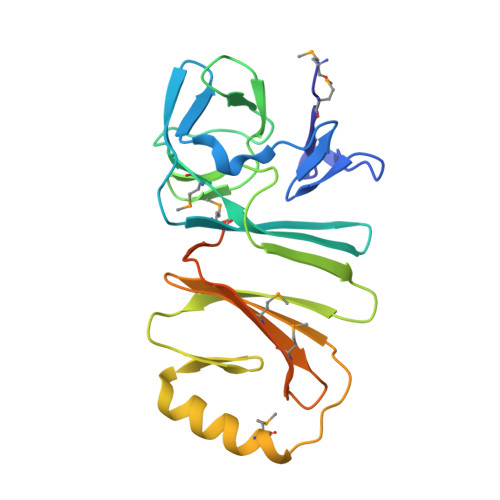
Structure of VACV poxin 2'3' cGAMP-specific nuclease


Experimental Data Snapshot

  • Method: X-RAY DIFFRACTION
  • Resolution: 1.70 Å
  • R-Value Free: 
    0.182 (Depositor), 0.184 (DCC) 
  • R-Value Work: 
    0.160 (Depositor), 0.161 (DCC) 
  • R-Value Observed: 
    0.160 (Depositor) 

wwPDB Validation 3D Report Full Report

Validation slider image for 6EA6

This is version 1.4 of the entry. See complete history

Literature

Viral and metazoan poxins are cGAMP-specific nucleases that restrict cGAS-STING signalling.

Eaglesham, J.B.Pan, Y.Kupper, T.S.Kranzusch, P.J.

(2019) Nature 566: 259-263

  • DOI: https://doi.org/10.1038/s41586-019-0928-6
  • Primary Citation Related Structures: 
    6EA6, 6EA8, 6EA9

  • PubMed Abstract: 

    Cytosolic DNA triggers innate immune responses through the activation of cyclic GMP-AMP synthase (cGAS) and production of the cyclic dinucleotide second messenger 2',3'-cyclic GMP-AMP (cGAMP) 1-4 . 2',3'-cGAMP is a potent inducer of immune signalling; however, no intracellular nucleases are known to cleave 2',3'-cGAMP and prevent the activation of the receptor stimulator of interferon genes (STING) 5-7 . Here we develop a biochemical screen to analyse 24 mammalian viruses, and identify poxvirus immune nucleases (poxins) as a family of 2',3'-cGAMP-degrading enzymes. Poxins cleave 2',3'-cGAMP to restrict STING-dependent signalling and deletion of the poxin gene (B2R) attenuates vaccinia virus replication in vivo. Crystal structures of vaccinia virus poxin in pre- and post-reactive states define the mechanism of selective 2',3'-cGAMP degradation through metal-independent cleavage of the 3'-5' bond, converting 2',3'-cGAMP into linear Gp[2'-5']Ap[3']. Poxins are conserved in mammalian poxviruses. In addition, we identify functional poxin homologues in the genomes of moths and butterflies and the baculoviruses that infect these insects. Baculovirus and insect host poxin homologues retain selective 2',3'-cGAMP degradation activity, suggesting an ancient role for poxins in cGAS-STING regulation. Our results define poxins as a family of 2',3'-cGAMP-specific nucleases and demonstrate a mechanism for how viruses evade innate immunity.


  • Organizational Affiliation
    • Department of Microbiology and Immunobiology, Harvard Medical School, Boston, MA, USA.

Macromolecule Content 

  • Total Structure Weight: 100.29 kDa 
  • Atom Count: 6,910 
  • Modeled Residue Count: 773 
  • Deposited Residue Count: 880 
  • Unique protein chains: 1

Macromolecules

Find similar proteins by:|  3D Structure
Entity ID: 1
MoleculeChains  Sequence LengthOrganismDetailsImage
Protein B2A,
B [auth C],
C [auth B],
D
220Vaccinia virus WRMutation(s): 0 
Gene Names: VACWR184B2R
EC: 3.1
UniProt
Find proteins for Q01225 (Vaccinia virus (strain Western Reserve))
Explore Q01225 
Go to UniProtKB:  Q01225
Entity Groups
Sequence Clusters30% Identity50% Identity70% Identity90% Identity95% Identity100% Identity
UniProt GroupQ01225
Sequence Annotations
Expand
Reference Sequence

Small Molecules

Modified Residues  1 Unique
IDChains TypeFormula2D DiagramParent
MSE
Query on MSE
A,
B [auth C],
C [auth B],
D
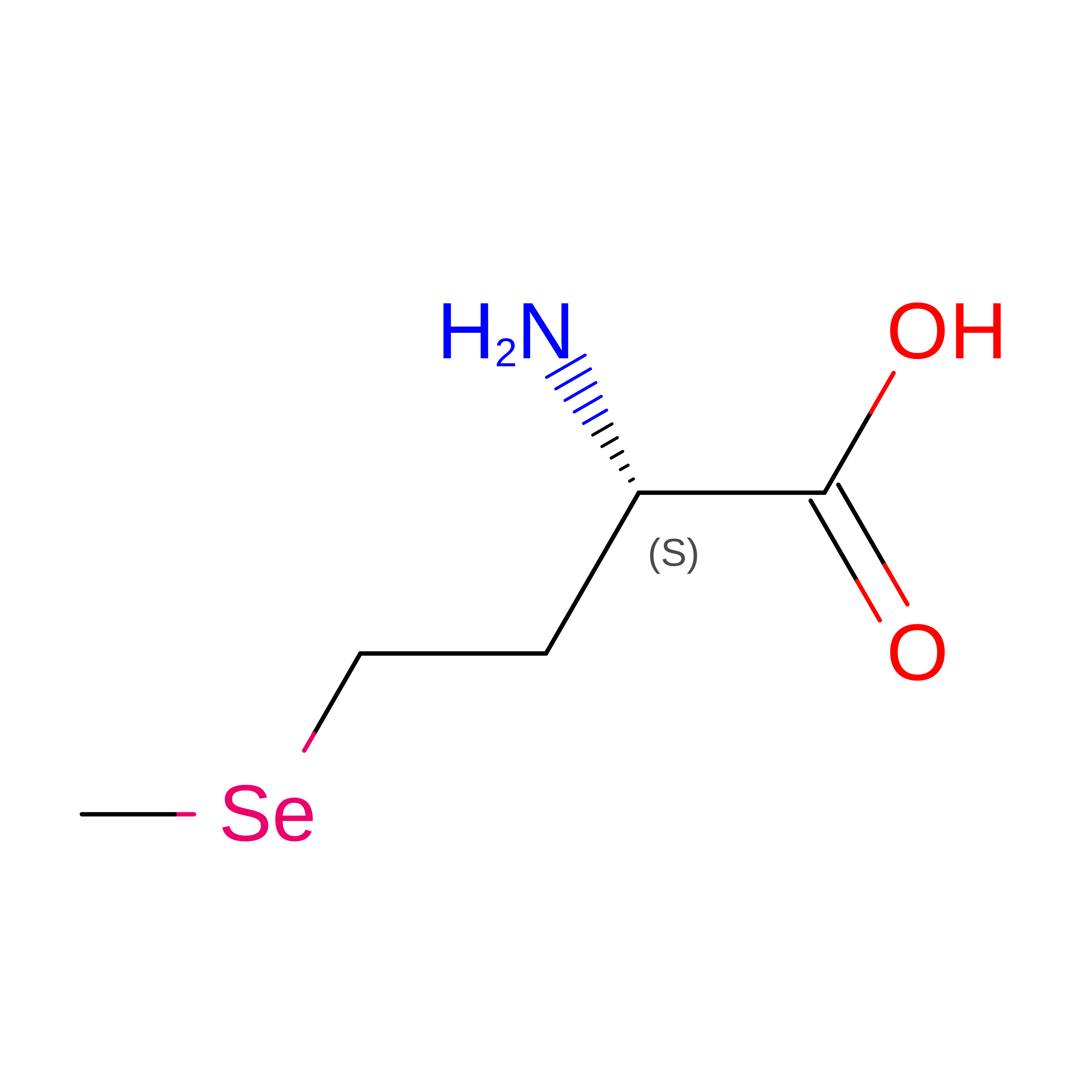
L-PEPTIDE LINKINGC5 H11 N O2 SeMET

Experimental Data & Validation

Experimental Data

  • Method: X-RAY DIFFRACTION
  • Resolution: 1.70 Å
  • R-Value Free:  0.182 (Depositor), 0.184 (DCC) 
  • R-Value Work:  0.160 (Depositor), 0.161 (DCC) 
  • R-Value Observed: 0.160 (Depositor) 
Space Group: P 1 21 1
Unit Cell:
Length ( Å )Angle ( ˚ )
a = 55.026α = 90
b = 93.194β = 105.63
c = 94.133γ = 90
Software Package:
Software NamePurpose
PHENIXrefinement
XDSdata reduction
Aimlessdata scaling
PHASERphasing

Structure Validation

View Full Validation Report


Entry History 

Deposition Data

Revision History  (Full details and data files)

  • Version 1.0: 2019-02-06
    Type: Initial release
  • Version 1.1: 2019-02-20
    Changes: Data collection, Database references
  • Version 1.2: 2019-02-27
    Changes: Data collection, Database references
  • Version 1.3: 2019-12-11
    Changes: Derived calculations
  • Version 1.4: 2024-10-23
    Changes: Data collection, Database references, Structure summary