6E8T | pdb_00006e8t

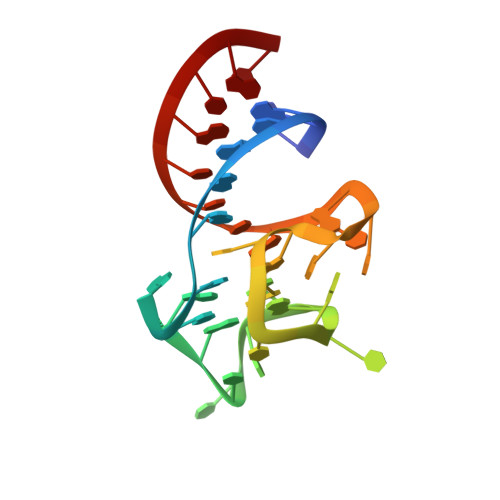
Structure of the Mango-III (A10U) aptamer bound to TO1-Biotin


Experimental Data Snapshot

  • Method: X-RAY DIFFRACTION
  • Resolution: 2.90 Å
  • R-Value Free: 
    0.236 (Depositor), 0.236 (DCC) 
  • R-Value Work: 
    0.195 (Depositor), 0.197 (DCC) 
  • R-Value Observed: 
    0.199 (Depositor) 

Starting Model: experimental
View more details

wwPDB Validation 3D Report Full Report

Validation slider image for 6E8T

Ligand Structure Quality Assessment 


This is version 1.2 of the entry. See complete history

Literature

Structure and functional reselection of the Mango-III fluorogenic RNA aptamer.

Trachman 3rd., R.J.Autour, A.Jeng, S.C.Y.Abdolahzadeh, A.Andreoni, A.Cojocaru, R.Garipov, R.Dolgosheina, E.V.Knutson, J.R.Ryckelynck, M.Unrau, P.J.Ferre-D'Amare, A.R.

(2019) Nat Chem Biol 15: 472-479

  • DOI: https://doi.org/10.1038/s41589-019-0267-9
  • Primary Citation Related Structures: 
    6E8S, 6E8T, 6E8U

  • PubMed Abstract: 

    Several turn-on RNA aptamers that activate small-molecule fluorophores have been selected in vitro. Among these, the ~30 nucleotide Mango-III is notable because it binds the thiazole orange derivative TO1-Biotin with high affinity and fluoresces brightly (quantum yield 0.55). Uniquely among related aptamers, Mango-III exhibits biphasic thermal melting, characteristic of molecules with tertiary structure. We report crystal structures of TO1-Biotin complexes of Mango-III, a structure-guided mutant Mango-III(A10U), and a functionally reselected mutant iMango-III. The structures reveal a globular architecture arising from an unprecedented pseudoknot-like connectivity between a G-quadruplex and an embedded non-canonical duplex. The fluorophore is restrained into a planar conformation by the G-quadruplex, a lone, long-range trans Watson-Crick pair (whose A10U mutation increases quantum yield to 0.66), and a pyrimidine perpendicular to the nucleobase planes of those motifs. The improved iMango-III and Mango-III(A10U) fluoresce ~50% brighter than enhanced green fluorescent protein, making them suitable tags for live cell RNA visualization.


  • Organizational Affiliation
    • Biochemistry and Biophysics Center, National Heart, Lung, and Blood Institute, Bethesda, MD, USA.

Macromolecule Content 

  • Total Structure Weight: 48.17 kDa 
  • Atom Count: 3,169 
  • Modeled Residue Count: 143 
  • Deposited Residue Count: 144 
  • Unique nucleic acid chains: 1

Macromolecules

Find similar nucleic acids by:  (by identity cutoff) 
Entity ID: 1
MoleculeChains LengthOrganismImage
RNA (35-MER)A [auth D],
B [auth C],
C [auth B],
D [auth A]
36synthetic construct
Sequence Annotations
Expand
Reference Sequence

Small Molecules

Ligands 3 Unique
IDChains Name / Formula / InChI Key2D Diagram3D Interactions
HZG

Query on HZG


Download:Ideal Coordinates CCD File
E [auth D],
G [auth C],
J [auth B],
L [auth A]
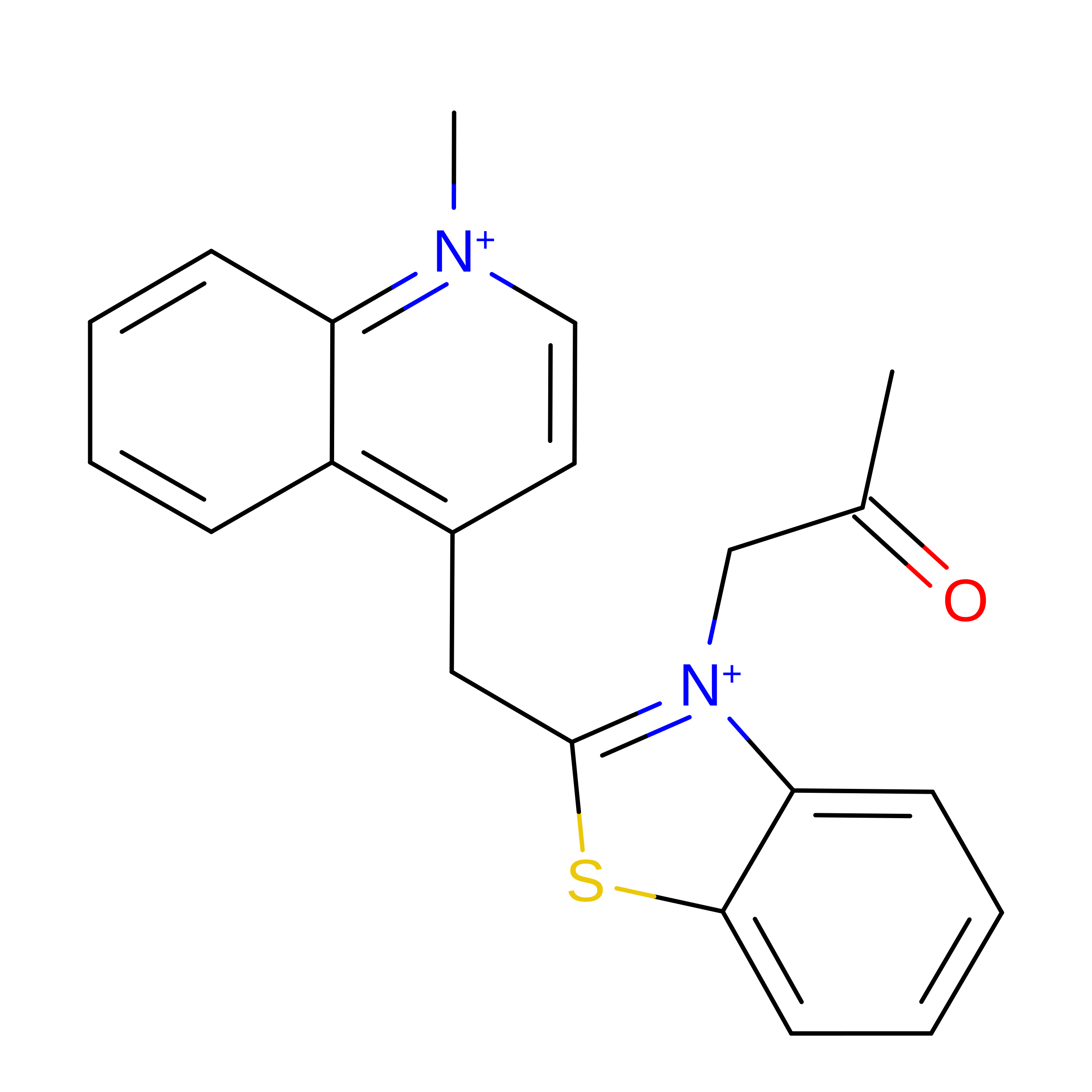
1-methyl-4-{[3-(2-oxopropyl)-1,3-benzothiazol-3-ium-2-yl]methyl}quinolin-1-ium
C21 H20 N2 O S
HTPXDOYVWJQKFJ-UHFFFAOYSA-N
K

Query on K


Download:Ideal Coordinates CCD File
F [auth D],
H [auth C],
K [auth B],
M [auth A]
POTASSIUM ION
K
NPYPAHLBTDXSSS-UHFFFAOYSA-N
NA

Query on NA


Download:Ideal Coordinates CCD File
I [auth C]SODIUM ION
Na
FKNQFGJONOIPTF-UHFFFAOYSA-N

Experimental Data & Validation

Experimental Data

  • Method: X-RAY DIFFRACTION
  • Resolution: 2.90 Å
  • R-Value Free:  0.236 (Depositor), 0.236 (DCC) 
  • R-Value Work:  0.195 (Depositor), 0.197 (DCC) 
  • R-Value Observed: 0.199 (Depositor) 
Space Group: H 3
Unit Cell:
Length ( Å )Angle ( ˚ )
a = 91.945α = 90
b = 91.945β = 90
c = 161.691γ = 120
Software Package:
Software NamePurpose
PHENIXrefinement
PHENIXrefinement
DIALSdata reduction
DIALSdata scaling
PHASERphasing

Structure Validation

View Full Validation Report


Ligand Structure Quality Assessment 


Entry History 

Deposition Data

Revision History  (Full details and data files)

  • Version 1.0: 2019-04-17
    Type: Initial release
  • Version 1.1: 2019-04-24
    Changes: Data collection, Database references
  • Version 1.2: 2023-10-11
    Changes: Data collection, Database references, Derived calculations, Refinement description