6E6B | pdb_00006e6b

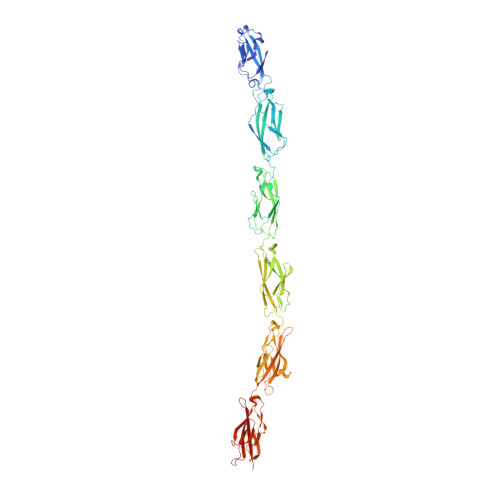
Crystal structure of the Protocadherin GammaB4 extracellular domain


Experimental Data Snapshot

  • Method: X-RAY DIFFRACTION
  • Resolution: 4.52 Å
  • R-Value Free: 
    0.277 (Depositor), 0.282 (DCC) 
  • R-Value Work: 
    0.231 (Depositor), 0.238 (DCC) 
  • R-Value Observed: 
    0.234 (Depositor) 

Starting Models: experimental
View more details

wwPDB Validation 3D Report Full Report

Validation slider image for 6E6B

Ligand Structure Quality Assessment 


This is version 2.2 of the entry. See complete history

Literature

Visualization of clustered protocadherin neuronal self-recognition complexes.

Brasch, J.Goodman, K.M.Noble, A.J.Rapp, M.Mannepalli, S.Bahna, F.Dandey, V.P.Bepler, T.Berger, B.Maniatis, T.Potter, C.S.Carragher, B.Honig, B.Shapiro, L.

(2019) Nature 569: 280-283

  • DOI: https://doi.org/10.1038/s41586-019-1089-3
  • Primary Citation Related Structures: 
    6E6B

  • PubMed Abstract: 

    Neurite self-recognition and avoidance are fundamental properties of all nervous systems 1 . These processes facilitate dendritic arborization 2,3 , prevent formation of autapses 4 and allow free interaction among non-self neurons 1,2,4,5 . Avoidance among self neurites is mediated by stochastic cell-surface expression of combinations of about 60 isoforms of α-, β- and γ-clustered protocadherin that provide mammalian neurons with single-cell identities 1,2,4-13 . Avoidance is observed between neurons that express identical protocadherin repertoires 2,5 , and single-isoform differences are sufficient to prevent self-recognition 10 . Protocadherins form isoform-promiscuous cis dimers and isoform-specific homophilic trans dimers 10,14-20 . Although these interactions have previously been characterized in isolation 15,17-20 , structures of full-length protocadherin ectodomains have not been determined, and how these two interfaces engage in self-recognition between neuronal surfaces remains unknown. Here we determine the molecular arrangement of full-length clustered protocadherin ectodomains in single-isoform self-recognition complexes, using X-ray crystallography and cryo-electron tomography. We determine the crystal structure of the clustered protocadherin γB4 ectodomain, which reveals a zipper-like lattice that is formed by alternating cis and trans interactions. Using cryo-electron tomography, we show that clustered protocadherin γB6 ectodomains tethered to liposomes spontaneously assemble into linear arrays at membrane contact sites, in a configuration that is consistent with the assembly observed in the crystal structure. These linear assemblies pack against each other as parallel arrays to form larger two-dimensional structures between membranes. Our results suggest that the formation of ordered linear assemblies by clustered protocadherins represents the initial self-recognition step in neuronal avoidance, and thus provide support for the isoform-mismatch chain-termination model of protocadherin-mediated self-recognition, which depends on these linear chains 11 .


  • Organizational Affiliation
    • Zuckerman Mind, Brain and Behavior Institute, Columbia University, New York, NY, USA.

Macromolecule Content 

  • Total Structure Weight: 146.62 kDa 
  • Atom Count: 9,742 
  • Modeled Residue Count: 1,258 
  • Deposited Residue Count: 1,292 
  • Unique protein chains: 1

Macromolecules

Find similar proteins by:|  3D Structure
Entity ID: 1
MoleculeChains  Sequence LengthOrganismDetailsImage
Protocadherin gamma B4
A, B
646Mus musculusMutation(s): 0 
Gene Names: Pcdhgb4
UniProt
Find proteins for Q91XX6 (Mus musculus)
Explore Q91XX6 
Go to UniProtKB:  Q91XX6
Entity Groups
Sequence Clusters30% Identity50% Identity70% Identity90% Identity95% Identity100% Identity
UniProt GroupQ91XX6
Glycosylation
Glycosylation Sites: 5Go to GlyGen: Q91XX6-1
Sequence Annotations
Expand
Reference Sequence

Oligosaccharides

Help  
Entity ID: 2
MoleculeChains Length2D Diagram GlycosylationD Interactions
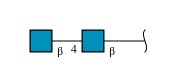
2-acetamido-2-deoxy-beta-D-glucopyranose-(1-4)-2-acetamido-2-deoxy-beta-D-glucopyranose
C
2N-Glycosylation
Glycosylation Resources
GlyTouCan: G42666HT
GlyCosmos: G42666HT
GlyGen: G42666HT
Entity ID: 3
MoleculeChains Length2D Diagram GlycosylationD Interactions
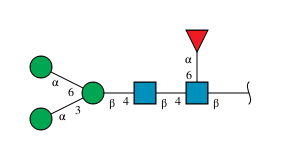
alpha-D-mannopyranose-(1-3)-[alpha-D-mannopyranose-(1-6)]beta-D-mannopyranose-(1-4)-2-acetamido-2-deoxy-beta-D-glucopyranose-(1-4)-[alpha-L-fucopyranose-(1-6)]2-acetamido-2-deoxy-beta-D-glucopyranose
D
6N-Glycosylation
Glycosylation Resources
GlyTouCan: G82348BZ
GlyCosmos: G82348BZ
GlyGen: G82348BZ
Entity ID: 4
MoleculeChains Length2D Diagram GlycosylationD Interactions
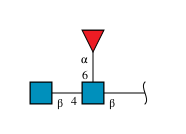
2-acetamido-2-deoxy-beta-D-glucopyranose-(1-4)-[alpha-L-fucopyranose-(1-6)]2-acetamido-2-deoxy-beta-D-glucopyranose
E
3N-Glycosylation
Glycosylation Resources
GlyTouCan: G21290RB
GlyCosmos: G21290RB
GlyGen: G21290RB

Small Molecules

Ligands 3 Unique
IDChains Name / Formula / InChI Key2D Diagram3D Interactions
NAG

Query on NAG


Download:Ideal Coordinates CCD File
OA [auth B],
W [auth A],
X [auth A]
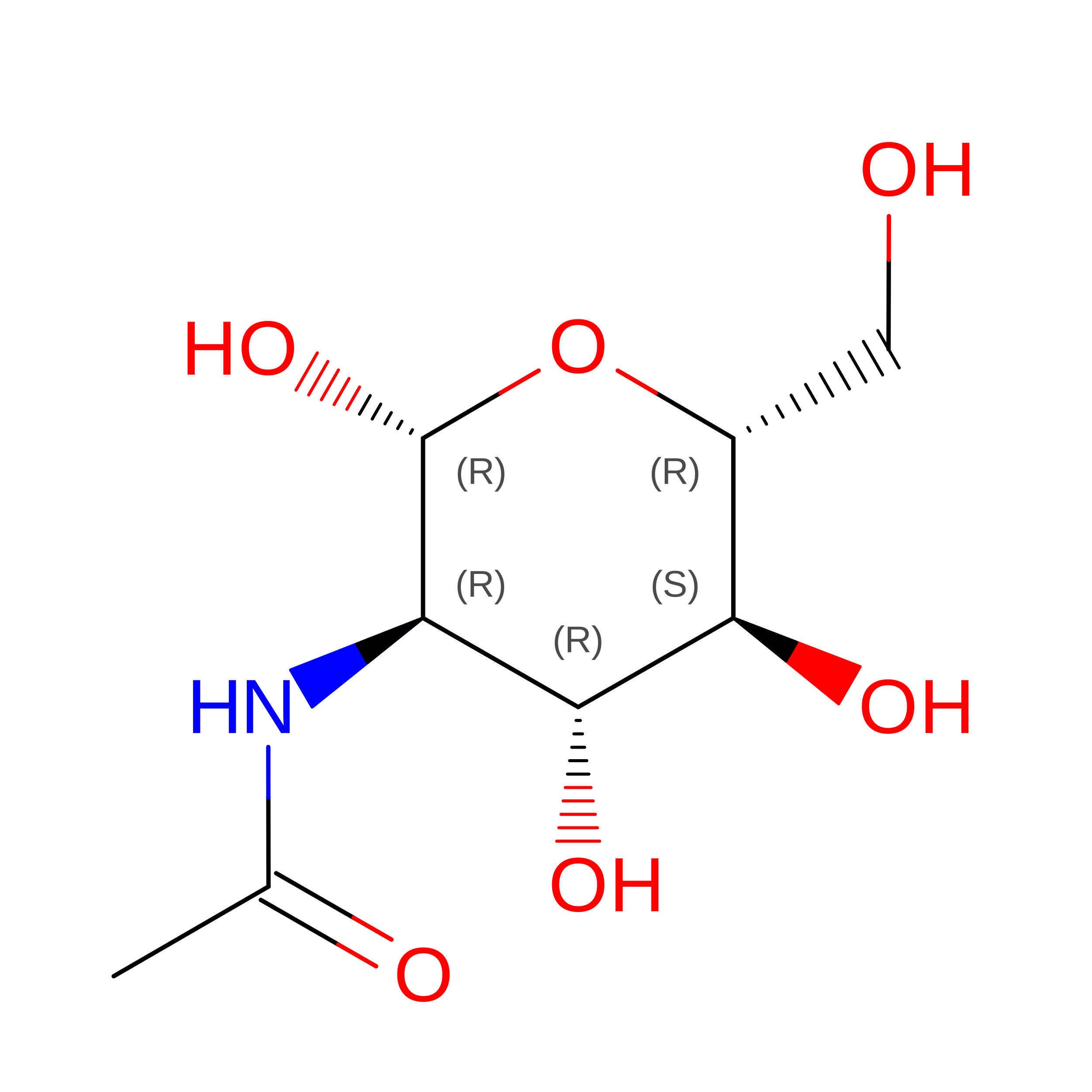
2-acetamido-2-deoxy-beta-D-glucopyranose
C8 H15 N O6
OVRNDRQMDRJTHS-FMDGEEDCSA-N
MAN

Query on MAN


Download:Ideal Coordinates CCD File
NA [auth B],
PA [auth B],
U [auth A],
V [auth A]
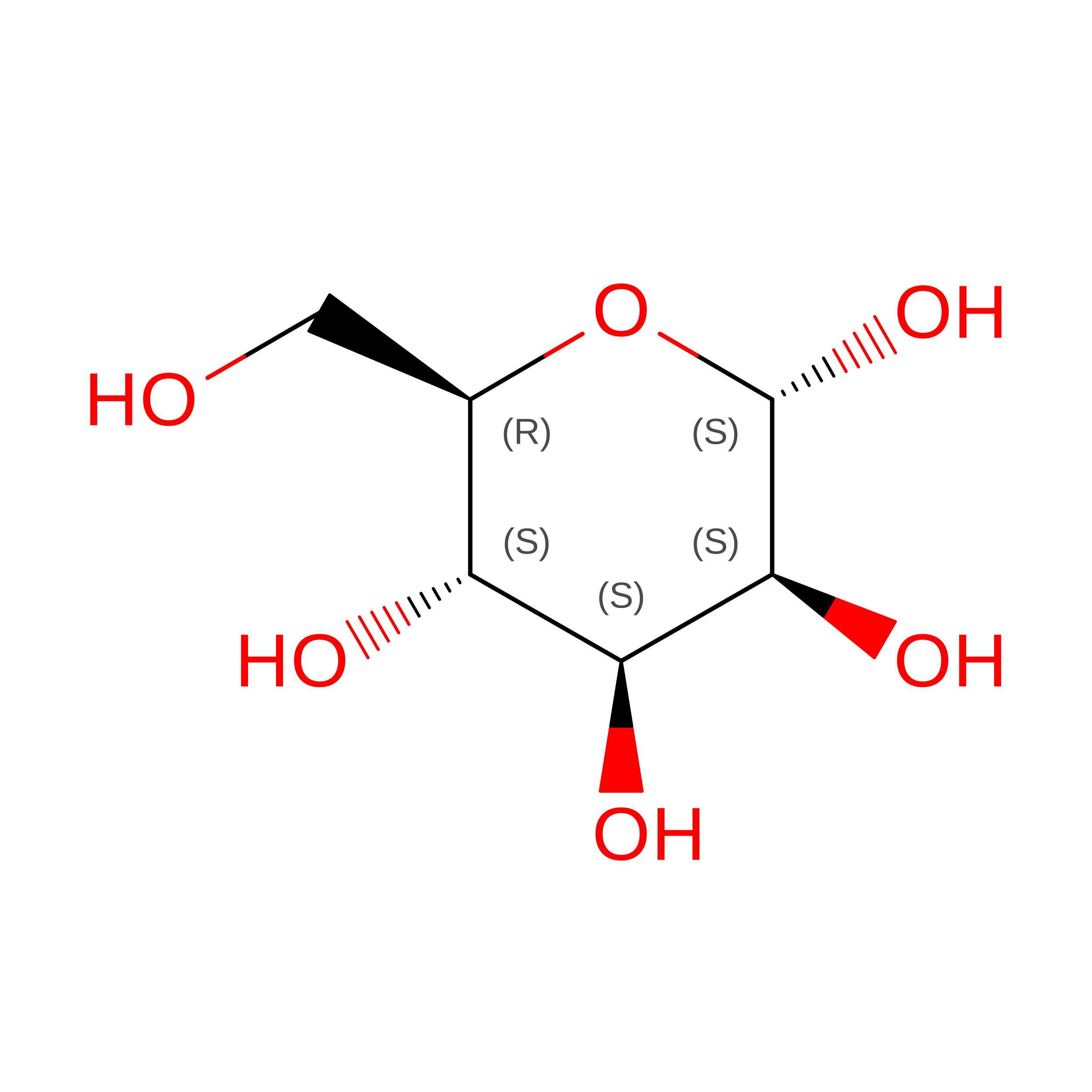
alpha-D-mannopyranose
C6 H12 O6
WQZGKKKJIJFFOK-PQMKYFCFSA-N
CA

Query on CA


Download:Ideal Coordinates CCD File
AA [auth B]
BA [auth B]
CA [auth B]
DA [auth B]
EA [auth B]
AA [auth B],
BA [auth B],
CA [auth B],
DA [auth B],
EA [auth B],
F [auth A],
FA [auth B],
G [auth A],
GA [auth B],
H [auth A],
HA [auth B],
I [auth A],
IA [auth B],
J [auth A],
JA [auth B],
K [auth A],
KA [auth B],
L [auth A],
LA [auth B],
M [auth A],
MA [auth B],
N [auth A],
O [auth A],
P [auth A],
Q [auth A],
R [auth A],
S [auth A],
T [auth A],
Y [auth B],
Z [auth B]
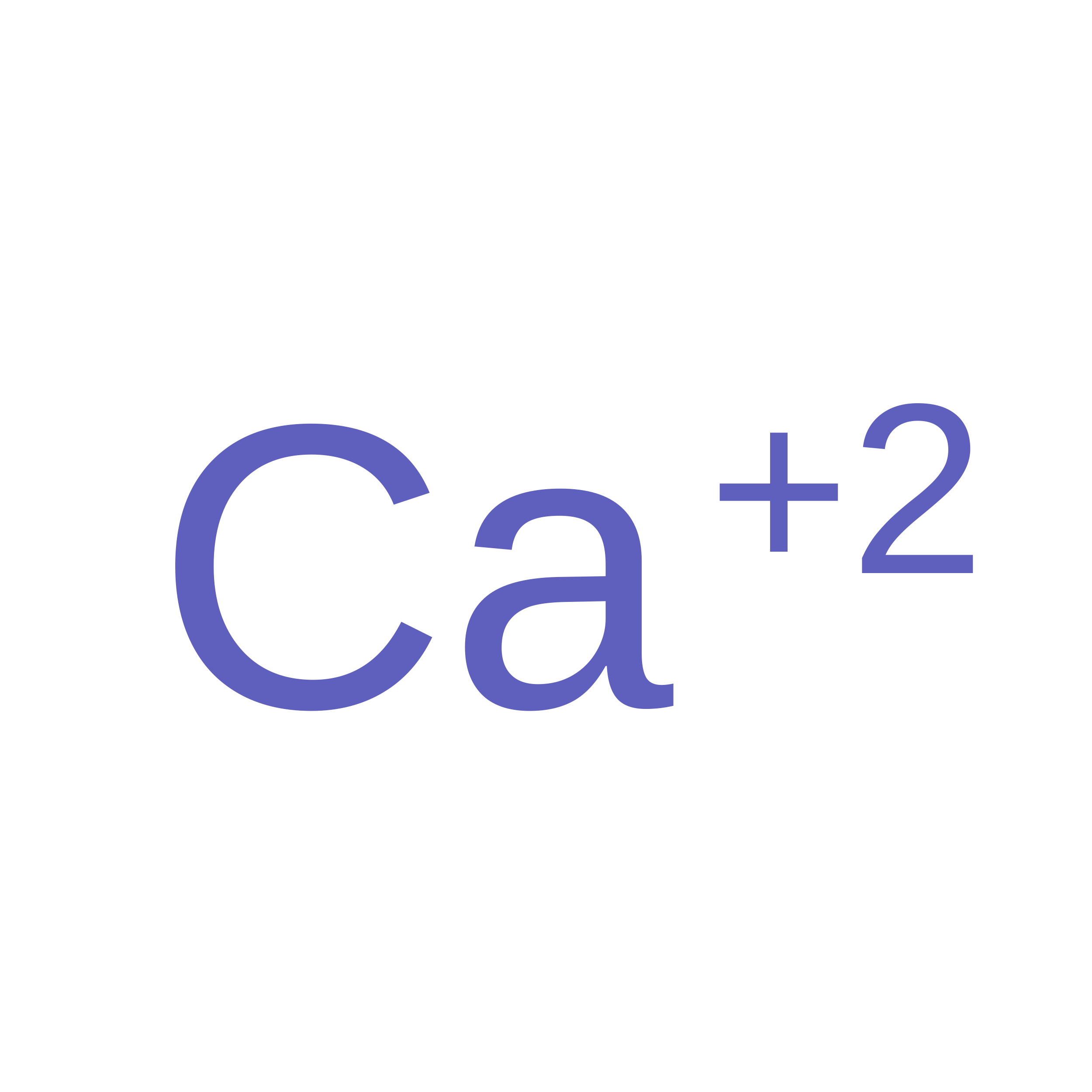
CALCIUM ION
Ca
BHPQYMZQTOCNFJ-UHFFFAOYSA-N

Experimental Data & Validation

Experimental Data

  • Method: X-RAY DIFFRACTION
  • Resolution: 4.52 Å
  • R-Value Free:  0.277 (Depositor), 0.282 (DCC) 
  • R-Value Work:  0.231 (Depositor), 0.238 (DCC) 
  • R-Value Observed: 0.234 (Depositor) 
Space Group: P 1 21 1
Unit Cell:
Length ( Å )Angle ( ˚ )
a = 127.73α = 90
b = 87.58β = 109.94
c = 149.33γ = 90
Software Package:
Software NamePurpose
PHENIXrefinement
XDSdata reduction
XSCALEdata scaling
PHASERphasing

Structure Validation

View Full Validation Report


Ligand Structure Quality Assessment 


Entry History 

& Funding Information

Deposition Data


Funding OrganizationLocationGrant Number
National Institutes of Health/National Institute of Mental Health (NIH/NIMH)United StatesR01 MH114817

Revision History  (Full details and data files)

  • Version 1.0: 2019-04-10
    Type: Initial release
  • Version 1.1: 2019-04-24
    Changes: Data collection, Database references
  • Version 1.2: 2019-05-22
    Changes: Data collection, Database references
  • Version 1.3: 2019-11-27
    Changes: Author supporting evidence, Data collection
  • Version 2.0: 2020-07-29
    Type: Remediation
    Reason: Carbohydrate remediation
    Changes: Atomic model, Data collection, Derived calculations, Structure summary
  • Version 2.1: 2023-10-11
    Changes: Data collection, Database references, Derived calculations, Refinement description, Structure summary
  • Version 2.2: 2024-11-13
    Changes: Structure summary