6E5G | pdb_00006e5g

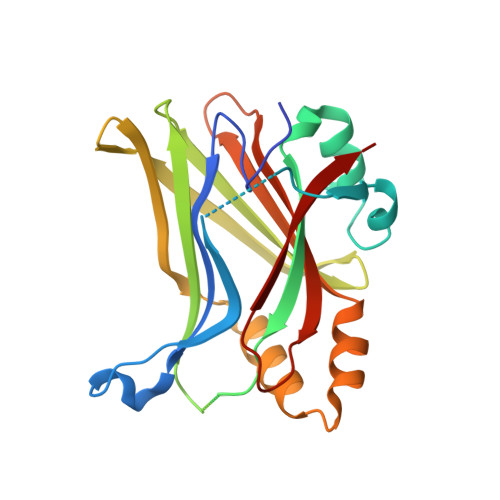
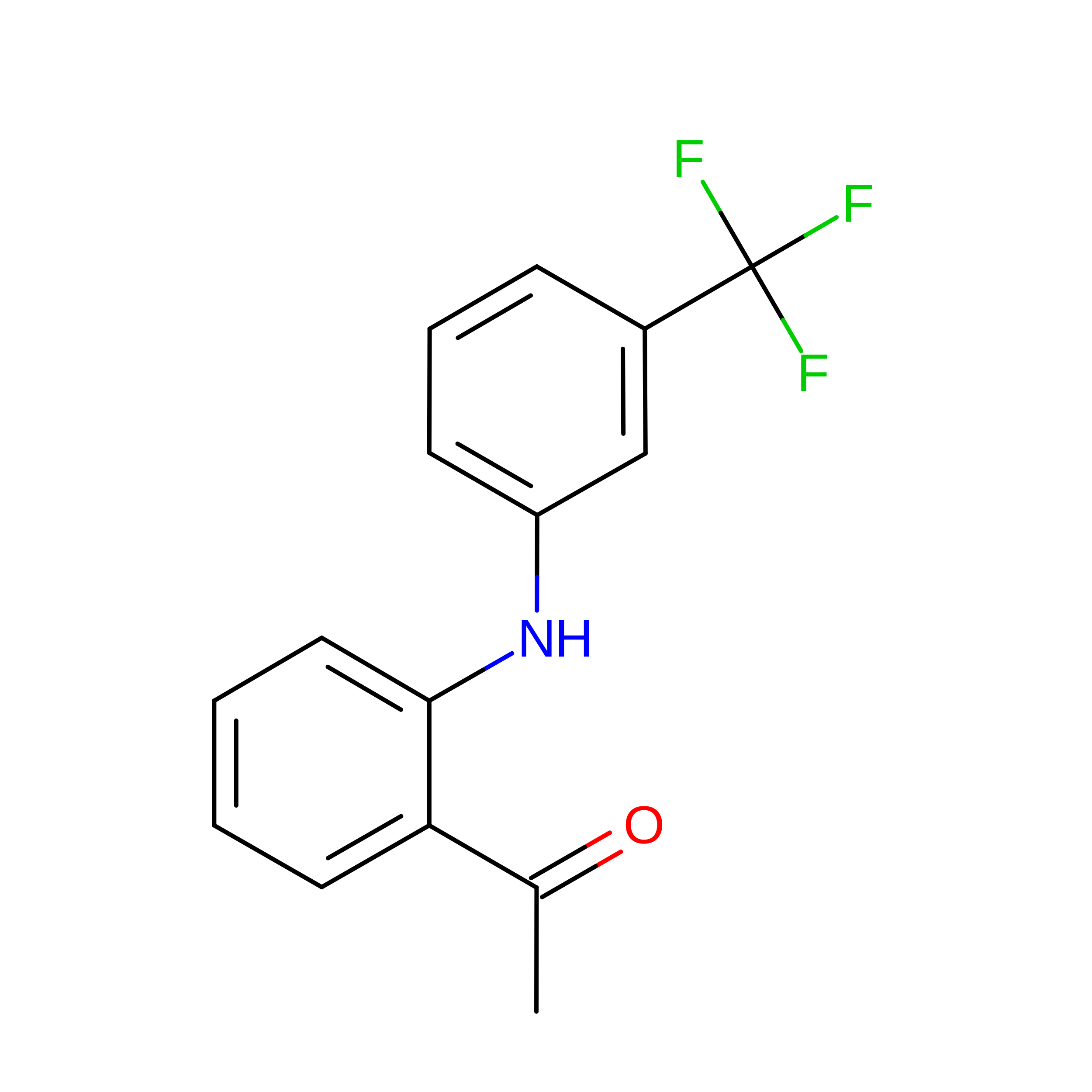
Crystal structure of human TEAD2-Yap binding domain covalently bound to an allosteric regulator


Experimental Data Snapshot

  • Method: X-RAY DIFFRACTION
  • Resolution: 2.43 Å
  • R-Value Free: 
    0.268 (Depositor), 0.268 (DCC) 
  • R-Value Work: 
    0.221 (Depositor), 0.224 (DCC) 
  • R-Value Observed: 
    0.223 (Depositor) 

Starting Model: experimental
View more details

wwPDB Validation 3D Report Full Report

Validation slider image for 6E5G

Ligand Structure Quality Assessment 


This is version 1.3 of the entry. See complete history

Literature

Small-Molecule Covalent Modification of Conserved Cysteine Leads to Allosteric Inhibition of the TEAD⋅Yap Protein-Protein Interaction.

Bum-Erdene, K.Zhou, D.Gonzalez-Gutierrez, G.Ghozayel, M.K.Si, Y.Xu, D.Shannon, H.E.Bailey, B.J.Corson, T.W.Pollok, K.E.Wells, C.D.Meroueh, S.O.

(2019) Cell Chem Biol 26: 378

  • DOI: https://doi.org/10.1016/j.chembiol.2018.11.010
  • Primary Citation Related Structures: 
    6E5G

  • PubMed Abstract: 

    The Hippo pathway coordinates extracellular signals onto the control of tissue homeostasis and organ size. Hippo signaling primarily regulates the ability of Yap1 to bind and co-activate TEA domain (TEAD) transcription factors. Yap1 tightly binds to TEAD4 via a large flat interface, making the development of small-molecule orthosteric inhibitors highly challenging. Here, we report small-molecule TEAD⋅Yap inhibitors that rapidly and selectively form a covalent bond with a conserved cysteine located within the unique deep hydrophobic palmitate-binding pocket of TEADs. Inhibition of TEAD4 binding to Yap1 by these compounds was irreversible and occurred on a longer time scale. In mammalian cells, the compounds formed a covalent complex with TEAD4, inhibited its binding to Yap1, blocked its transcriptional activity, and suppressed expression of connective tissue growth factor. The compounds inhibited cell viability of patient-derived glioblastoma spheroids, making them suitable as chemical probes to explore Hippo signaling in cancer.


  • Organizational Affiliation
    • Department of Biochemistry and Molecular Biology, Indiana University School of Medicine, Indianapolis, IN 46202, USA.

Macromolecule Content 

  • Total Structure Weight: 53.99 kDa 
  • Atom Count: 3,515 
  • Modeled Residue Count: 415 
  • Deposited Residue Count: 470 
  • Unique protein chains: 1

Macromolecules

Find similar proteins by:|  3D Structure
Entity ID: 1
MoleculeChains  Sequence LengthOrganismDetailsImage
Transcriptional enhancer factor TEF-4A [auth B],
B [auth A]
235Homo sapiensMutation(s): 0 
Gene Names: TEAD2TEF4
UniProt & NIH Common Fund Data Resources
Find proteins for Q15562 (Homo sapiens)
Explore Q15562 
Go to UniProtKB:  Q15562
PHAROS:  Q15562
GTEx:  ENSG00000074219 
Entity Groups
Sequence Clusters30% Identity50% Identity70% Identity90% Identity95% Identity100% Identity
UniProt GroupQ15562
Sequence Annotations
Expand
Reference Sequence

Small Molecules

Experimental Data & Validation

Experimental Data

  • Method: X-RAY DIFFRACTION
  • Resolution: 2.43 Å
  • R-Value Free:  0.268 (Depositor), 0.268 (DCC) 
  • R-Value Work:  0.221 (Depositor), 0.224 (DCC) 
  • R-Value Observed: 0.223 (Depositor) 
Space Group: C 1 2 1
Unit Cell:
Length ( Å )Angle ( ˚ )
a = 123.757α = 90
b = 61.226β = 116.89
c = 79.839γ = 90
Software Package:
Software NamePurpose
PHENIXrefinement
XDSdata reduction
XDSdata scaling
PHASERphasing

Structure Validation

View Full Validation Report


Ligand Structure Quality Assessment 


Entry History 

& Funding Information

Deposition Data


Funding OrganizationLocationGrant Number
American Cancer SocietyUnited StatesRSG-12-092-01-CDD

Revision History  (Full details and data files)

  • Version 1.0: 2019-01-09
    Type: Initial release
  • Version 1.1: 2019-04-03
    Changes: Data collection, Database references
  • Version 1.2: 2023-10-11
    Changes: Data collection, Database references, Refinement description
  • Version 1.3: 2024-10-16
    Changes: Structure summary