6E2F | pdb_00006e2f

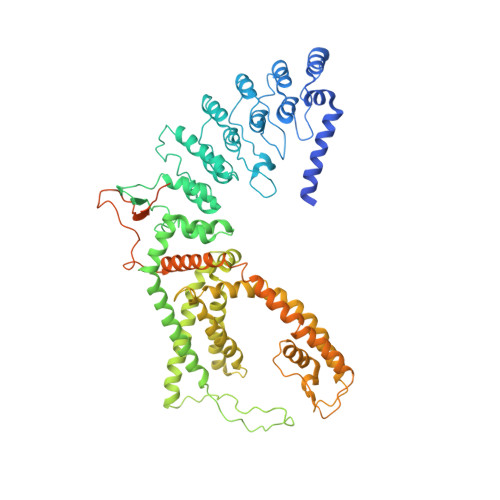
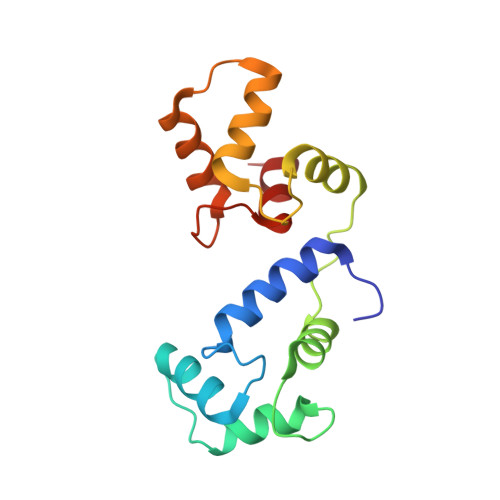
Cryo-EM structure of human TRPV6 in complex with Calmodulin


Experimental Data Snapshot

  • Method: ELECTRON MICROSCOPY
  • Resolution: 3.90 Å
  • Aggregation State: PARTICLE 
  • Reconstruction Method: SINGLE PARTICLE 

wwPDB Validation 3D Report Full Report

Validation slider image for 6E2F

This is version 1.4 of the entry. See complete history

Literature

Mechanism of calmodulin inactivation of the calcium-selective TRP channel TRPV6.

Singh, A.K.McGoldrick, L.L.Twomey, E.C.Sobolevsky, A.I.

(2018) Sci Adv 4: eaau6088-eaau6088

  • DOI: https://doi.org/10.1126/sciadv.aau6088
  • Primary Citation Related Structures: 
    6E2F, 6E2G

  • PubMed Abstract: 

    Calcium (Ca 2+ ) plays a major role in numerous physiological processes. Ca 2+ homeostasis is tightly controlled by ion channels, the aberrant regulation of which results in various diseases including cancers. Calmodulin (CaM)-mediated Ca 2+ -induced inactivation is an ion channel regulatory mechanism that protects cells against the toxic effects of Ca 2+ overload. We used cryo-electron microscopy to capture the epithelial calcium channel TRPV6 (transient receptor potential vanilloid subfamily member 6) inactivated by CaM. The TRPV6-CaM complex exhibits 1:1 stoichiometry; one TRPV6 tetramer binds both CaM lobes, which adopt a distinct head-to-tail arrangement. The CaM carboxyl-terminal lobe plugs the channel through a unique cation-π interaction by inserting the side chain of lysine K115 into a tetra-tryptophan cage at the pore's intracellular entrance. We propose a mechanism of CaM-mediated Ca 2+ -induced inactivation that can be explored for therapeutic design.


  • Organizational Affiliation
    • Department of Biochemistry and Molecular Biophysics, Columbia University, 650 West 168th Street, New York, NY 10032, USA.

Macromolecule Content 

  • Total Structure Weight: 350.3 kDa 
  • Atom Count: 21,204 
  • Modeled Residue Count: 2,640 
  • Deposited Residue Count: 3,049 
  • Unique protein chains: 2

Macromolecules

Find similar proteins by:|  3D Structure
Entity ID: 1
MoleculeChains  Sequence LengthOrganismDetailsImage
Transient receptor potential cation channel subfamily V member 6
A, B, C, D
725Homo sapiensMutation(s): 0 
Gene Names: TRPV6ECAC2
Membrane Entity: Yes 
UniProt & NIH Common Fund Data Resources
Find proteins for Q9H1D0 (Homo sapiens)
Explore Q9H1D0 
Go to UniProtKB:  Q9H1D0
PHAROS:  Q9H1D0
GTEx:  ENSG00000165125 
Entity Groups
Sequence Clusters30% Identity50% Identity70% Identity90% Identity95% Identity100% Identity
UniProt GroupQ9H1D0
Sequence Annotations
Expand
Reference Sequence
Find similar proteins by:|  3D Structure
Entity ID: 2
MoleculeChains  Sequence LengthOrganismDetailsImage
Calmodulin-1149Homo sapiensMutation(s): 0 
Gene Names: CALM1CALMCAMCAM1
UniProt & NIH Common Fund Data Resources
Find proteins for P0DP23 (Homo sapiens)
Explore P0DP23 
Go to UniProtKB:  P0DP23
PHAROS:  P0DP23
GTEx:  ENSG00000198668 
Entity Groups
Sequence Clusters30% Identity50% Identity70% Identity90% Identity95% Identity100% Identity
UniProt GroupP0DP23
Sequence Annotations
Expand
Reference Sequence

Experimental Data & Validation

Experimental Data

  • Method: ELECTRON MICROSCOPY
  • Resolution: 3.90 Å
  • Aggregation State: PARTICLE 
  • Reconstruction Method: SINGLE PARTICLE 
EM Software:
TaskSoftware PackageVersion
RECONSTRUCTIONcryoSPARC
MODEL REFINEMENTPHENIX

Structure Validation

View Full Validation Report


Entry History 

& Funding Information

Deposition Data


Funding OrganizationLocationGrant Number
National Institutes of Health/National Human Genome Research Institute (NIH/NHGRI)United States1R01CA206573-01A1

Revision History  (Full details and data files)

  • Version 1.0: 2018-08-22
    Type: Initial release
  • Version 1.1: 2018-10-24
    Changes: Data collection, Database references
  • Version 1.2: 2019-12-18
    Changes: Author supporting evidence, Other
  • Version 1.3: 2024-03-13
    Changes: Data collection, Database references, Derived calculations
  • Version 1.4: 2025-05-28
    Changes: Data collection, Structure summary