6D1W | pdb_00006d1w

human PKD2 F604P mutant


Experimental Data Snapshot

  • Method: ELECTRON MICROSCOPY
  • Resolution: 3.54 Å
  • Aggregation State: PARTICLE 
  • Reconstruction Method: SINGLE PARTICLE 

wwPDB Validation 3D Report Full Report

Validation slider image for 6D1W

This is version 1.4 of the entry. See complete history

Literature

Hydrophobic pore gates regulate ion permeation in polycystic kidney disease 2 and 2L1 channels.

Zheng, W.Yang, X.Hu, R.Cai, R.Hofmann, L.Wang, Z.Hu, Q.Liu, X.Bulkey, D.Yu, Y.Tang, J.Flockerzi, V.Cao, Y.Cao, E.Chen, X.Z.

(2018) Nat Commun 9: 2302-2302

  • DOI: https://doi.org/10.1038/s41467-018-04586-x
  • Primary Citation Related Structures: 
    6D1W

  • PubMed Abstract: 

    PKD2 and PKD1 genes are mutated in human autosomal dominant polycystic kidney disease. PKD2 can form either a homomeric cation channel or a heteromeric complex with the PKD1 receptor, presumed to respond to ligand(s) and/or mechanical stimuli. Here, we identify a two-residue hydrophobic gate in PKD2L1, and a single-residue hydrophobic gate in PKD2. We find that a PKD2 gain-of-function gate mutant effectively rescues PKD2 knockdown-induced phenotypes in embryonic zebrafish. The structure of a PKD2 activating mutant F604P by cryo-electron microscopy reveals a π- to α-helix transition within the pore-lining helix S6 that leads to repositioning of the gate residue and channel activation. Overall the results identify hydrophobic gates and a gating mechanism of PKD2 and PKD2L1.


  • Organizational Affiliation
    • National "111" Center for Cellular Regulation and Molecular Pharmaceutics, Hubei University of Technology, Wuhan, Hubei, 430068, China.

Macromolecule Content 

  • Total Structure Weight: 342.64 kDa 
  • Atom Count: 14,492 
  • Modeled Residue Count: 1,804 
  • Deposited Residue Count: 2,960 
  • Unique protein chains: 1

Macromolecules

Find similar proteins by:|  3D Structure
Entity ID: 1
MoleculeChains  Sequence LengthOrganismDetailsImage
Polycystin-2
A, B, C, D
740Homo sapiensMutation(s): 1 
Gene Names: PKD2TRPP2
Membrane Entity: Yes 
UniProt & NIH Common Fund Data Resources
Find proteins for Q13563 (Homo sapiens)
Explore Q13563 
Go to UniProtKB:  Q13563
PHAROS:  Q13563
GTEx:  ENSG00000118762 
Entity Groups
Sequence Clusters30% Identity50% Identity70% Identity90% Identity95% Identity100% Identity
UniProt GroupQ13563
Glycosylation
Glycosylation Sites: 3Go to GlyGen: Q13563-1
Sequence Annotations
Expand
Reference Sequence

Small Molecules

Ligands 1 Unique
IDChains Name / Formula / InChI Key2D Diagram3D Interactions
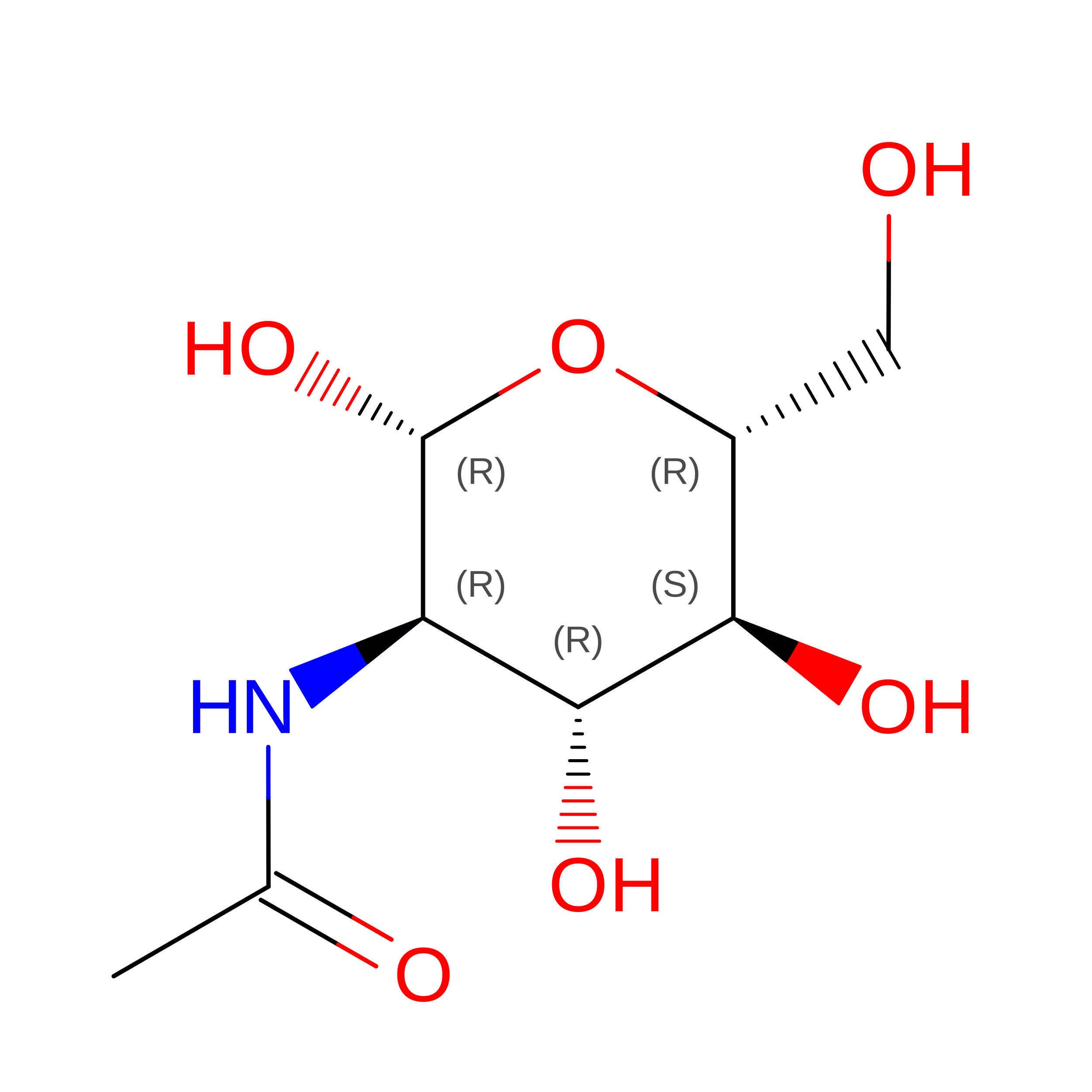
NAG

Query on NAG


Download:Ideal Coordinates CCD File
E [auth A]
F [auth A]
G [auth A]
H [auth B]
I [auth B]
E [auth A],
F [auth A],
G [auth A],
H [auth B],
I [auth B],
J [auth B],
K [auth C],
L [auth C],
M [auth C],
N [auth D],
O [auth D],
P [auth D]
2-acetamido-2-deoxy-beta-D-glucopyranose
C8 H15 N O6
OVRNDRQMDRJTHS-FMDGEEDCSA-N

Experimental Data & Validation

Experimental Data

  • Method: ELECTRON MICROSCOPY
  • Resolution: 3.54 Å
  • Aggregation State: PARTICLE 
  • Reconstruction Method: SINGLE PARTICLE 
EM Software:
TaskSoftware PackageVersion
MODEL REFINEMENTPHENIX

Structure Validation

View Full Validation Report


Entry History 

& Funding Information

Deposition Data


Funding OrganizationLocationGrant Number
National Institutes of Health/National Institute of Diabetes and Digestive and Kidney Disease (NIH/NIDDK)United StatesR01 DK110575-01

Revision History  (Full details and data files)

  • Version 1.0: 2018-06-27
    Type: Initial release
  • Version 1.1: 2019-12-18
    Changes: Author supporting evidence, Other
  • Version 1.2: 2020-07-29
    Type: Remediation
    Reason: Carbohydrate remediation
    Changes: Data collection, Derived calculations, Structure summary
  • Version 1.3: 2024-11-13
    Changes: Data collection, Database references, Structure summary
  • Version 1.4: 2025-05-21
    Changes: Data collection