6BZD | pdb_00006bzd

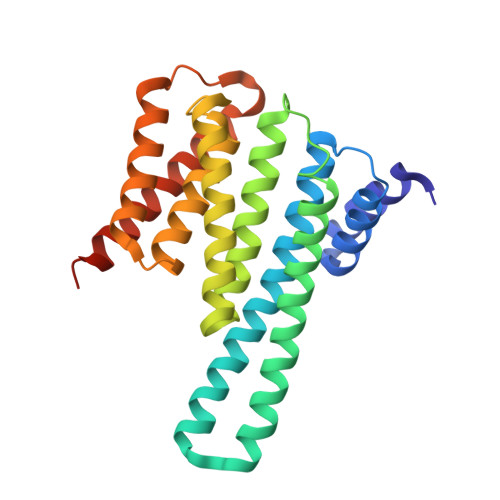
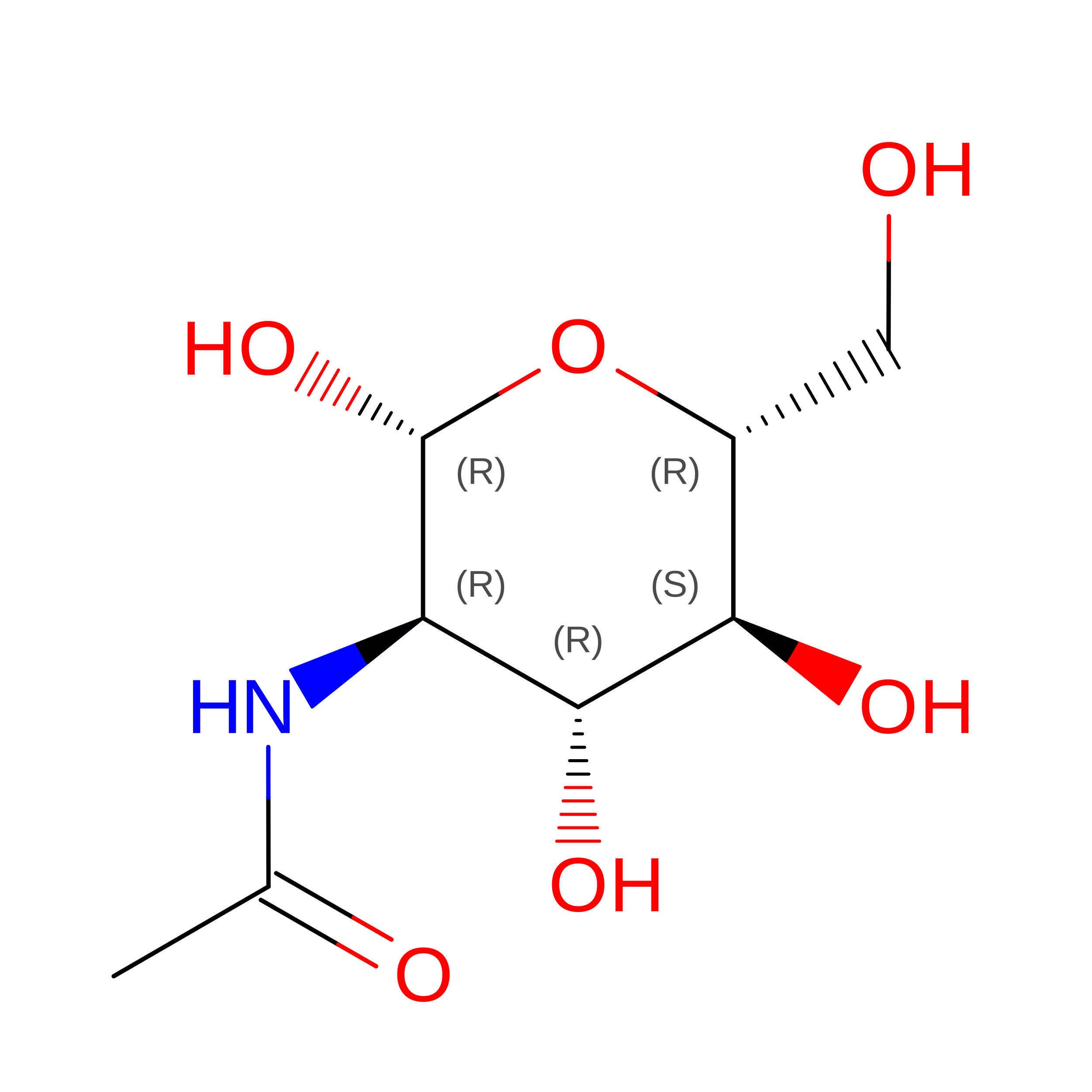
Structure of 14-3-3 gamma R57E mutant bound to GlcNAcylated peptide


Experimental Data Snapshot

  • Method: X-RAY DIFFRACTION
  • Resolution: 2.67 Å
  • R-Value Free: 
    0.281 (Depositor), 0.284 (DCC) 
  • R-Value Work: 
    0.246 (Depositor), 0.246 (DCC) 
  • R-Value Observed: 
    0.247 (Depositor) 

Starting Model: experimental
View more details

wwPDB Validation 3D Report Full Report

Validation slider image for 6BZD

Ligand Structure Quality Assessment 


This is version 1.6 of the entry. See complete history

Literature

Structural basis of O-GlcNAc recognition by mammalian 14-3-3 proteins.

Toleman, C.A.Schumacher, M.A.Yu, S.H.Zeng, W.Cox, N.J.Smith, T.J.Soderblom, E.J.Wands, A.M.Kohler, J.J.Boyce, M.

(2018) Proc Natl Acad Sci U S A 115: 5956-5961

  • DOI: https://doi.org/10.1073/pnas.1722437115
  • Primary Citation Related Structures: 
    6BYJ, 6BYK, 6BYL, 6BZD

  • PubMed Abstract: 

    O-GlcNAc is an intracellular posttranslational modification that governs myriad cell biological processes and is dysregulated in human diseases. Despite this broad pathophysiological significance, the biochemical effects of most O-GlcNAcylation events remain uncharacterized. One prevalent hypothesis is that O-GlcNAc moieties may be recognized by "reader" proteins to effect downstream signaling. However, no general O-GlcNAc readers have been identified, leaving a considerable gap in the field. To elucidate O-GlcNAc signaling mechanisms, we devised a biochemical screen for candidate O-GlcNAc reader proteins. We identified several human proteins, including 14-3-3 isoforms, that bind O-GlcNAc directly and selectively. We demonstrate that 14-3-3 proteins bind O-GlcNAc moieties in human cells, and we present the structures of 14-3-3β/α and γ bound to glycopeptides, providing biophysical insights into O-GlcNAc-mediated protein-protein interactions. Because 14-3-3 proteins also bind to phospho-serine and phospho-threonine, they may integrate information from O-GlcNAc and O-phosphate signaling pathways to regulate numerous physiological functions.


  • Organizational Affiliation
    • Department of Biochemistry, Duke University School of Medicine, Durham, NC 27710.

Macromolecule Content 

  • Total Structure Weight: 117.18 kDa 
  • Atom Count: 7,889 
  • Modeled Residue Count: 967 
  • Deposited Residue Count: 1,024 
  • Unique protein chains: 2

Macromolecules

Find similar proteins by:|  3D Structure
Entity ID: 1
MoleculeChains  Sequence LengthOrganismDetailsImage
14-3-3 protein gamma
A, B, C, D
246Homo sapiensMutation(s): 1 
Gene Names: YWHAG
UniProt & NIH Common Fund Data Resources
Find proteins for P61981 (Homo sapiens)
Explore P61981 
Go to UniProtKB:  P61981
PHAROS:  P61981
GTEx:  ENSG00000170027 
Entity Groups
Sequence Clusters30% Identity50% Identity70% Identity90% Identity95% Identity100% Identity
UniProt GroupP61981
Sequence Annotations
Expand
Reference Sequence
Find similar proteins by:  Sequence   |   3D Structure  
Entity ID: 2
MoleculeChains  Sequence LengthOrganismDetailsImage
GlcNAcylated peptideE [auth G],
F [auth K]
20synthetic constructMutation(s): 0 

Small Molecules

Experimental Data & Validation

Experimental Data

  • Method: X-RAY DIFFRACTION
  • Resolution: 2.67 Å
  • R-Value Free:  0.281 (Depositor), 0.284 (DCC) 
  • R-Value Work:  0.246 (Depositor), 0.246 (DCC) 
  • R-Value Observed: 0.247 (Depositor) 
Space Group: P 1 21 1
Unit Cell:
Length ( Å )Angle ( ˚ )
a = 76.366α = 90
b = 60β = 90.5
c = 125.786γ = 90
Software Package:
Software NamePurpose
PHENIXrefinement
SCALAdata scaling
PHASERphasing
PDB_EXTRACTdata extraction
MOSFLMdata reduction

Structure Validation

View Full Validation Report


Ligand Structure Quality Assessment 


Entry History 

Deposition Data

Revision History  (Full details and data files)

  • Version 1.0: 2018-05-09
    Type: Initial release
  • Version 1.1: 2018-05-23
    Changes: Data collection, Database references
  • Version 1.2: 2018-06-06
    Changes: Data collection, Database references
  • Version 1.3: 2018-06-20
    Changes: Data collection, Database references
  • Version 1.4: 2020-07-29
    Type: Remediation
    Reason: Carbohydrate remediation
    Changes: Data collection, Derived calculations, Structure summary
  • Version 1.5: 2023-10-04
    Changes: Data collection, Database references, Refinement description, Structure summary
  • Version 1.6: 2024-10-30
    Changes: Structure summary