6BQV | pdb_00006bqv

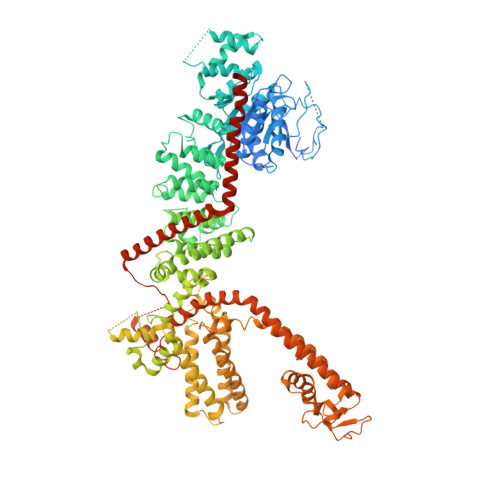
Human TRPM4 ion channel in lipid nanodiscs in a calcium-bound state


Experimental Data Snapshot

  • Method: ELECTRON MICROSCOPY
  • Resolution: 3.10 Å
  • Aggregation State: PARTICLE 
  • Reconstruction Method: SINGLE PARTICLE 

wwPDB Validation 3D Report Full Report

Validation slider image for 6BQV

This is version 1.5 of the entry. See complete history

Literature

Structure of the human TRPM4 ion channel in a lipid nanodisc.

Autzen, H.E.Myasnikov, A.G.Campbell, M.G.Asarnow, D.Julius, D.Cheng, Y.

(2018) Science 359: 228-232

  • DOI: https://doi.org/10.1126/science.aar4510
  • Primary Citation Related Structures: 
    6BQR, 6BQV

  • PubMed Abstract: 

    Transient receptor potential (TRP) melastatin 4 (TRPM4) is a widely expressed cation channel associated with a variety of cardiovascular disorders. TRPM4 is activated by increased intracellular calcium in a voltage-dependent manner but, unlike many other TRP channels, is permeable to monovalent cations only. Here we present two structures of full-length human TRPM4 embedded in lipid nanodiscs at ~3-angstrom resolution, as determined by single-particle cryo-electron microscopy. These structures, with and without calcium bound, reveal a general architecture for this major subfamily of TRP channels and a well-defined calcium-binding site within the intracellular side of the S1-S4 domain. The structures correspond to two distinct closed states. Calcium binding induces conformational changes that likely prime the channel for voltage-dependent opening.


  • Organizational Affiliation
    • Department of Biochemistry and Biophysics, University of California, San Francisco, CA 94143, USA.

Macromolecule Content 

  • Total Structure Weight: 545.08 kDa 
  • Atom Count: 29,716 
  • Modeled Residue Count: 3,728 
  • Deposited Residue Count: 4,872 
  • Unique protein chains: 1

Macromolecules

Find similar proteins by:|  3D Structure
Entity ID: 1
MoleculeChains  Sequence LengthOrganismDetailsImage
Transient receptor potential cation channel subfamily M member 4
A, B, C, D
1,218Homo sapiensMutation(s): 0 
Gene Names: TRPM4LTRPC4
Membrane Entity: Yes 
UniProt & NIH Common Fund Data Resources
Find proteins for Q8TD43 (Homo sapiens)
Explore Q8TD43 
Go to UniProtKB:  Q8TD43
PHAROS:  Q8TD43
GTEx:  ENSG00000130529 
Entity Groups
Sequence Clusters30% Identity50% Identity70% Identity90% Identity95% Identity100% Identity
UniProt GroupQ8TD43
Sequence Annotations
Expand
Reference Sequence

Small Molecules

Ligands 2 Unique
IDChains Name / Formula / InChI Key2D Diagram3D Interactions
Y01

Query on Y01


Download:Ideal Coordinates CCD File
F [auth A]
G [auth A]
H [auth A]
J [auth B]
K [auth B]
F [auth A],
G [auth A],
H [auth A],
J [auth B],
K [auth B],
L [auth B],
N [auth C],
O [auth C],
P [auth C],
R [auth D],
S [auth D],
T [auth D]
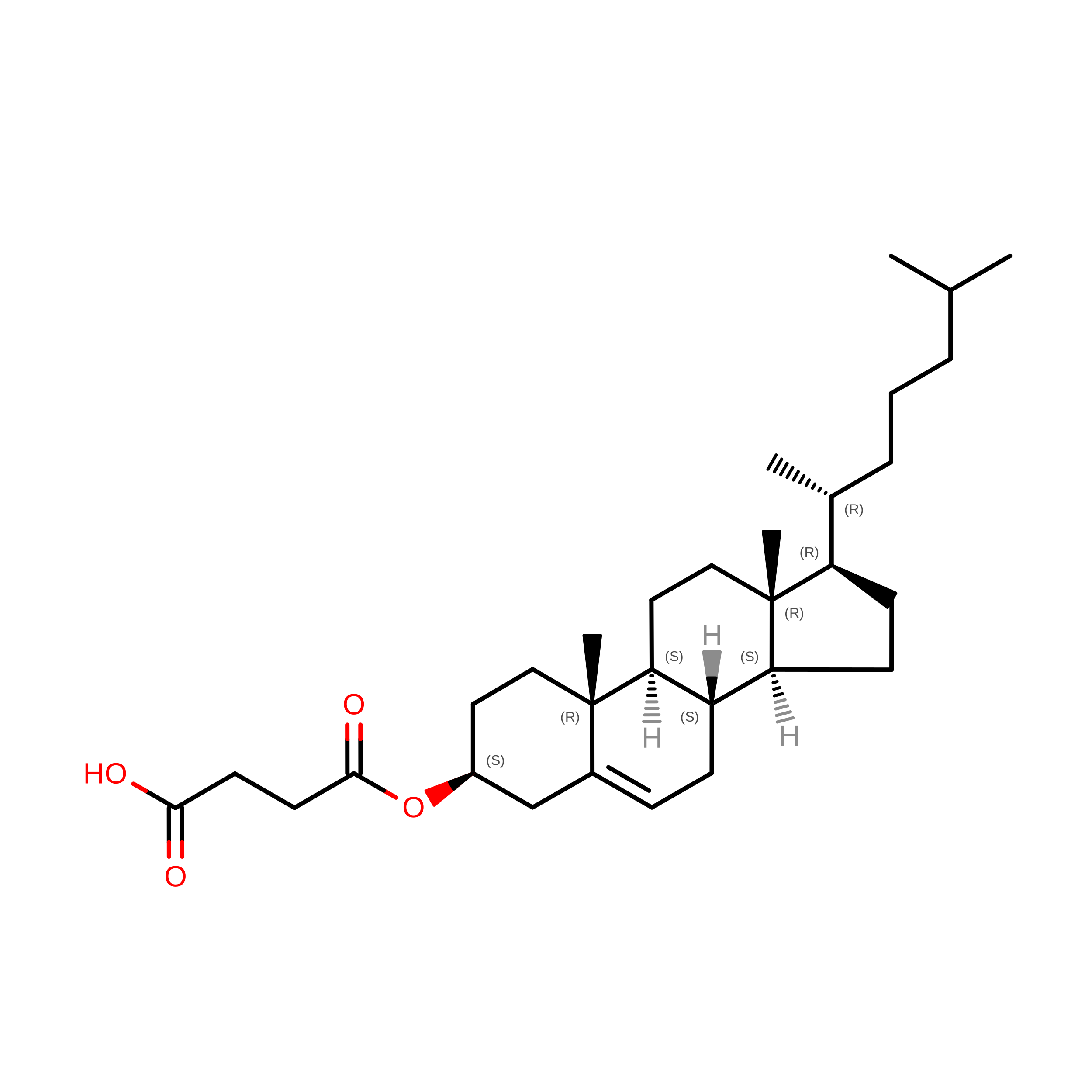
CHOLESTEROL HEMISUCCINATE
C31 H50 O4
WLNARFZDISHUGS-MIXBDBMTSA-N
CA

Query on CA


Download:Ideal Coordinates CCD File
E [auth A],
I [auth B],
M [auth C],
Q [auth D]
CALCIUM ION
Ca
BHPQYMZQTOCNFJ-UHFFFAOYSA-N

Experimental Data & Validation

Experimental Data

  • Method: ELECTRON MICROSCOPY
  • Resolution: 3.10 Å
  • Aggregation State: PARTICLE 
  • Reconstruction Method: SINGLE PARTICLE 
EM Software:
TaskSoftware PackageVersion
MODEL REFINEMENTPHENIX
RECONSTRUCTIONRELION2.1

Structure Validation

View Full Validation Report


Entry History 

& Funding Information

Deposition Data


Funding OrganizationLocationGrant Number
National Institutes of Health/National Institute of General Medical Sciences (NIH/NIGMS)United StatesR01GM098672
National Institutes of Health/Office of the DirectorUnited StatesS10OD020054
National Institutes of Health/Office of the DirectorUnited StatesS10OD021741
National Institutes of Health/National Institute of Neurological Disorders and Stroke (NIH/NINDS)United StatesR01NS047723
Danish Council of Independent ResearchDenmarkDFF-5051-00085

Revision History  (Full details and data files)

  • Version 1.0: 2017-12-20
    Type: Initial release
  • Version 1.1: 2018-01-17
    Changes: Author supporting evidence
  • Version 1.2: 2018-01-24
    Changes: Database references
  • Version 1.3: 2018-08-22
    Changes: Data collection, Database references
  • Version 1.4: 2019-12-18
    Changes: Author supporting evidence
  • Version 1.5: 2024-03-13
    Changes: Data collection, Database references