6BQB | pdb_00006bqb

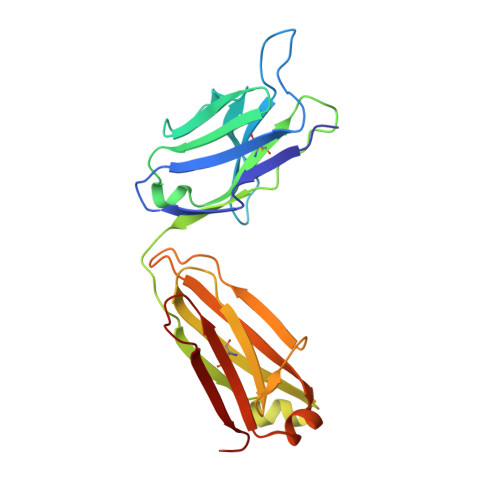
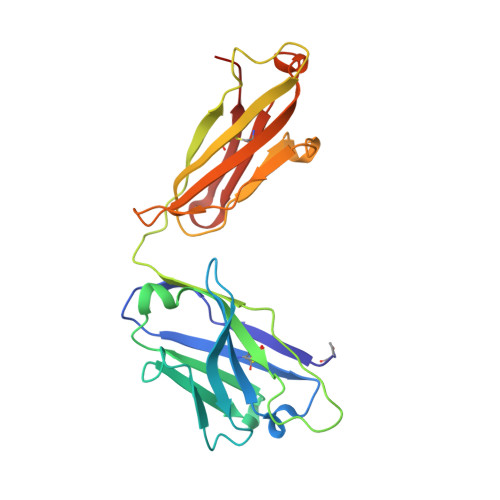
MGG4 Fab in complex with peptide


Experimental Data Snapshot

  • Method: X-RAY DIFFRACTION
  • Resolution: 1.77 Å
  • R-Value Free: 
    0.196 (Depositor), 0.198 (DCC) 
  • R-Value Work: 
    0.166 (Depositor), 0.168 (DCC) 
  • R-Value Observed: 
    0.168 (Depositor) 

wwPDB Validation 3D Report Full Report

Validation slider image for 6BQB

This is version 2.0 of the entry. See complete history

Literature

A public antibody lineage that potently inhibits malaria infection through dual binding to the circumsporozoite protein.

Tan, J.Sack, B.K.Oyen, D.Zenklusen, I.Piccoli, L.Barbieri, S.Foglierini, M.Fregni, C.S.Marcandalli, J.Jongo, S.Abdulla, S.Perez, L.Corradin, G.Varani, L.Sallusto, F.Sim, B.K.L.Hoffman, S.L.Kappe, S.H.I.Daubenberger, C.Wilson, I.A.Lanzavecchia, A.

(2018) Nat Med 24: 401-407

  • DOI: https://doi.org/10.1038/nm.4513
  • Primary Citation Related Structures: 
    6BQB

  • PubMed Abstract: 

    Immunization with attenuated Plasmodium falciparum sporozoites (PfSPZs) has been shown to be protective against malaria, but the features of the antibody response induced by this treatment remain unclear. To investigate this response in detail, we isolated IgM and IgG monoclonal antibodies from Tanzanian volunteers who were immunized with repeated injection of Sanaria PfSPZ Vaccine and who were found to be protected from controlled human malaria infection with infectious homologous PfSPZs. All isolated IgG monoclonal antibodies bound to P. falciparum circumsporozoite protein (PfCSP) and recognized distinct epitopes in its N terminus, NANP-repeat region, and C terminus. Strikingly, the most effective antibodies, as determined in a humanized mouse model, bound not only to the repeat region, but also to a minimal peptide at the PfCSP N-terminal junction that is not in the RTS,S vaccine. These dual-specific antibodies were isolated from different donors and were encoded by VH3-30 or VH3-33 alleles that encode tryptophan or arginine at position 52. Using structural and mutational data, we describe the elements required for germline recognition and affinity maturation. Our study provides potent neutralizing antibodies and relevant information for lineage-targeted vaccine design and immunization strategies.


  • Organizational Affiliation
    • Institute for Research in Biomedicine, Università della Svizzera italiana, Bellinzona, Switzerland.

Macromolecule Content 

  • Total Structure Weight: 49.94 kDa 
  • Atom Count: 4,128 
  • Modeled Residue Count: 448 
  • Deposited Residue Count: 460 
  • Unique protein chains: 3

Macromolecules

Find similar proteins by:|  3D Structure
Entity ID: 1
MoleculeChains  Sequence LengthOrganismDetailsImage
MGG4 Fab light chainA [auth L]220Homo sapiensMutation(s): 0 
Find similar proteins by:|  3D Structure
Entity ID: 2
MoleculeChains  Sequence LengthOrganismDetailsImage
MGG4 Fab heavy chainB [auth H]224Homo sapiensMutation(s): 0 
Find similar proteins by:  Sequence   |   3D Structure  
Entity ID: 3
MoleculeChains  Sequence LengthOrganismDetailsImage
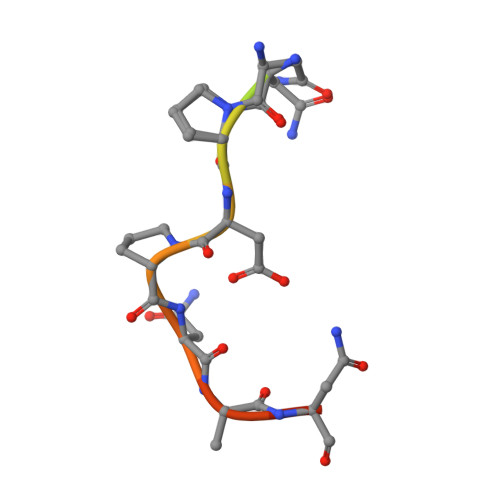
N-terminal junction peptideC [auth P]16Plasmodium falciparumMutation(s): 0 
UniProt
Find proteins for Q7K740 (Plasmodium falciparum (isolate 3D7))
Explore Q7K740 
Go to UniProtKB:  Q7K740
Entity Groups
Sequence Clusters30% Identity50% Identity70% Identity90% Identity95% Identity100% Identity
UniProt GroupQ7K740
Sequence Annotations
Expand
Reference Sequence

Experimental Data & Validation

Experimental Data

  • Method: X-RAY DIFFRACTION
  • Resolution: 1.77 Å
  • R-Value Free:  0.196 (Depositor), 0.198 (DCC) 
  • R-Value Work:  0.166 (Depositor), 0.168 (DCC) 
  • R-Value Observed: 0.168 (Depositor) 
Space Group: P 21 21 21
Unit Cell:
Length ( Å )Angle ( ˚ )
a = 55.782α = 90
b = 68.062β = 90
c = 148.61γ = 90
Software Package:
Software NamePurpose
PHENIXrefinement
HKL-2000data reduction
SCALEPACKdata scaling
PHASERphasing

Structure Validation

View Full Validation Report


Entry History 

& Funding Information

Deposition Data


Funding OrganizationLocationGrant Number
PATH's Malaria Vaccine InitiativeUnited States--

Revision History  (Full details and data files)

  • Version 1.0: 2018-03-07
    Type: Initial release
  • Version 1.1: 2018-04-04
    Changes: Data collection, Database references
  • Version 1.2: 2018-04-25
    Changes: Data collection, Database references
  • Version 2.0: 2024-11-20
    Changes: Data collection, Database references, Polymer sequence, Structure summary