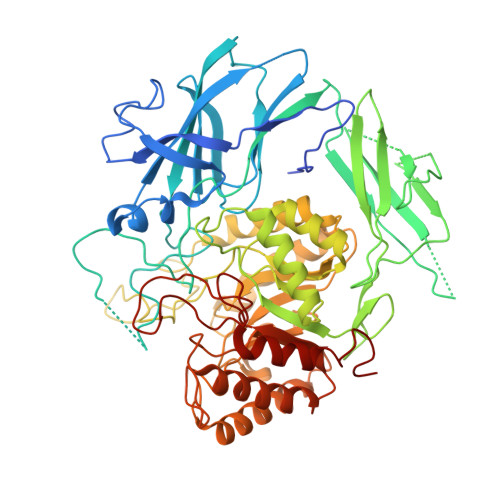
6BJW | pdb_00006bjw

Eubacterium eligens Beta-glucuronidase


Experimental Data Snapshot

  • Method: X-RAY DIFFRACTION
  • Resolution: 3.00 Å
  • R-Value Free: 
    0.257 (Depositor), 0.258 (DCC) 
  • R-Value Work: 
    0.224 (Depositor), 0.225 (DCC) 
  • R-Value Observed: 
    0.227 (Depositor) 

wwPDB Validation 3D Report Full Report

Validation slider image for 6BJW

This is version 1.4 of the entry. See complete history

Literature

Gut Microbial beta-Glucuronidase Inhibition via Catalytic Cycle Interception.

Pellock, S.J.Creekmore, B.C.Walton, W.G.Mehta, N.Biernat, K.A.Cesmat, A.P.Ariyarathna, Y.Dunn, Z.D.Li, B.Jin, J.James, L.I.Redinbo, M.R.

(2018) ACS Cent Sci 4: 868-879

  • DOI: https://doi.org/10.1021/acscentsci.8b00239
  • Primary Citation Related Structures: 
    6BJQ, 6BJW, 6BO6, 6D4O

  • PubMed Abstract: 

    Microbial β-glucuronidases (GUSs) cause severe gut toxicities that limit the efficacy of cancer drugs and other therapeutics. Selective inhibitors of bacterial GUS have been shown to alleviate these side effects. Using structural and chemical biology, mass spectrometry, and cell-based assays, we establish that piperazine-containing GUS inhibitors intercept the glycosyl-enzyme catalytic intermediate of these retaining glycosyl hydrolases. We demonstrate that piperazine-based compounds are substrate-dependent GUS inhibitors that bind to the GUS-GlcA catalytic intermediate as a piperazine-linked glucuronide (GlcA, glucuronic acid). We confirm the GUS-dependent formation of inhibitor-glucuronide conjugates by LC-MS and show that methylated piperazine analogs display significantly reduced potencies. We further demonstrate that a range of approved piperazine- and piperidine-containing drugs from many classes, including those for the treatment of depression, infection, and cancer, function by the same mechanism, and we confirm through gene editing that these compounds selectively inhibit GUS in living bacterial cells. Together, these data reveal a unique mechanism of GUS inhibition and show that a range of therapeutics may impact GUS activities in the human gut.


  • Organizational Affiliation
    • Department of Chemistry, Center for Integrated Chemical Biology and Drug Discovery, Eshelman School of Pharmacy, and Integrated Program for Biological and Genome Sciences, and Departments of Biochemistry and Microbiology, University of North Carolina at Chapel Hill, Chapel Hill, North Carolina 27599, United States.

Macromolecule Content 

  • Total Structure Weight: 72.35 kDa 
  • Atom Count: 4,608 
  • Modeled Residue Count: 582 
  • Deposited Residue Count: 635 
  • Unique protein chains: 1

Macromolecules

Find similar proteins by:|  3D Structure
Entity ID: 1
MoleculeChains  Sequence LengthOrganismDetailsImage
Glycoside Hydrolase Family 2 candidate b-glucuronidase635Lachnospira eligens ATCC 27750Mutation(s): 0 
Gene Names: EUBELI_20590
EC: 3.2.1.31
UniProt
Find proteins for C4Z6Z2 (Lachnospira eligens (strain ATCC 27750 / DSM 3376 / VPI C15-48 / C15-B4))
Explore C4Z6Z2 
Go to UniProtKB:  C4Z6Z2
Entity Groups
Sequence Clusters30% Identity50% Identity70% Identity90% Identity95% Identity100% Identity
UniProt GroupC4Z6Z2
Sequence Annotations
Expand
Reference Sequence

Experimental Data & Validation

Experimental Data

  • Method: X-RAY DIFFRACTION
  • Resolution: 3.00 Å
  • R-Value Free:  0.257 (Depositor), 0.258 (DCC) 
  • R-Value Work:  0.224 (Depositor), 0.225 (DCC) 
  • R-Value Observed: 0.227 (Depositor) 
Space Group: P 64 2 2
Unit Cell:
Length ( Å )Angle ( ˚ )
a = 179.775α = 90
b = 179.775β = 90
c = 134.929γ = 120
Software Package:
Software NamePurpose
PHENIXrefinement
XDSdata reduction
HKL-3000data scaling
PHENIXphasing

Structure Validation

View Full Validation Report


Entry History 

& Funding Information

Deposition Data


Funding OrganizationLocationGrant Number
National Institutes of Health/National Cancer Institute (NIH/NCI)United States--

Revision History  (Full details and data files)

  • Version 1.0: 2018-07-25
    Type: Initial release
  • Version 1.1: 2019-02-06
    Changes: Data collection, Database references
  • Version 1.2: 2019-02-20
    Changes: Author supporting evidence, Data collection
  • Version 1.3: 2022-03-23
    Changes: Author supporting evidence, Database references
  • Version 1.4: 2024-05-22
    Changes: Data collection