6BHV | pdb_00006bhv

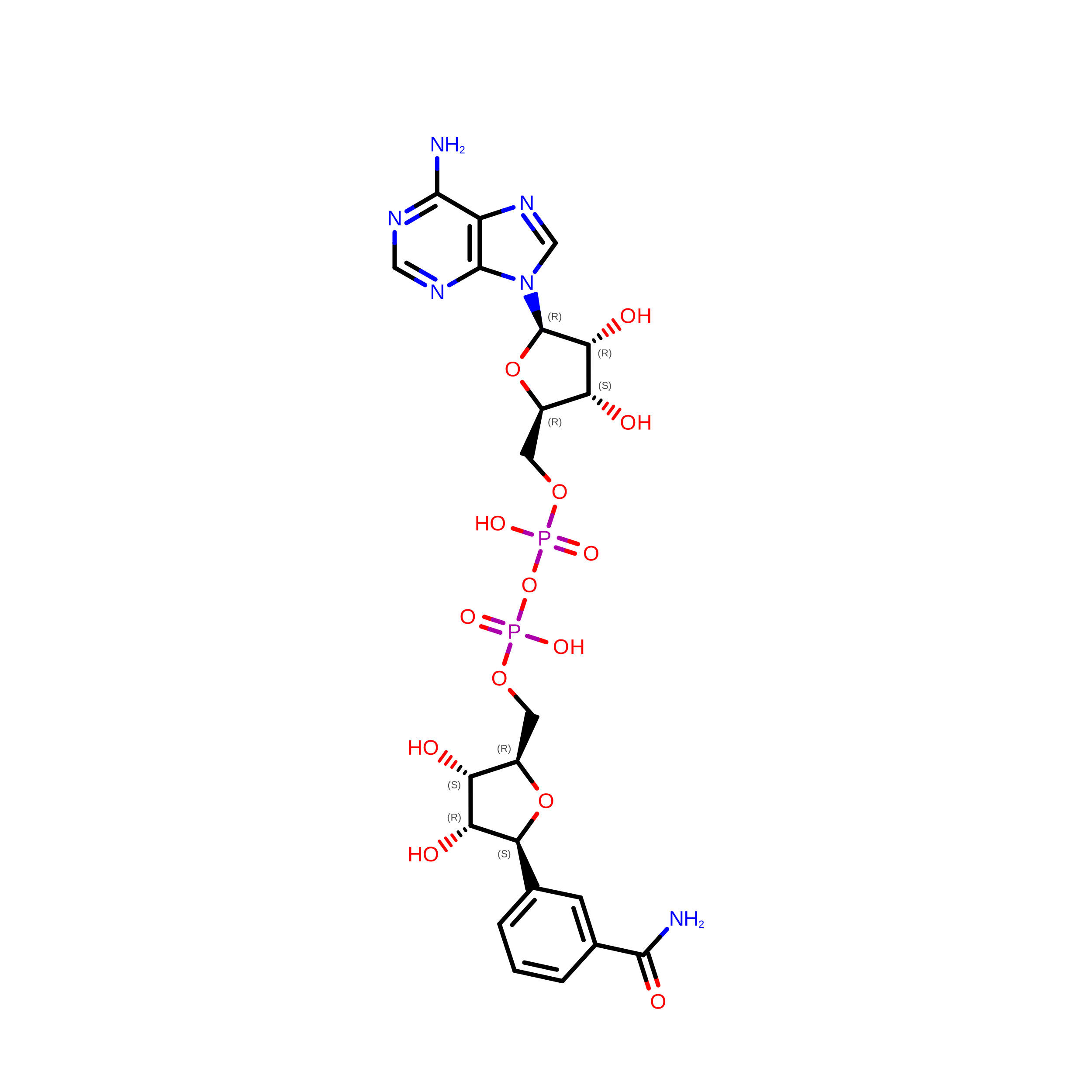
Human PARP-1 bound to NAD+ analog benzamide adenine dinucleotide (BAD)


Experimental Data Snapshot

  • Method: X-RAY DIFFRACTION
  • Resolution: 2.30 Å
  • R-Value Free: 
    0.222 (Depositor), 0.227 (DCC) 
  • R-Value Work: 
    0.198 (Depositor), 0.202 (DCC) 
  • R-Value Observed: 
    0.199 (Depositor) 

Starting Model: experimental
View more details

wwPDB Validation 3D Report Full Report

Validation slider image for 6BHV

Ligand Structure Quality Assessment 


This is version 1.4 of the entry. See complete history

Literature

NAD+analog reveals PARP-1 substrate-blocking mechanism and allosteric communication from catalytic center to DNA-binding domains.

Langelier, M.F.Zandarashvili, L.Aguiar, P.M.Black, B.E.Pascal, J.M.

(2018) Nat Commun 9: 844-844

  • DOI: https://doi.org/10.1038/s41467-018-03234-8
  • Primary Citation Related Structures: 
    6BHV

  • PubMed Abstract: 

    PARP-1 cleaves NAD + and transfers the resulting ADP-ribose moiety onto target proteins and onto subsequent polymers of ADP-ribose. An allosteric network connects PARP-1 multi-domain detection of DNA damage to catalytic domain structural changes that relieve catalytic autoinhibition; however, the mechanism of autoinhibition is undefined. Here, we show using the non-hydrolyzable NAD + analog benzamide adenine dinucleotide (BAD) that PARP-1 autoinhibition results from a selective block on NAD + binding. Following DNA damage detection, BAD binding to the catalytic domain leads to changes in PARP-1 dynamics at distant DNA-binding surfaces, resulting in increased affinity for DNA damage, and providing direct evidence of reverse allostery. Our findings reveal a two-step mechanism to activate and to then stabilize PARP-1 on a DNA break, indicate that PARP-1 allostery influences persistence on DNA damage, and have important implications for PARP inhibitors that engage the NAD + binding site.


  • Organizational Affiliation
    • Department of Biochemistry and Molecular Medicine, Université de Montréal, Montréal, QC, H3C 3J7, Canada.

Macromolecule Content 

  • Total Structure Weight: 122.66 kDa 
  • Atom Count: 7,704 
  • Modeled Residue Count: 939 
  • Deposited Residue Count: 1,084 
  • Unique protein chains: 1

Macromolecules

Find similar proteins by:|  3D Structure
Entity ID: 1
MoleculeChains  Sequence LengthOrganismDetailsImage
Poly [ADP-ribose] polymerase 1
A, B, C, D
271Homo sapiensMutation(s): 0 
Gene Names: PARP1ADPRTPPOL
EC: 2.4.2.30 (PDB Primary Data), 2.4.2 (UniProt)
UniProt & NIH Common Fund Data Resources
Find proteins for P09874 (Homo sapiens)
Explore P09874 
Go to UniProtKB:  P09874
PHAROS:  P09874
GTEx:  ENSG00000143799 
Entity Groups
Sequence Clusters30% Identity50% Identity70% Identity90% Identity95% Identity100% Identity
UniProt GroupP09874
Sequence Annotations
Expand
Reference Sequence

Small Molecules

Experimental Data & Validation

Experimental Data

  • Method: X-RAY DIFFRACTION
  • Resolution: 2.30 Å
  • R-Value Free:  0.222 (Depositor), 0.227 (DCC) 
  • R-Value Work:  0.198 (Depositor), 0.202 (DCC) 
  • R-Value Observed: 0.199 (Depositor) 
Space Group: P 1
Unit Cell:
Length ( Å )Angle ( ˚ )
a = 44.51α = 98.66
b = 75.356β = 104.94
c = 85.607γ = 106.73
Software Package:
Software NamePurpose
REFMACrefinement
XDSdata reduction
XDSdata scaling
PHASERphasing

Structure Validation

View Full Validation Report


Ligand Structure Quality Assessment 


Entry History 

& Funding Information

Deposition Data


Funding OrganizationLocationGrant Number
Canadian Institutes of Health Research (CIHR)Canada142354

Revision History  (Full details and data files)

  • Version 1.0: 2018-02-28
    Type: Initial release
  • Version 1.1: 2018-03-28
    Changes: Data collection, Database references
  • Version 1.2: 2019-02-20
    Changes: Author supporting evidence, Data collection
  • Version 1.3: 2020-01-08
    Changes: Author supporting evidence
  • Version 1.4: 2023-10-04
    Changes: Data collection, Database references, Refinement description