6BHT | pdb_00006bht

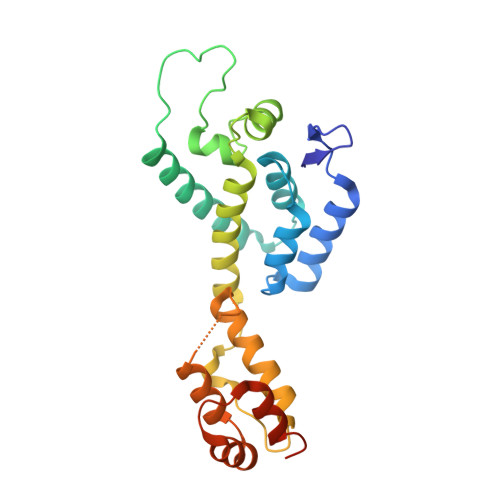
HIV-1 CA hexamer in complex with IP6, orthorhombic crystal form


Experimental Data Snapshot

  • Method: X-RAY DIFFRACTION
  • Resolution: 2.69 Å
  • R-Value Free: 
    0.255 (Depositor), 0.257 (DCC) 
  • R-Value Work: 
    0.227 (Depositor), 0.230 (DCC) 
  • R-Value Observed: 
    0.227 (Depositor) 

Starting Model: experimental
View more details

wwPDB Validation 3D Report Full Report

Validation slider image for 6BHT

Ligand Structure Quality Assessment 


This is version 1.7 of the entry. See complete history

Literature

Inositol phosphates are assembly co-factors for HIV-1.

Dick, R.A.Zadrozny, K.K.Xu, C.Schur, F.K.M.Lyddon, T.D.Ricana, C.L.Wagner, J.M.Perilla, J.R.Ganser-Pornillos, B.K.Johnson, M.C.Pornillos, O.Vogt, V.M.

(2018) Nature 560: 509-512

  • DOI: https://doi.org/10.1038/s41586-018-0396-4
  • Primary Citation Related Structures: 
    6BHR, 6BHS, 6BHT

  • PubMed Abstract: 

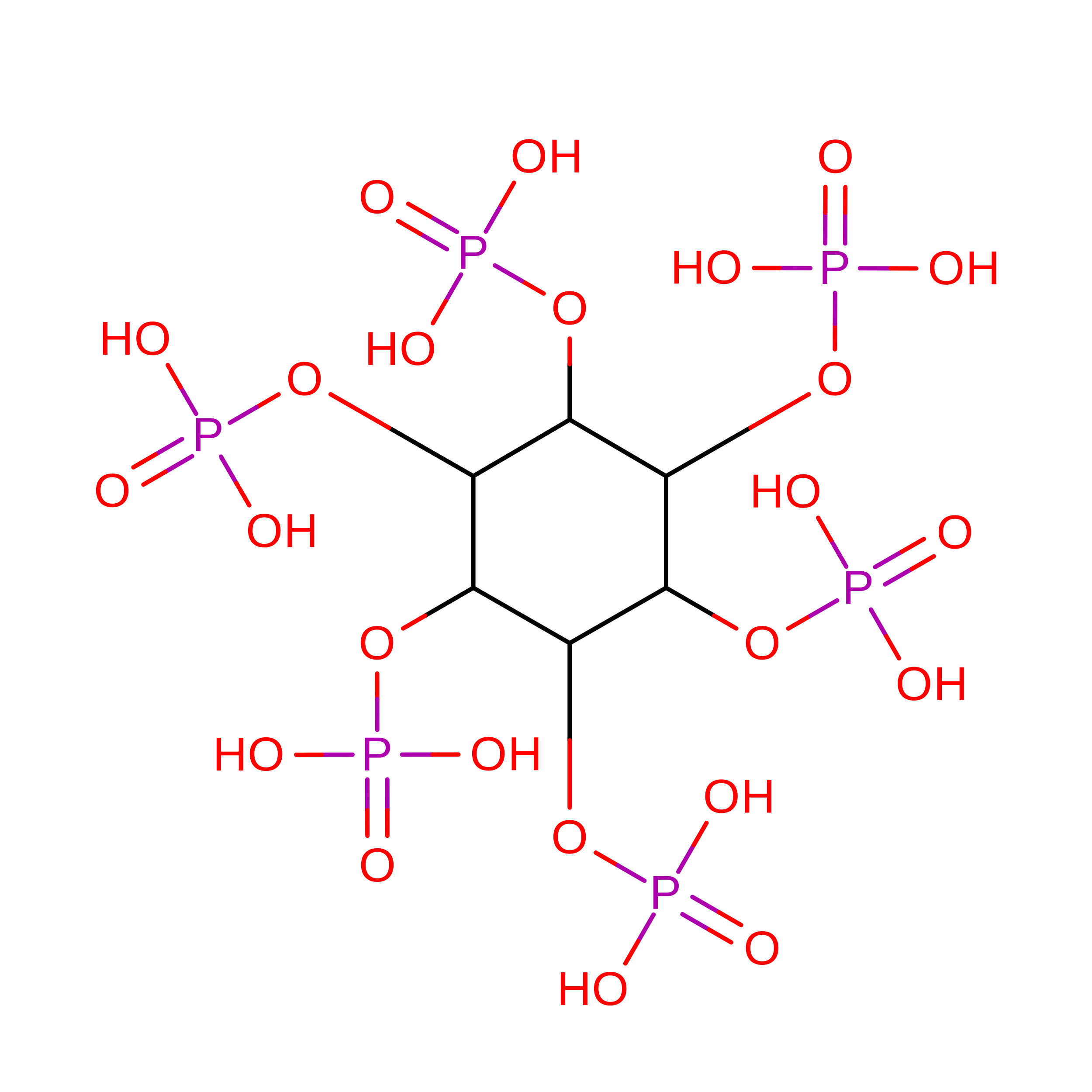
    A short, 14-amino-acid segment called SP1, located in the Gag structural protein 1 , has a critical role during the formation of the HIV-1 virus particle. During virus assembly, the SP1 peptide and seven preceding residues fold into a six-helix bundle, which holds together the Gag hexamer and facilitates the formation of a curved immature hexagonal lattice underneath the viral membrane 2,3 . Upon completion of assembly and budding, proteolytic cleavage of Gag leads to virus maturation, in which the immature lattice is broken down; the liberated CA domain of Gag then re-assembles into the mature conical capsid that encloses the viral genome and associated enzymes. Folding and proteolysis of the six-helix bundle are crucial rate-limiting steps of both Gag assembly and disassembly, and the six-helix bundle is an established target of HIV-1 inhibitors 4,5 . Here, using a combination of structural and functional analyses, we show that inositol hexakisphosphate (InsP6, also known as IP 6 ) facilitates the formation of the six-helix bundle and assembly of the immature HIV-1 Gag lattice. IP 6 makes ionic contacts with two rings of lysine residues at the centre of the Gag hexamer. Proteolytic cleavage then unmasks an alternative binding site, where IP 6 interaction promotes the assembly of the mature capsid lattice. These studies identify IP 6 as a naturally occurring small molecule that promotes both assembly and maturation of HIV-1.


  • Organizational Affiliation
    • Department of Molecular Biology and Genetics, Cornell University, Ithaca, NY, USA. rad82@cornell.edu.

Macromolecule Content 

  • Total Structure Weight: 308.18 kDa 
  • Atom Count: 19,794 
  • Modeled Residue Count: 2,551 
  • Deposited Residue Count: 2,772 
  • Unique protein chains: 1

Macromolecules

Find similar proteins by:|  3D Structure
Entity ID: 1
MoleculeChains  Sequence LengthOrganismDetailsImage
Capsid protein p24
A, B, C, D, E
A, B, C, D, E, F, G, H, I, J, K, L
231Human immunodeficiency virus type 1 (NEW YORK-5 ISOLATE)Mutation(s): 4 
Gene Names: gag
UniProt
Find proteins for P12493 (Human immunodeficiency virus type 1 group M subtype B (isolate NY5))
Explore P12493 
Go to UniProtKB:  P12493
Entity Groups
Sequence Clusters30% Identity50% Identity70% Identity90% Identity95% Identity100% Identity
UniProt GroupP12493
Sequence Annotations
Expand
Reference Sequence

Experimental Data & Validation

Experimental Data

  • Method: X-RAY DIFFRACTION
  • Resolution: 2.69 Å
  • R-Value Free:  0.255 (Depositor), 0.257 (DCC) 
  • R-Value Work:  0.227 (Depositor), 0.230 (DCC) 
  • R-Value Observed: 0.227 (Depositor) 
Space Group: P 21 21 21
Unit Cell:
Length ( Å )Angle ( ˚ )
a = 135.317α = 90
b = 137.173β = 90
c = 209.354γ = 90
Software Package:
Software NamePurpose
PHENIXrefinement
HKL-2000data reduction
HKL-2000data scaling
MOLREPphasing

Structure Validation

View Full Validation Report


Ligand Structure Quality Assessment 


Entry History 

& Funding Information

Deposition Data


Funding OrganizationLocationGrant Number
National Institutes of Health/National Institute Of Allergy and Infectious Diseases (NIH/NIAID)United StatesR01-AI129678
National Institutes of Health/National Institute of General Medical Sciences (NIH/NIGMS)United StatesU54-GM103297

Revision History  (Full details and data files)

  • Version 1.0: 2018-08-01
    Type: Initial release
  • Version 1.1: 2018-08-15
    Changes: Data collection, Database references, Source and taxonomy
  • Version 1.2: 2018-09-05
    Changes: Data collection, Database references, Source and taxonomy
  • Version 1.3: 2019-02-20
    Changes: Author supporting evidence, Data collection
  • Version 1.4: 2019-12-11
    Changes: Author supporting evidence
  • Version 1.5: 2020-10-14
    Changes: Structure summary
  • Version 1.6: 2023-10-04
    Changes: Data collection, Database references, Refinement description
  • Version 1.7: 2024-11-06
    Changes: Structure summary