6BC9 | pdb_00006bc9

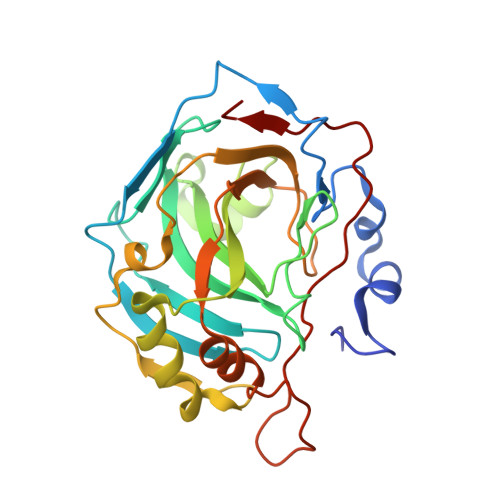
Joint X-ray/neutron structure of human carbonic anhydrase II in complex with dorzolamide


Experimental Data Snapshot

  • Method: X-RAY DIFFRACTION
  • Resolution: 1.80 Å
  • R-Value Free: 
    0.196 (Depositor), 0.174 (DCC) 
  • R-Value Work: 
    0.178 (Depositor), 0.157 (DCC) 

  • Method: NEUTRON DIFFRACTION

Starting Model: experimental
View more details

wwPDB Validation 3D Report Full Report

Validation slider image for 6BC9

This is version 1.4 of the entry. See complete history

Literature

"To Be or Not to Be" Protonated: Atomic Details of Human Carbonic Anhydrase-Clinical Drug Complexes by Neutron Crystallography and Simulation.

Kovalevsky, A.Aggarwal, M.Velazquez, H.Cuneo, M.J.Blakeley, M.P.Weiss, K.L.Smith, J.C.Fisher, S.Z.McKenna, R.

(2018) Structure 26: 383-390.e3

  • DOI: https://doi.org/10.1016/j.str.2018.01.006
  • Primary Citation Related Structures: 
    6BBS, 6BC9, 6BCC

  • PubMed Abstract: 

    Human carbonic anhydrases (hCAs) play various roles in cells, and have been drug targets for decades. Sequence similarities of hCA isoforms necessitate designing specific inhibitors, which requires detailed structural information for hCA-inhibitor complexes. We present room temperature neutron structures of hCA II in complex with three clinical drugs that provide in-depth analysis of drug binding, including protonation states of the inhibitors, hydration water structure, and direct visualization of hydrogen-bonding networks in the enzyme's active site. All sulfonamide inhibitors studied bind to the Zn metal center in the deprotonated, anionic, form. Other chemical groups of the drugs can remain neutral or be protonated when bound to hCA II. MD simulations have shown that flexible functional groups of the inhibitors may alter their conformations at room temperature and occupy different sub-sites. This study offers insights into the design of specific drugs to target cancer-related hCA isoform IX.


  • Organizational Affiliation
    • Biology and Soft Matter Division, Oak Ridge National Laboratory, Oak Ridge, TN 37831, USA. Electronic address: kovalevskyay@ornl.gov.

Macromolecule Content 

  • Total Structure Weight: 29.68 kDa 
  • Atom Count: 2,192 
  • Modeled Residue Count: 257 
  • Deposited Residue Count: 260 
  • Unique protein chains: 1

Macromolecules

Find similar proteins by:|  3D Structure
Entity ID: 1
MoleculeChains  Sequence LengthOrganismDetailsImage
Carbonic anhydrase 2260Homo sapiensMutation(s): 0 
Gene Names: CA2
EC: 4.2.1.1 (PDB Primary Data), 4.2.1.69 (UniProt)
UniProt & NIH Common Fund Data Resources
Find proteins for P00918 (Homo sapiens)
Explore P00918 
Go to UniProtKB:  P00918
PHAROS:  P00918
GTEx:  ENSG00000104267 
Entity Groups
Sequence Clusters30% Identity50% Identity70% Identity90% Identity95% Identity100% Identity
UniProt GroupP00918
Sequence Annotations
Expand
Reference Sequence

Small Molecules

Ligands 2 Unique
IDChains Name / Formula / InChI Key2D Diagram3D Interactions
ETS

Query on ETS


Download:Ideal Coordinates CCD File
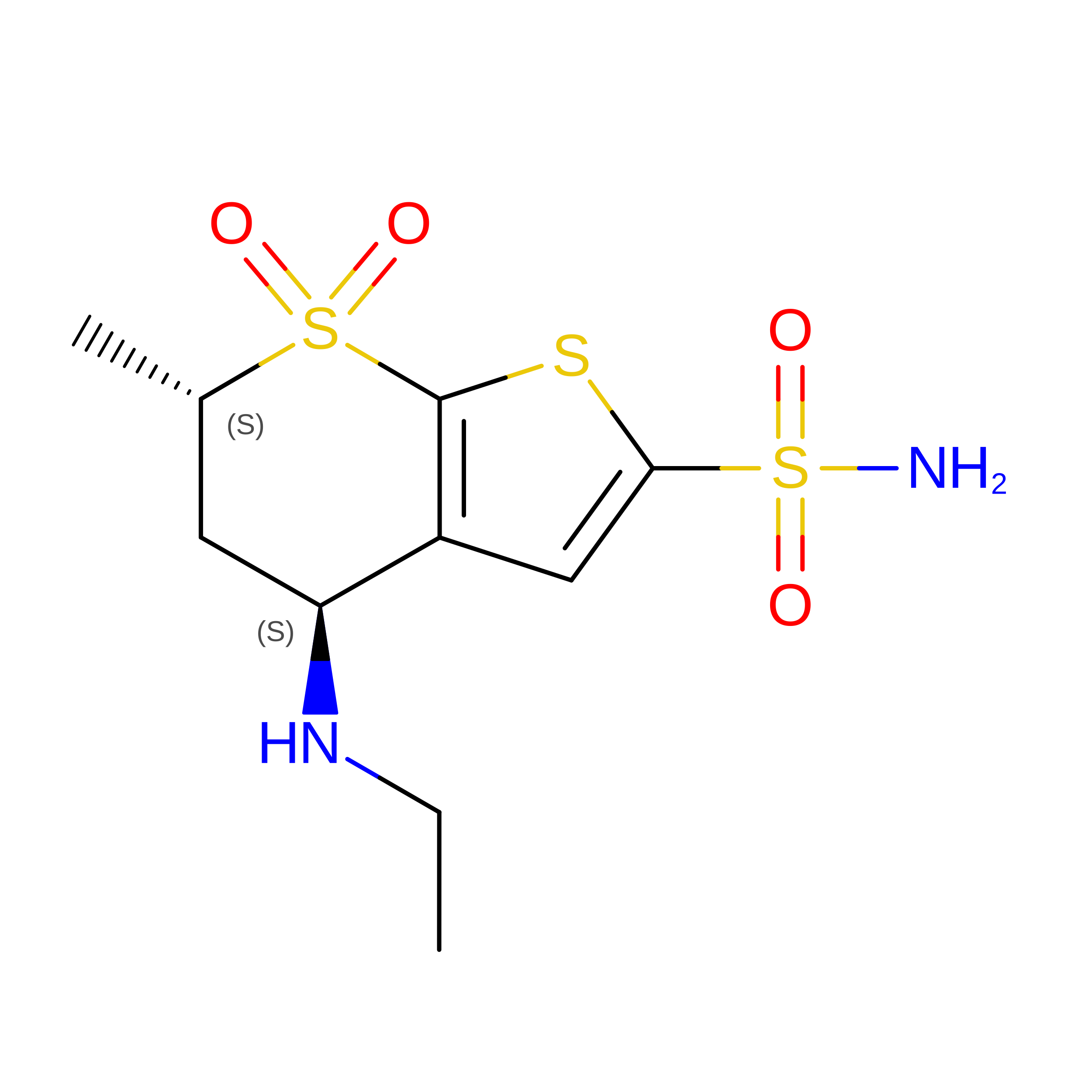
C [auth A](4S-TRANS)-4-(ETHYLAMINO)-5,6-DIHYDRO-6-METHYL-4H-THIENO(2,3-B)THIOPYRAN-2-SULFONAMIDE-7,7-DIOXIDE
C10 H16 N2 O4 S3
IAVUPMFITXYVAF-XPUUQOCRSA-N
ZN

Query on ZN


Download:Ideal Coordinates CCD File
B [auth A]ZINC ION
Zn
PTFCDOFLOPIGGS-UHFFFAOYSA-N
Binding Affinity Annotations 
IDSourceBinding Affinity
ETS BindingDB:  6BC9 Ki: min: 0.2, max: 25.02 (nM) from 9 assay(s)
Kd: 0.04 (nM) from 1 assay(s)
IC50: min: 0.23, max: 43 (nM) from 4 assay(s)

Experimental Data & Validation

Experimental Data

  • Method: X-RAY DIFFRACTION
  • Resolution: 1.80 Å
  • R-Value Free:  0.196 (Depositor), 0.174 (DCC) 
  • R-Value Work:  0.178 (Depositor), 0.157 (DCC) 
  • Method: NEUTRON DIFFRACTION
Space Group: P 1 21 1
Unit Cell:
Length ( Å )Angle ( ˚ )
a = 42.8α = 90
b = 42.1β = 104.6
c = 72.7γ = 90
Software Package:
Software NamePurpose
nCNSrefinement

Structure Validation

View Full Validation Report


Entry History 

Deposition Data

Revision History  (Full details and data files)

  • Version 1.0: 2018-02-28
    Type: Initial release
  • Version 1.1: 2018-03-21
    Changes: Database references
  • Version 1.2: 2018-04-25
    Changes: Data collection
  • Version 1.3: 2023-10-04
    Changes: Data collection, Database references, Refinement description
  • Version 1.4: 2025-11-12
    Changes: Data collection, Structure summary