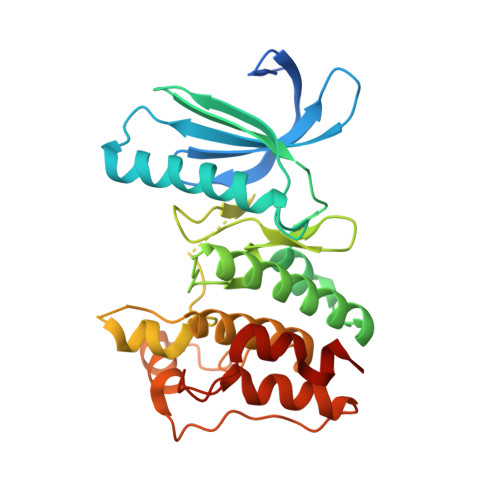
6B4W | pdb_00006b4w

TTK in Complex with Inhibitor


Experimental Data Snapshot

  • Method: X-RAY DIFFRACTION
  • Resolution: 2.90 Å
  • R-Value Free: 
    0.253 (Depositor), 0.251 (DCC) 
  • R-Value Work: 
    0.191 (Depositor), 0.198 (DCC) 
  • R-Value Observed: 
    0.194 (Depositor) 

wwPDB Validation 3D Report Full Report

Validation slider image for 6B4W

Ligand Structure Quality Assessment 


This is version 2.1 of the entry. See complete history

Literature

The Discovery of a Dual TTK Protein Kinase/CDC2-Like Kinase (CLK2) Inhibitor for the Treatment of Triple Negative Breast Cancer Initiated from a Phenotypic Screen.

Riggs, J.R.Nagy, M.Elsner, J.Erdman, P.Cashion, D.Robinson, D.Harris, R.Huang, D.Tehrani, L.Deyanat-Yazdi, G.Narla, R.K.Peng, X.Tran, T.Barnes, L.Miller, T.Katz, J.Tang, Y.Chen, M.Moghaddam, M.F.Bahmanyar, S.Pagarigan, B.Delker, S.LeBrun, L.Chamberlain, P.P.Calabrese, A.Canan, S.S.Leftheris, K.Zhu, D.Boylan, J.F.

(2017) J Med Chem 60: 8989-9002

  • DOI: https://doi.org/10.1021/acs.jmedchem.7b01223
  • Primary Citation Related Structures: 
    6B4W

  • PubMed Abstract: 

    Triple negative breast cancer (TNBC) remains a serious unmet medical need with discouragingly high relapse rates. We report here the synthesis and structure-activity relationship (SAR) of a novel series of 2,4,5-trisubstituted-7H-pyrrolo[2,3-d]pyrimidines with potent activity against TNBC tumor cell lines. These compounds were discovered from a TNBC phenotypic screen and possess a unique dual inhibition profile targeting TTK (mitotic exit) and CLK2 (mRNA splicing). Design and optimization, driven with a TNBC tumor cell assay, identified potent and selective compounds with favorable in vitro and in vivo activity profiles and good iv PK properties. This cell-based driven SAR produced compounds with strong single agent in vivo efficacy in multiple TNBC xenograft models without significant body weight loss. These data supported the nomination of CC-671 into IND-enabling studies as a single agent TNBC therapy.


  • Organizational Affiliation
    • Celgene Corporation , 10300 Campus Pointe Drive, Suite 100, San Diego, California 92121, United States.

Macromolecule Content 

  • Total Structure Weight: 35.52 kDa 
  • Atom Count: 2,116 
  • Modeled Residue Count: 259 
  • Deposited Residue Count: 303 
  • Unique protein chains: 1

Macromolecules

Find similar proteins by:|  3D Structure
Entity ID: 1
MoleculeChains  Sequence LengthOrganismDetailsImage
Dual specificity protein kinase TTK303Homo sapiensMutation(s): 0 
Gene Names: TTKMPS1MPS1L1
EC: 2.7.12.1
UniProt & NIH Common Fund Data Resources
Find proteins for P33981 (Homo sapiens)
Explore P33981 
Go to UniProtKB:  P33981
PHAROS:  P33981
GTEx:  ENSG00000112742 
Entity Groups
Sequence Clusters30% Identity50% Identity70% Identity90% Identity95% Identity100% Identity
UniProt GroupP33981
Sequence Annotations
Expand
Reference Sequence

Small Molecules

Ligands 2 Unique
IDChains Name / Formula / InChI Key2D Diagram3D Interactions
CQ7

Query on CQ7


Download:Ideal Coordinates CCD File
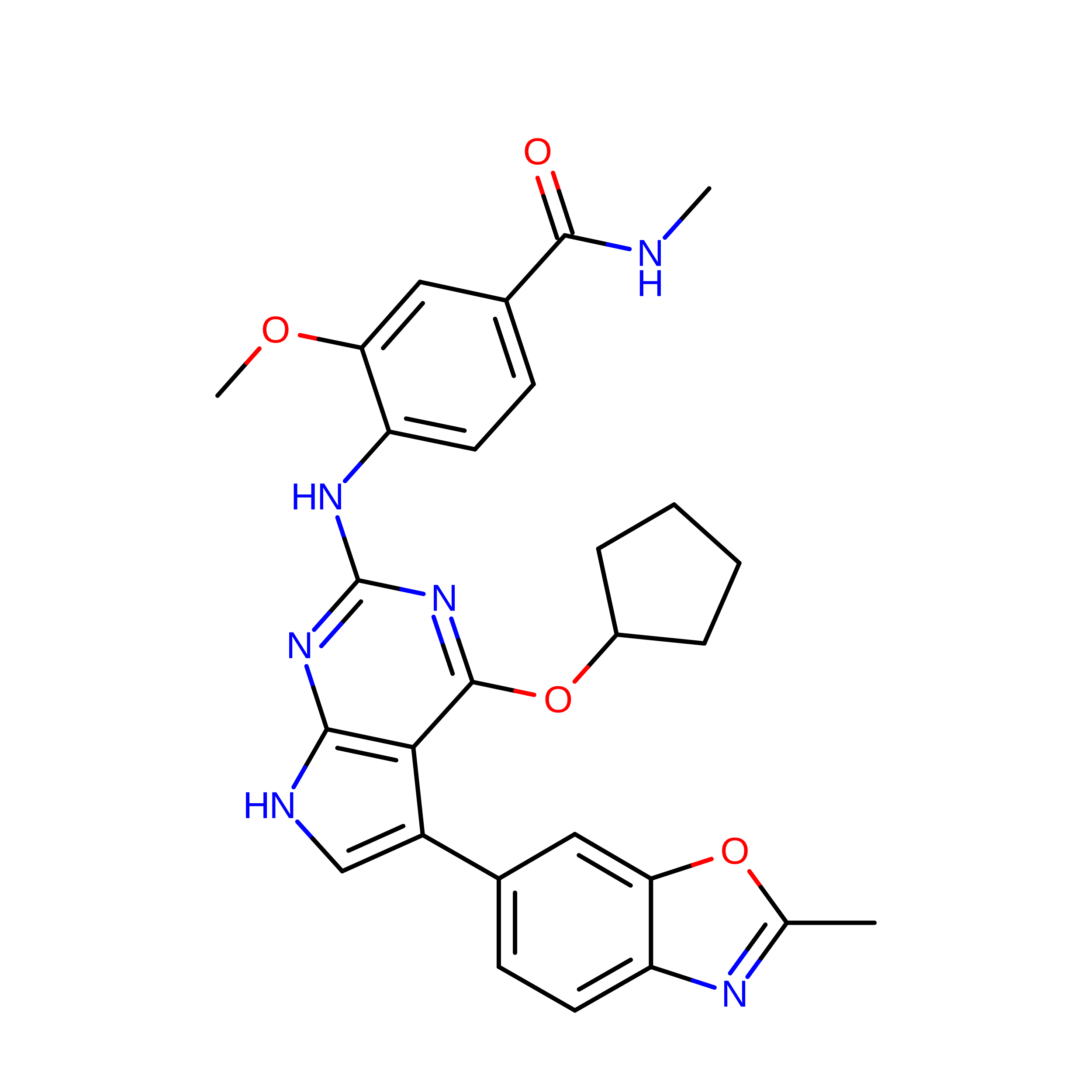
B [auth A]4-{[4-(cyclopentyloxy)-5-(2-methyl-1,3-benzoxazol-6-yl)-7H-pyrrolo[2,3-d]pyrimidin-2-yl]amino}-3-methoxy-N-methylbenzamide
C28 H28 N6 O4
CWJLAVRXVFHDSJ-UHFFFAOYSA-N
CAC

Query on CAC


Download:Ideal Coordinates CCD File
C [auth A]CACODYLATE ION
C2 H6 As O2
OGGXGZAMXPVRFZ-UHFFFAOYSA-M

Experimental Data & Validation

Experimental Data

  • Method: X-RAY DIFFRACTION
  • Resolution: 2.90 Å
  • R-Value Free:  0.253 (Depositor), 0.251 (DCC) 
  • R-Value Work:  0.191 (Depositor), 0.198 (DCC) 
  • R-Value Observed: 0.194 (Depositor) 
Space Group: I 2 2 2
Unit Cell:
Length ( Å )Angle ( ˚ )
a = 71.351α = 90
b = 109.581β = 90
c = 114.401γ = 90
Software Package:
Software NamePurpose
REFMACrefinement
HKL-2000data reduction
HKL-2000data scaling
PHASERphasing

Structure Validation

View Full Validation Report


Ligand Structure Quality Assessment 


Entry History 

Deposition Data

Revision History  (Full details and data files)

  • Version 1.0: 2017-10-25
    Type: Initial release
  • Version 2.0: 2017-11-22
    Changes: Database references, Polymer sequence
  • Version 2.1: 2024-03-13
    Changes: Data collection, Database references