6B16 | pdb_00006b16

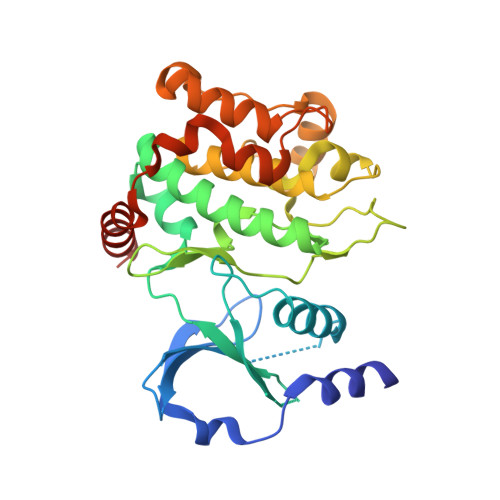
P21-activated kinase 1 in complex with a 4-azaindole inhibitor


Experimental Data Snapshot

  • Method: X-RAY DIFFRACTION
  • Resolution: 2.29 Å
  • R-Value Free: 
    0.250 (Depositor), 0.250 (DCC) 
  • R-Value Work: 
    0.202 (Depositor), 0.208 (DCC) 
  • R-Value Observed: 
    0.204 (Depositor) 

wwPDB Validation 3D Report Full Report

Validation slider image for 6B16

Ligand Structure Quality Assessment 


This is version 1.1 of the entry. See complete history

Literature

Synthesis and evaluation of a series of 4-azaindole-containing p21-activated kinase-1 inhibitors.

Lee, W.Crawford, J.J.Aliagas, I.Murray, L.J.Tay, S.Wang, W.Heise, C.E.Hoeflich, K.P.La, H.Mathieu, S.Mintzer, R.Ramaswamy, S.Rouge, L.Rudolph, J.

(2016) Bioorg Med Chem Lett 26: 3518-3524

  • DOI: https://doi.org/10.1016/j.bmcl.2016.06.031
  • Primary Citation Related Structures: 
    6B16

  • PubMed Abstract: 

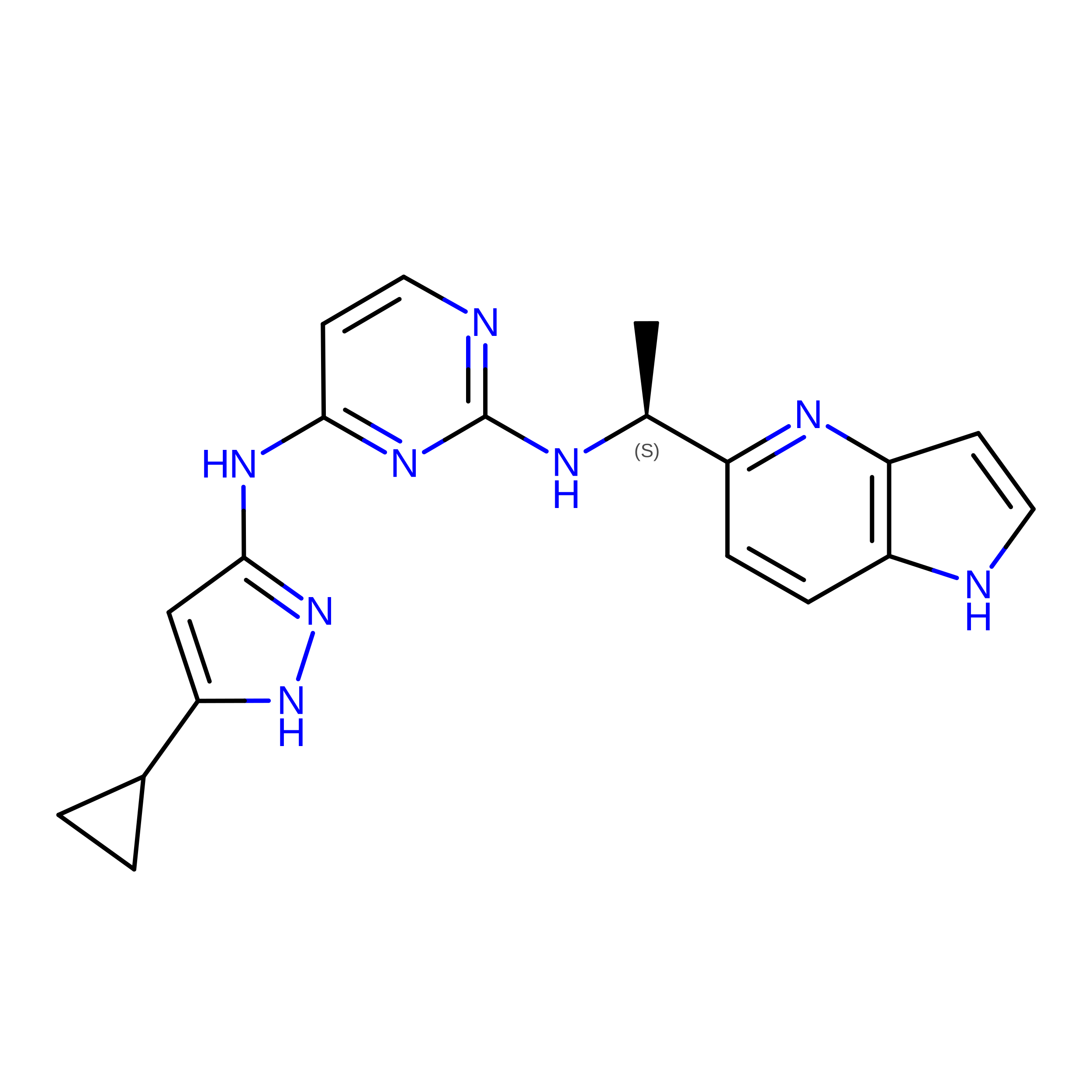
    A series of 4-azaindole-containing p21-activated kinase-1 (PAK1) inhibitors was prepared with the goal of improving physicochemical properties relative to an indole starting point. Indole 1 represented an attractive, non-basic scaffold with good PAK1 affinity and cellular potency but was compromised by high lipophilicity (clogD=4.4). Azaindole 5 was designed as an indole surrogate with the goal of lowering logD and resulted in equipotent PAK1 inhibition with a 2-fold improvement in cellular potency over 1. Structure-activity relationship studies around 5 identified additional 4-azaindole analogs with superior PAK1 biochemical activity (Ki <10nM) and up to 24-fold selectivity for group I over group II PAKs. Compounds from this series showed enhanced permeability, improved aqueous solubility, and lower plasma protein binding over indole 1. The improvement in physicochemical properties translated to a 20-fold decrease in unbound clearance in mouse PK studies for azaindole 5 relative to indole 1.


  • Organizational Affiliation
    • Discovery Chemistry, Genentech, Inc., 1 DNA Way, South San Francisco, CA 94080, USA. Electronic address: wendyle@gene.com.

Macromolecule Content 

  • Total Structure Weight: 67.96 kDa 
  • Atom Count: 4,515 
  • Modeled Residue Count: 566 
  • Deposited Residue Count: 602 
  • Unique protein chains: 1

Macromolecules

Find similar proteins by:|  3D Structure
Entity ID: 1
MoleculeChains  Sequence LengthOrganismDetailsImage
Serine/threonine-protein kinase PAK 1
A, B
301Homo sapiensMutation(s): 0 
Gene Names: PAK1
EC: 2.7.11.1
UniProt & NIH Common Fund Data Resources
Find proteins for Q13153 (Homo sapiens)
Explore Q13153 
Go to UniProtKB:  Q13153
PHAROS:  Q13153
GTEx:  ENSG00000149269 
Entity Groups
Sequence Clusters30% Identity50% Identity70% Identity90% Identity95% Identity100% Identity
UniProt GroupQ13153
Sequence Annotations
Expand
Reference Sequence

Small Molecules

Binding Affinity Annotations 
IDSourceBinding Affinity
C7Y BindingDB:  6B16 Ki: 32 (nM) from 1 assay(s)

Experimental Data & Validation

Experimental Data

  • Method: X-RAY DIFFRACTION
  • Resolution: 2.29 Å
  • R-Value Free:  0.250 (Depositor), 0.250 (DCC) 
  • R-Value Work:  0.202 (Depositor), 0.208 (DCC) 
  • R-Value Observed: 0.204 (Depositor) 
Space Group: P 1 21 1
Unit Cell:
Length ( Å )Angle ( ˚ )
a = 62.682α = 90
b = 82.458β = 106.31
c = 66.036γ = 90
Software Package:
Software NamePurpose
PHENIXrefinement
HKL-2000data reduction
SCALEPACKdata scaling
PHASERphasing

Structure Validation

View Full Validation Report


Ligand Structure Quality Assessment 


Entry History 

Deposition Data

Revision History  (Full details and data files)

  • Version 1.0: 2017-10-25
    Type: Initial release
  • Version 1.1: 2024-11-06
    Changes: Data collection, Database references, Structure summary