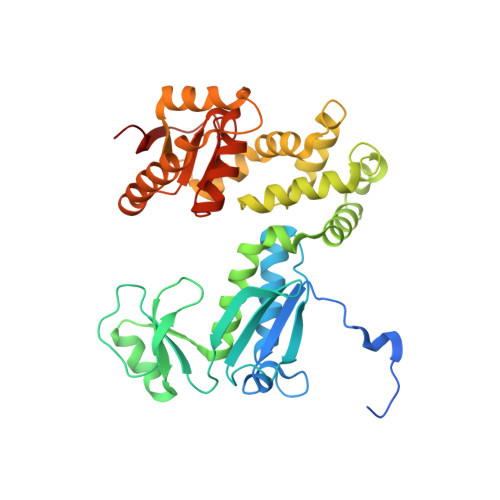
6AI2 | pdb_00006ai2

Structure of the 328-692 fragment of FlhA (F459A)


Experimental Data Snapshot

  • Method: X-RAY DIFFRACTION
  • Resolution: 3.30 Å
  • R-Value Free: 
    0.257 (Depositor), 0.256 (DCC) 
  • R-Value Work: 
    0.218 (Depositor), 0.220 (DCC) 
  • R-Value Observed: 
    0.223 (Depositor) 

Starting Model: experimental
View more details

wwPDB Validation 3D Report Full Report

Validation slider image for 6AI2

This is version 1.3 of the entry. See complete history

Literature

Structural Insights into the Substrate Specificity Switch Mechanism of the Type III Protein Export Apparatus.

Inoue, Y.Ogawa, Y.Kinoshita, M.Terahara, N.Shimada, M.Kodera, N.Ando, T.Namba, K.Kitao, A.Imada, K.Minamino, T.

(2019) Structure 27: 965

  • DOI: https://doi.org/10.1016/j.str.2019.03.017
  • Primary Citation Related Structures: 
    6AI0, 6AI1, 6AI2, 6AI3

  • PubMed Abstract: 

    Bacteria use a type III protein export apparatus for construction of the flagellum, which consists of the basal body, the hook, and the filament. FlhA forms a homo-nonamer through its C-terminal cytoplasmic domains (FlhA C ) and ensures the strict order of flagellar assembly. FlhA C goes through dynamic domain motions during protein export, but it remains unknown how it occurs. Here, we report that the FlhA(G368C) mutation biases FlhA C toward a closed form, thereby reducing the binding affinity of FlhA C for flagellar export chaperones in complex with their cognate filament-type substrates. The G368C mutations also restrict the conformational flexibility of a linker region of FlhA (FlhA L ), suppressing FlhA C ring formation. We propose that interactions of FlhA L with its neighboring subunit converts FlhA C in the ring from a closed conformation to an open one, allowing the chaperon/substrate complexes to bind to the FlhA C ring to form the filament at the hook tip.


  • Organizational Affiliation
    • Graduate School of Frontier Biosciences, Osaka University, 1-3 Yamadaoka, Suita, Osaka 565-0871, Japan.

Macromolecule Content 

  • Total Structure Weight: 81.19 kDa 
  • Atom Count: 5,334 
  • Modeled Residue Count: 690 
  • Deposited Residue Count: 738 
  • Unique protein chains: 1

Macromolecules

Find similar proteins by:|  3D Structure
Entity ID: 1
MoleculeChains  Sequence LengthOrganismDetailsImage
Flagellar biosynthesis protein FlhA
A, B
369Salmonella enterica subsp. enterica serovar Typhimurium str. LT2Mutation(s): 1 
Gene Names: flhASTM1913
UniProt
Find proteins for P40729 (Salmonella typhimurium (strain LT2 / SGSC1412 / ATCC 700720))
Explore P40729 
Go to UniProtKB:  P40729
Entity Groups
Sequence Clusters30% Identity50% Identity70% Identity90% Identity95% Identity100% Identity
UniProt GroupP40729
Sequence Annotations
Expand
Reference Sequence

Experimental Data & Validation

Experimental Data

  • Method: X-RAY DIFFRACTION
  • Resolution: 3.30 Å
  • R-Value Free:  0.257 (Depositor), 0.256 (DCC) 
  • R-Value Work:  0.218 (Depositor), 0.220 (DCC) 
  • R-Value Observed: 0.223 (Depositor) 
Space Group: I 41
Unit Cell:
Length ( Å )Angle ( ˚ )
a = 216.39α = 90
b = 216.39β = 90
c = 65.33γ = 90
Software Package:
Software NamePurpose
MOSFLMdata reduction
Aimlessdata scaling
PHENIXrefinement
PDB_EXTRACTdata extraction
PHENIXphasing

Structure Validation

View Full Validation Report


Entry History 

& Funding Information

Deposition Data


Funding OrganizationLocationGrant Number
Japan Society for the Promotion of ScienceJapanJP15H02386
Japan Society for the Promotion of ScienceJapanJP26293097
Ministry of Education, Culture, Sports, Science and Technology (Japan)JapanJP23115008
Ministry of Education, Culture, Sports, Science and Technology (Japan)JapanJP24117004
Ministry of Education, Culture, Sports, Science and Technology (Japan)JapanJP25121718
Ministry of Education, Culture, Sports, Science and Technology (Japan)JapanJP15H01640

Revision History  (Full details and data files)

  • Version 1.0: 2019-03-20
    Type: Initial release
  • Version 1.1: 2019-05-15
    Changes: Data collection, Database references
  • Version 1.2: 2019-06-19
    Changes: Data collection, Database references
  • Version 1.3: 2023-11-22
    Changes: Data collection, Database references, Refinement description