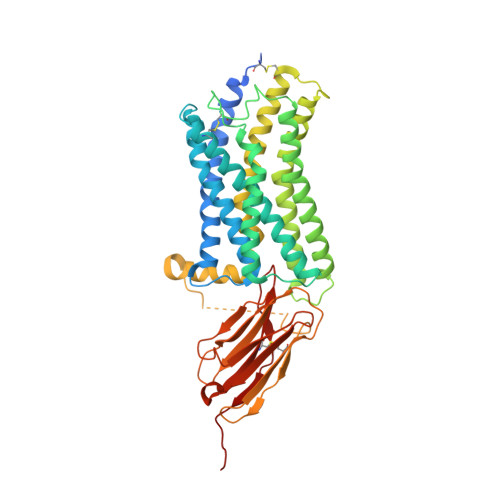
5WB1 | pdb_00005wb1

Ligand-free US28 with stabilizing intracellular nanobody


Experimental Data Snapshot

  • Method: X-RAY DIFFRACTION
  • Resolution: 3.51 Å
  • R-Value Free: 
    0.289 (Depositor), 0.291 (DCC) 
  • R-Value Work: 
    0.242 (Depositor), 0.246 (DCC) 
  • R-Value Observed: 
    0.247 (Depositor) 

Starting Model: experimental
View more details

wwPDB Validation 3D Report Full Report

Validation slider image for 5WB1

This is version 1.4 of the entry. See complete history

Literature

Viral GPCR US28 can signal in response to chemokine agonists of nearly unlimited structural degeneracy.

Miles, T.F.Spiess, K.Jude, K.M.Tsutsumi, N.Burg, J.S.Ingram, J.R.Waghray, D.Hjorto, G.M.Larsen, O.Ploegh, H.L.Rosenkilde, M.M.Garcia, K.C.

(2018) Elife 7

  • DOI: https://doi.org/10.7554/eLife.35850
  • Primary Citation Related Structures: 
    5WB1, 5WB2

  • PubMed Abstract: 

    Human cytomegalovirus has hijacked and evolved a human G-protein-coupled receptor into US28, which functions as a promiscuous chemokine 'sink' to facilitate evasion of host immune responses. To probe the molecular basis of US28's unique ligand cross-reactivity, we deep-sequenced CX3CL1 chemokine libraries selected on 'molecular casts' of the US28 active-state and find that US28 can engage thousands of distinct chemokine sequences, many of which elicit diverse signaling outcomes. The structure of a G-protein-biased CX3CL1-variant in complex with US28 revealed an entirely unique chemokine amino terminal peptide conformation and remodeled constellation of receptor-ligand interactions. Receptor signaling, however, is remarkably robust to mutational disruption of these interactions. Thus, US28 accommodates and functionally discriminates amongst highly degenerate chemokine sequences by sensing the steric bulk of the ligands, which distort both receptor extracellular loops and the walls of the ligand binding pocket to varying degrees, rather than requiring sequence-specific bonding chemistries for recognition and signaling.


  • Organizational Affiliation
    • Department of Molecular and Cellular Physiology, Stanford University School of Medicine, Stanford, United States.

Macromolecule Content 

  • Total Structure Weight: 51.83 kDa 
  • Atom Count: 3,291 
  • Modeled Residue Count: 420 
  • Deposited Residue Count: 458 
  • Unique protein chains: 1

Macromolecules

Find similar proteins by:|  3D Structure
Entity ID: 1
MoleculeChains  Sequence LengthOrganismDetailsImage
Envelope protein US28, nanobody 7 fusion protein458Human betaherpesvirus 5Lama glama
This entity is chimeric
Mutation(s): 0 
Gene Names: US28
Membrane Entity: Yes 
UniProt
Find proteins for P69333 (Human cytomegalovirus (strain Towne))
Explore P69333 
Go to UniProtKB:  P69333
Entity Groups
Sequence Clusters30% Identity50% Identity70% Identity90% Identity95% Identity100% Identity
UniProt GroupP69333
Sequence Annotations
Expand
Reference Sequence

Experimental Data & Validation

Experimental Data

  • Method: X-RAY DIFFRACTION
  • Resolution: 3.51 Å
  • R-Value Free:  0.289 (Depositor), 0.291 (DCC) 
  • R-Value Work:  0.242 (Depositor), 0.246 (DCC) 
  • R-Value Observed: 0.247 (Depositor) 
Space Group: P 1 21 1
Unit Cell:
Length ( Å )Angle ( ˚ )
a = 77.6α = 90
b = 38.3β = 107.4
c = 99.8γ = 90
Software Package:
Software NamePurpose
PHENIXrefinement
XDSdata reduction
XSCALEdata scaling
PHASERphasing

Structure Validation

View Full Validation Report


Entry History 

& Funding Information

Deposition Data


Funding OrganizationLocationGrant Number
National Institutes of Health/National Institute of General Medical Sciences (NIH/NIGMS)United StatesGM097015

Revision History  (Full details and data files)

  • Version 1.0: 2018-06-13
    Type: Initial release
  • Version 1.1: 2018-07-25
    Changes: Data collection, Database references
  • Version 1.2: 2020-01-01
    Changes: Author supporting evidence
  • Version 1.3: 2023-10-04
    Changes: Data collection, Database references, Refinement description
  • Version 1.4: 2024-10-23
    Changes: Structure summary