Download Mendeley
Two-metal versus one-metal mechanisms of lysine adenylylation by ATP-dependent and NAD(+)-dependent polynucleotide ligases.
Unciuleac, M.C., Goldgur, Y., Shuman, S.(2017) Proc Natl Acad Sci U S A 114: 2592-2597
- PubMed: 28223499 Search on PubMedSearch on PubMed Central
- DOI: https://doi.org/10.1073/pnas.1619220114
- Primary Citation Related Structures:
5TT5, 5TT6 - PubMed Abstract:
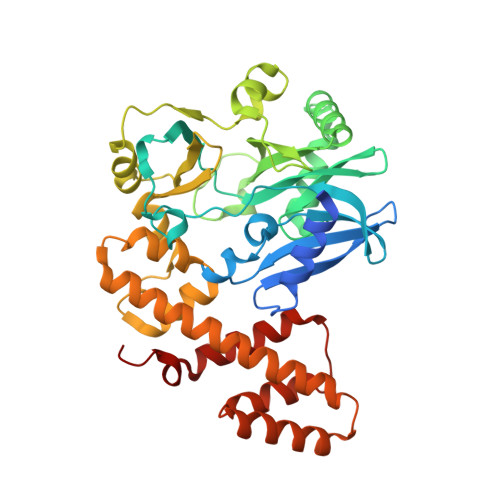
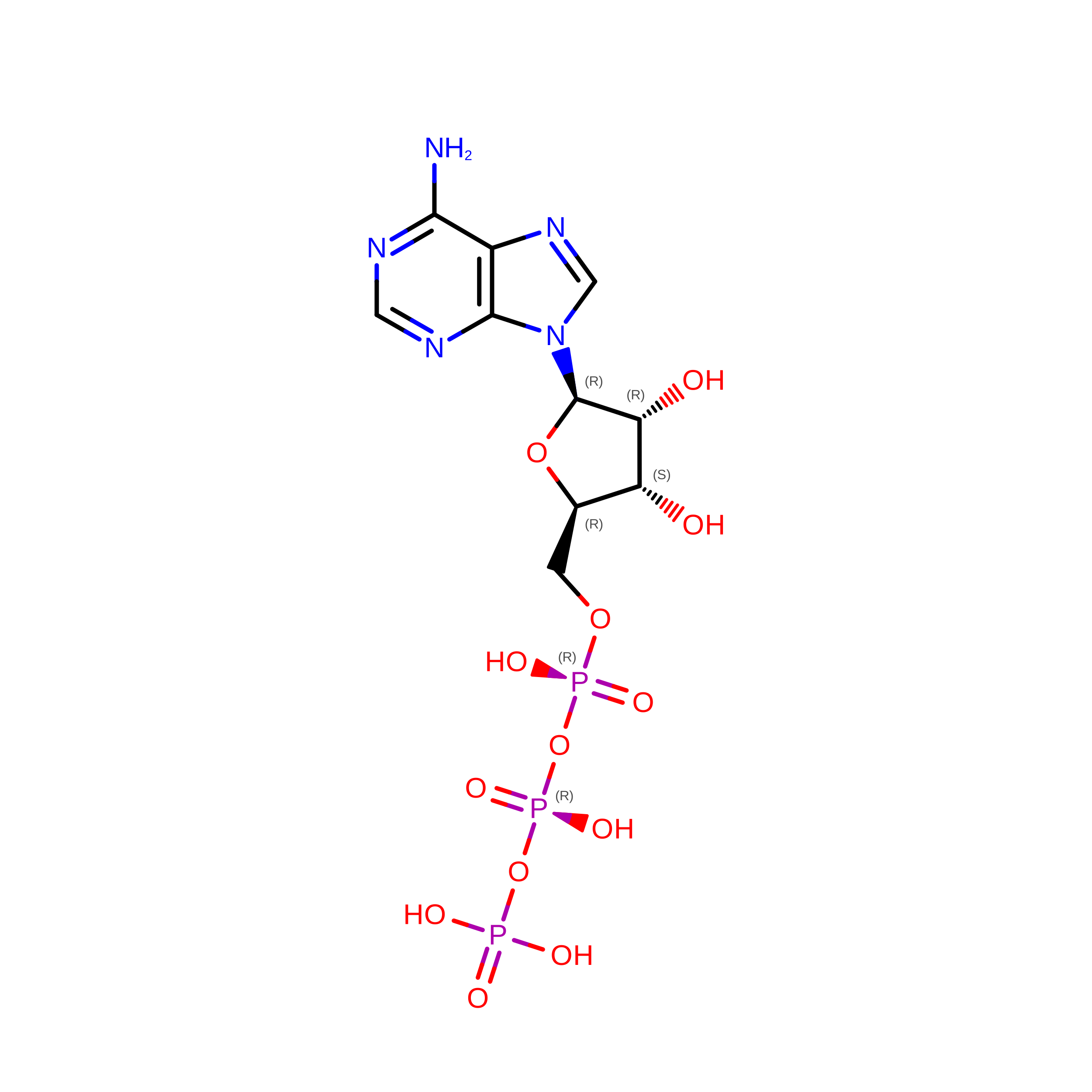
Polynucleotide ligases comprise a ubiquitous superfamily of nucleic acid repair enzymes that join 3'-OH and 5'-PO 4 DNA or RNA ends. Ligases react with ATP or NAD + and a divalent cation cofactor to form a covalent enzyme-(lysine-Nζ)-adenylate intermediate. Here, we report crystal structures of the founding members of the ATP-dependent RNA ligase family (T4 RNA ligase 1; Rnl1) and the NAD + -dependent DNA ligase family ( Escherichia coli LigA), captured as their respective Michaelis complexes, which illuminate distinctive catalytic mechanisms of the lysine adenylylation reaction. The 2.2-Å Rnl1•ATP•(Mg 2+ ) 2 structure highlights a two-metal mechanism, whereby: a ligase-bound "catalytic" Mg 2+ (H 2 O) 5 coordination complex lowers the p K a of the lysine nucleophile and stabilizes the transition state of the ATP α phosphate; a second octahedral Mg 2+ coordination complex bridges the β and γ phosphates; and protein elements unique to Rnl1 engage the γ phosphate and associated metal complex and orient the pyrophosphate leaving group for in-line catalysis. By contrast, the 1.55-Å LigA•NAD + •Mg 2+ structure reveals a one-metal mechanism in which a ligase-bound Mg 2+ (H 2 O) 5 complex lowers the lysine p K a and engages the NAD + α phosphate, but the β phosphate and the nicotinamide nucleoside of the nicotinamide mononucleotide (NMN) leaving group are oriented solely via atomic interactions with protein elements that are unique to the LigA clade. The two-metal versus one-metal dichotomy demarcates a branchpoint in ligase evolution and favors LigA as an antibacterial drug target.
- Molecular Biology Program, Sloan-Kettering Institute, New York, NY 10065.
Organizational Affiliation: